
A subordinating conjunction is a word that joins a main clause to a subordinate clause, creating a complex sentence. The main clause makes sense on its own; the subordinate clause depends on it. Subordinating conjunctions are introduced in the UK National Curriculum from Year 3 and recur all the way through KS2, with direct testing in the KS2 SATs Grammar, Punctuation and Spelling (GPS) paper.
Here are three quick examples showing the subordinate clause in different positions:
- Start: Because it was raining, she grabbed her coat.
- Middle: She grabbed her coat because it was raining.
- End: She grabbed her coat, although she didn't mind the rain.
By Year 6, pupils are expected to vary clause placement deliberately for effect, not just tack "because" onto the end of every sentence.
Table of Contents
- What makes subordinating conjunctions different from other conjunctions?
- What are the most common subordinating conjunctions for KS2?
- How do you use subordinating conjunctions correctly?
- Worked examples and KS2 practice exercises
- Practical activities for teaching subordinating conjunctions in KS2
- Where do subordinating conjunctions sit in the UK National Curriculum?
- Key Takeaways
- Why "because" alone won't get your child to Year 6 standard
- Thepocketmoneygame makes KS2 grammar practice feel worth it
- Useful sources for teachers and parents
What makes subordinating conjunctions different from other conjunctions?
A main clause (also called an independent clause) is a complete thought. "The dog barked" works on its own. A subordinate clause (dependent clause) cannot stand alone. "Although the dog barked" leaves you waiting for the rest.
A subordinating conjunction is the joining word that creates that dependency. Remove it, and you can quickly test whether a conjunction is subordinating: one of the two clauses will stop making sense.
"Although the dog barked, nobody came to the door." Remove "although" and you get two complete sentences. That tells you "although" is subordinating — it creates the dependency. Compare with "and" (a coordinating conjunction): both sides of "and" remain complete sentences without it.
This simple removal test, drawn from BBC Bitesize's explanation of subordinating conjunctions, is one of the clearest ways to help pupils spot the difference.
What are the most common subordinating conjunctions for KS2?
Seven subordinating conjunctions are most commonly emphasized for KS2 teaching: when, if, because, although, while, after, before. These are the ones most likely to appear in SATs questions and in teacher assessment of writing.

Beyond those seven, here is a fuller grouped list you can use as a classroom word bank or display:
| Function | Subordinating conjunctions |
|---|---|
| Time | when, while, after, before, until, since, as soon as |
| Cause / Effect | because, since, as |
| Condition | if, unless, provided that, as long as |
| Contrast | although, even though, whereas, while |
| Place | where, wherever |
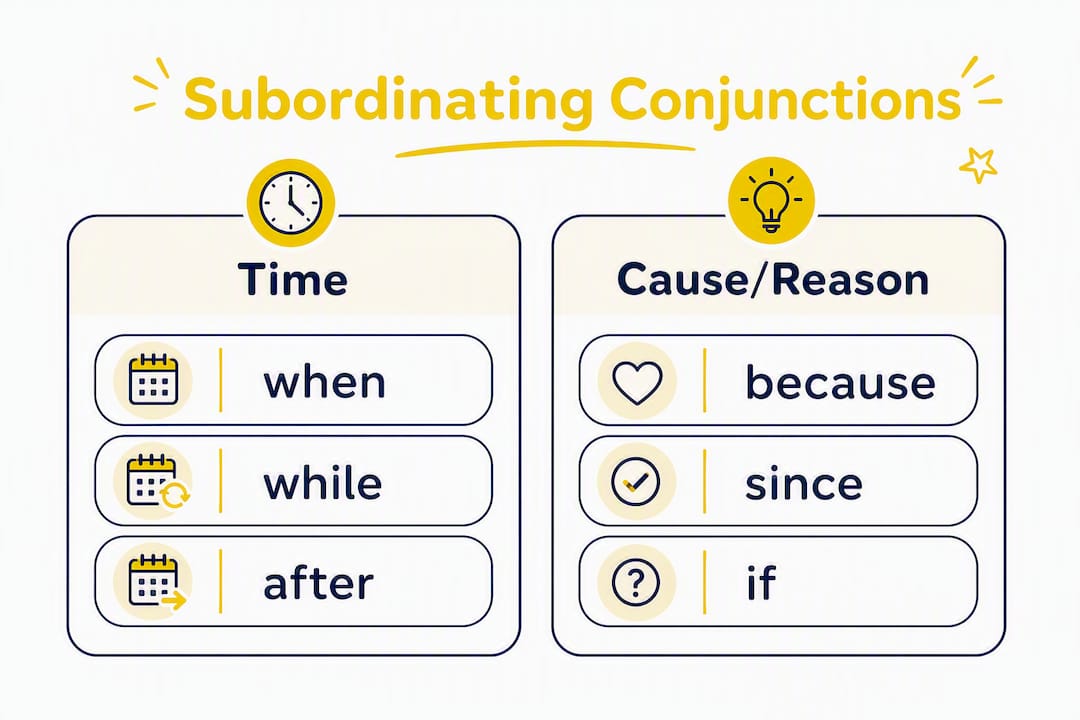
A note on words that do double duty. "While" can show time (While I was cooking, the phone rang) or contrast (While Tom loves football, his sister prefers swimming). "As" can show time or cause. Pointing out this flexibility helps Upper KS2 pupils make deliberate stylistic choices rather than just picking the first word that fits.
Quick starter activity: Write each conjunction on a card and ask pupils to sort them into the table above. Disagreements over "while" and "as" are the point — they spark exactly the kind of discussion that deepens understanding.
How do you use subordinating conjunctions correctly?
The subordinate clause can sit at the start, middle, or end of a sentence. Each position has a punctuation implication.
- End: She stayed inside because it was cold. No comma needed.
- Middle: She, because it was cold, stayed inside. Commas wrap the embedded clause. (Less common; more advanced.)
- Start: Because it was cold, she stayed inside. Comma required after the subordinate clause.
The fronted position is where most pupils go wrong. A frequent classroom error is omitting the comma when a subordinate clause is fronted, and it is worth teaching this rule explicitly alongside fronted adverbials, since the comma rule is identical.
Pro Tip: Write two versions of the same sentence on the board — one with the comma, one without — and ask pupils to read them aloud. The pause they naturally make is exactly where the comma goes. This physical, auditory prompt sticks far better than a grammar rule written in isolation.
Common mistakes to watch for:
- Sentence fragments. Pupils write "Although she tried hard." as a standalone sentence. Teach them to ask: "Does this make sense on its own?"
- "Because" overuse. Starting every complex sentence with "because" is the most common rut. Deliberately teaching time, condition, and contrast categories breaks the habit.
- Confusing subordinating with coordinating conjunctions. The coordinating conjunctions (for, and, nor, but, or, yet, so — often remembered as FANBOYS) join two equally weighted clauses. Neither side depends on the other. Subordinating conjunctions create an unequal relationship.
Worked examples and KS2 practice exercises
Sentence-combining activities quickly convert children from single-clause writing to more varied complex sentences, and visible progress tends to be rapid with targeted practice. Try these exercises with your child or class.
- Identify the subordinating conjunction. "She went to bed early because she felt tired." → Answer: because
- Identify the subordinate clause. "After the match ended, the players shook hands." → Answer: After the match ended
- Add a comma where needed. "Although he studied hard he failed the test." → Answer: Although he studied hard*,** he failed the test.*
- Complete the sentence. "Unless you tidy your room, ___." → Sample answer: you won't be allowed to watch TV.
- Move the clause. Rewrite "The cat hid under the bed when the thunder started" with the subordinate clause first. → Answer: When the thunder started, the cat hid under the bed.
- Choose the best conjunction. "___ it was late, she kept reading. (because / although / if)" → Answer: although (contrast between lateness and continued reading)
- Spot the error. "Because the bus was late." → Error: sentence fragment. Fix: Because the bus was late, we missed the film.
- Combine two sentences. "It rained. We played outside." Use "even though." → Answer: Even though it rained, we played outside.
- SATs-style: Underline the subordinate clause: "The children cheered when the teacher announced a trip." → Answer: when the teacher announced a trip
- SATs-style: Tick the sentence that uses a subordinating conjunction correctly. a) She left, and it was raining. b) She left although it was raining. → Answer: b
For more structured at-home practice, the Year 6 SATs preparation guide covers GPS paper strategies in detail.
Practical activities for teaching subordinating conjunctions in KS2
Teachers recommend starting with "because" as an intuitive entry point, then deliberately teaching by category (time, condition, contrast) to avoid repetitive sentence structures. Here is a three-part lesson sequence that works across ability levels.
Starter: Conjunction sorting (10 minutes) Give pupils a set of conjunction cards and two hoops labeled "Coordinating" and "Subordinating." Pupils sort and justify their choices. Lower-ability pupils work with the seven core KS2 words only; higher-ability pupils include "whereas," "provided that," and "as."
Main activity: Sentence transformation (20 minutes) Provide simple sentence pairs and ask pupils to combine them using a given conjunction, then rewrite with the subordinate clause fronted. This forces clause-placement variation rather than always ending with the subordinate clause.
- Lower ability: sentence frames with the conjunction provided ("___ the rain stopped, we went outside.")
- Higher ability: choose their own conjunction and justify why it fits better than alternatives.
Plenary: Spot and fix (10 minutes) Display three sentences on the board: one correct, one missing a comma, one a fragment. Pupils identify and correct. Quick, low-stakes, and excellent for consolidating the comma rule.
SEN-friendly adaptations. Pupils who find abstract grammar difficult benefit from printable word mats available from TES as a visual desk reference. Voice support (reading sentences aloud) helps pupils hear the natural pause that signals a comma. Chunking tasks into one step at a time — identify, then combine, then move the clause — prevents working-memory overload.
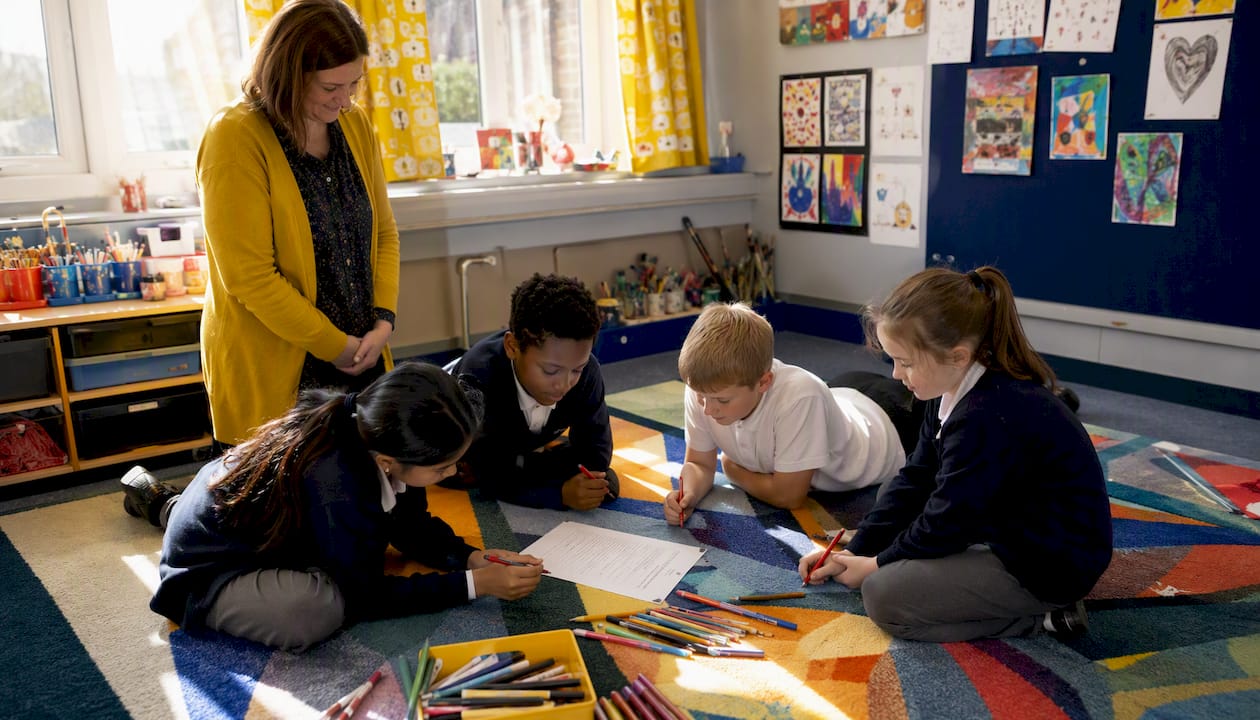
Pro Tip: For extension, ask Year 5–6 pupils to rewrite a persuasive paragraph three times, each time moving the subordinate clause to a different position. Ask them to explain which version sounds most persuasive and why. This pushes clause placement from a grammar exercise into a genuine writing craft discussion.
For children who need extra scaffolding at home, the ADHD and dyslexia learning app from Thepocketmoneygame offers neurodiversity-friendly features including voice support and immediate feedback.
Where do subordinating conjunctions sit in the UK National Curriculum?
The National Curriculum English programmes of study set out clear year-by-year expectations:
- Year 3: Introduction to subordinating conjunctions; pupils begin using "when," "if," "because," and "although" in their writing.
- Year 4: Wider use of conjunctions; pupils are expected to use subordinating conjunctions to add detail and explanation.
- Year 5–6: Varied and deliberate clause placement for effect; Oak National Academy lessons connect subordinating conjunctions to adverbial clauses, noting that adverbial clauses begin with subordinating conjunctions and linking this to relative clauses for Year 6 depth.
In the SATs GPS paper, pupils are typically asked to: identify the subordinating conjunction in a sentence; underline the subordinate clause; complete a sentence using an appropriate conjunction; or explain the relationship the conjunction creates (cause, contrast, time).
Collecting evidence of progress is straightforward. Keep a short writing sample from the start of a unit and one from the end. Look for: variety of conjunctions used (not just "because"), correct comma placement when the clause is fronted, and deliberate clause-position variation in longer pieces.
Key Takeaways
Subordinating conjunctions are the single most teachable tool for moving KS2 pupils from simple to complex sentences, and the comma rule for fronted clauses is the punctuation point most likely to appear in SATs.
| Point | Details |
|---|---|
| Core definition | A subordinating conjunction joins a dependent clause to a main clause; the subordinate clause cannot stand alone. |
| The comma rule | When the subordinate clause comes first, always place a comma before the main clause. |
| Go beyond "because" | Teach conjunctions by category (time, condition, contrast) to build sentence variety from Year 3 onward. |
| SATs relevance | The KS2 GPS paper tests identification, completion, and clause-relationship explanation for subordinating conjunctions. |
| Thepocketmoneygame | Adaptive practice with immediate feedback and voice support reinforces subordinating conjunction skills at home. |
Why "because" alone won't get your child to Year 6 standard
Most children latch onto "because" and never let go. It works, it's intuitive, and it answers the question "why?" every time. The problem is that a Year 6 writing piece built almost entirely on "because" reads flat, regardless of how good the ideas are. Assessors and teachers notice.
The real shift happens when pupils understand that subordinating conjunctions do different jobs. "Although" concedes a point before making a stronger one — a technique that is the backbone of persuasive writing. "Unless" sets a condition that creates tension in narrative. "Whereas" draws a contrast that makes an argument feel balanced and mature. These are not just grammar words; they are thinking tools.
The other thing that tends to get underestimated is clause placement. Moving the subordinate clause to the front of a sentence is not just a punctuation exercise. It changes emphasis, creates suspense, and signals to a reader that the writer is in control of their prose. A child who can write "Although she was exhausted, she kept going" has made a deliberate craft choice. That is what Year 6 standard actually looks like.
Thepocketmoneygame makes KS2 grammar practice feel worth it
Grammar practice at home can feel like pulling teeth, especially when your child has already sat through a full school day. Thepocketmoneygame is built for exactly that moment: short, adaptive sessions where children earn real pocket money for every correct answer, so there is a genuine reason to try.
The platform covers KS2 spelling, reading, and comprehension with adaptive difficulty that adjusts to your child's level, voice support for children who process better by listening, and a parent dashboard so you can see exactly where they are making progress. For children with ADHD or dyslexia, the immediate feedback loop means they never have to wait to find out if they got it right.
- Adaptive questions that match your child's current ability
- Immediate feedback after every answer
- Voice support for auditory learners
- Parent-controlled rewards that make practice feel purposeful
- Progress tracking so you know what to focus on next
Start your free trial of safe, no-download learning games and see how quickly a few minutes a day adds up.
Useful sources for teachers and parents
These are the curriculum and teaching-resource pages used to compile this guide:
- National Curriculum in England: English programmes of study (gov.uk) — the primary source for year-group expectations; use it to check statutory requirements.
- What is a subordinating conjunction? — BBC Bitesize — clear video and written explanations with simple examples; good for sharing with pupils directly.
- Subordinating conjunctions word mat — Teachit — printable word mat for classroom display or pupil desks.
- Free subordinating conjunctions list — TES — downloadable visual reference; useful for SEN adaptations and differentiation.