
What is KS1 reading comprehension and why does it matter?
KS1 reading comprehension is the ability of children aged 5–7 to understand, discuss, and interpret texts, and it sits at the heart of the UK National Curriculum's approach to early literacy. It goes well beyond recognizing words on a page. True comprehension means your child can make sense of what they read, connect it to what they already know, and talk about it with confidence.
Comprehension supports a gateway to imagination rather than a box to tick, your child picks up on that attitude.
Key components of KS1 reading comprehension include:
- Retrieving information directly from a text
- Making inferences about characters' feelings or motivations
- Predicting what might happen next in a story
- Discussing vocabulary and the meaning of new words
- Explaining the main topic of a non-fiction passage
- Connecting a text to personal experience
Resources like Oxford Owl, BBC Bitesize, and the Standards and Testing Agency all recognize comprehension as a core strand of the National Curriculum, assessed formally at the end of KS1.
How the curriculum builds comprehension across Years 1 and 2
The National Curriculum treats reading as two linked skills: word reading and comprehension. Phonics dominates Year 1, but comprehension runs alongside it from day one.
In Year 1 (ages 5–6), children develop skills from basic word reading to discussing stories and non-fiction. They retrieve information, infer feelings, make connections to personal experience, and explain the main topic of a passage. The emphasis is on verbalizing ideas and making personal connections, so talking about books together is genuinely curriculum work, not just a nice extra.
Year 2 (ages 6–7) shifts the gear. Children are expected to:
- Listen to and discuss a wide range of poetry, stories, and non-fiction at a level beyond their independent reading level
- Answer and ask questions about texts
- Predict outcomes and explain their views
- Make inferences based on what characters say and do
- Discuss the sequence of events and how information is related
- Recognize recurring literary language in stories and poems
The shift from phonics to comprehension doesn't happen overnight. By Year 2, most children are confident enough with decoding that the focus moves to understanding richer, more complex texts.

What are the optional KS1 English reading tests?
The Standards and Testing Agency recommends administering optional KS1 English reading tests in may at the end of KS1. Schools are not required to use them, but many do as a curriculum benchmark.
| Component | Format | Focus |
|---|---|---|
| Paper 1 | Reading prompt and answer booklet | Comprehension of a short fiction or non-fiction text |
| Paper 2 | Reading booklet and separate answer booklet | Comprehension of a longer or more varied text |
| Mark schemes | Provided by Standards and Testing Agency | Guide teachers in assessing comprehension responses |
The tests focus entirely on comprehension skills, not phonics or spelling. Questions ask children to retrieve facts, make inferences, predict outcomes, and explain their understanding. For parents of children who find timed reading tasks stressful, it helps to know that reading disabilities can affect how children perform under test conditions, and accommodations are available.
Practical resources and activities that actually build comprehension
Worksheets have their place, but they work best as one tool among many. The most effective comprehension practice combines reading, talking, and active engagement.
Useful resources for home and school include:
- Downloadable worksheets: Curriculum-aligned comprehension PDFs covering fiction, non-fiction, and poetry for KS1 ages
- Oxford Owl: Free e-books and age-specific reading guidance organized by year group
- BBC Bitesize: Short, interactive comprehension activities tied to the UK curriculum
- Story packs: Mixed text packs covering fairy tales, fact files, and poems give children exposure to different genres
- Thepocketmoneygame: Adaptive reading comprehension games for KS1 children, with voice support and real reward incentives that keep reluctant readers engaged
Activities that work particularly well at home include reading aloud together, pausing to ask what your child thinks will happen next, and letting them choose books they genuinely want to read.
Pro Tip: Don't limit comprehension practice to books. Comics, recipes, cereal boxes, and instruction leaflets all count as texts. Children who read widely across formats build vocabulary faster than those who stick to one genre.

Expert-backed strategies to strengthen comprehension skills
Reading aloud to children is one of the most powerful comprehension strategies at any age. It exposes children to fluent language, complex vocabulary, and sentence structures they cannot yet decode independently. Reading a book that is slightly above your child's level is not frustrating for them; it is exactly how vocabulary grows.
Asking open-ended questions that start with "how" and "why" pushes children to go back to the text and think carefully. "Why did she do that?" works better than "What happened next?" because it requires inference, not just recall.
Social discussion consistently outperforms drill-based approaches for building lasting comprehension. Talking about a character's motivation, debating a story's ending, or acting out a scene all deepen understanding in ways a worksheet cannot replicate. For neurodiverse learners especially, techniques like role-play and group story sequencing increase engagement naturally.
Pro Tip: Mix fiction and non-fiction deliberately. Children who only read stories often struggle with the structure of information texts, which appear in KS1 tests and throughout the curriculum. One non-fiction book for every two fiction books is a practical starting point.
How parents and teachers can support comprehension every day
At home, the single most effective habit is reading together daily, even after your child can read independently. Rereading favorite books reinforces word recognition and vocabulary, and children often notice details they missed the first time. Let your child pick the book sometimes. Ownership over reading choices builds motivation.
At school, teachers support comprehension through guided reading sessions, shared reading of class texts, and structured discussion. If you want to reinforce this at home, ask your child's teacher which texts the class is working on and read them together. That connection between home and school reading makes a real difference.
For children who find reading difficult, KS1 phonics support remains relevant even as comprehension takes center stage. Decoding and understanding work together, and a child who struggles with one will often struggle with the other.
Tracking reading progress without relying on formal tests
Formal tests give you a snapshot, but they miss a lot. The richest picture of your child's comprehension comes from everyday observation. Notice whether your child can retell a story in their own words, whether they ask questions about what they read, and whether they make connections between books and their own life.
Keep a simple reading log noting titles, genres, and one thing your child said or noticed about each book. Over a term, patterns emerge: maybe they thrive with non-fiction but lose the thread in longer fiction, or they predict endings confidently but struggle with vocabulary questions. That kind of specific insight helps you target practice far more effectively than a test score alone.
Books and texts worth putting in front of KS1 readers
The best KS1 texts combine accessible language with ideas worth talking about. For Year 1, look for books with clear story structures and vivid illustrations: Julia Donaldson's titles (including The Gruffalo and Zog) are curriculum staples for good reason. Non-fiction titles about animals, space, and the natural world work well because children already have opinions about them.
For Year 2, step up to slightly longer chapter books and more varied non-fiction. The Owl Who Was Afraid of the Dark by Jill Tomlinson, Flat Stanley by Jeff Brown, and the Horrid Henry series all sit at the right level while offering genuine story depth. Poetry collections, including those by Michael Rosen and Allan Ahlberg, build familiarity with literary language in a way that supports comprehension across all text types.
Key Takeaways
KS1 reading comprehension develops through consistent reading, open discussion, and exposure to varied texts aligned with the UK National Curriculum across Years 1 and 2.
| Point | Details |
|---|---|
| Comprehension is a lifelong skill | It supports critical thinking, decision making, and creativity well beyond school. |
| Year 1 vs. Year 2 progression | Year 1 focuses on retrieval and personal connection; Year 2 adds inference, prediction, and independent reading. |
| Optional KS1 tests | The Standards and Testing Agency provides Paper 1 and Paper 2 to benchmark comprehension at the end of KS1. |
| Read aloud regularly | Reading books above your child's independent level builds vocabulary and comprehension faster than solo reading. |
| Track progress informally | A reading log and daily conversation reveal more about comprehension growth than test scores alone. |
Try Thepocketmoneygame for KS1 reading practice
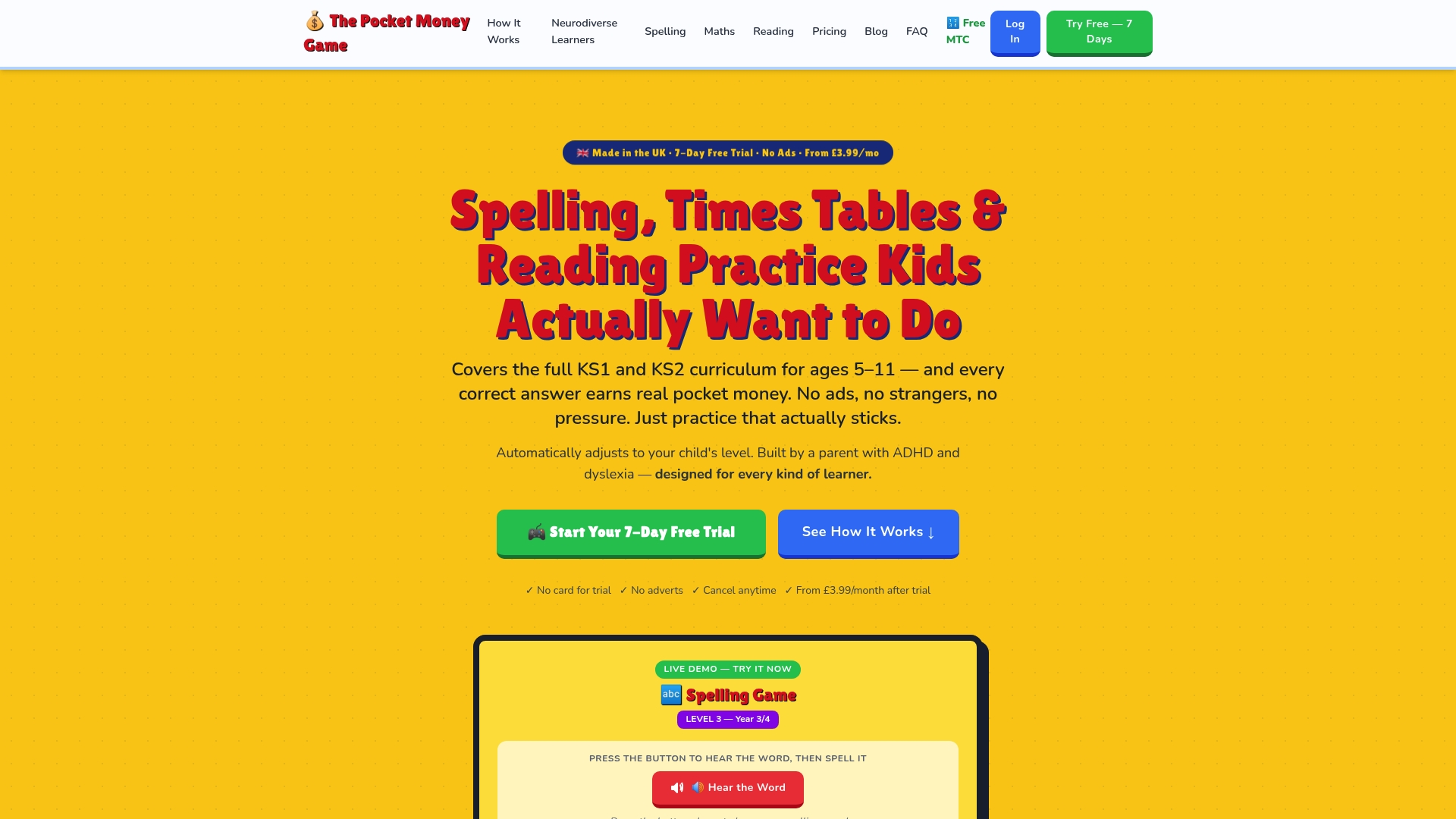
If your child needs a little extra motivation to practice reading comprehension, Thepocketmoneygame was built for exactly that. Developed by a parent with ADHD and dyslexia, the platform offers adaptive reading and spelling practice for children aged 5–11, with voice support, immediate feedback, and a reward system where children earn real pocket money for correct answers. It covers the KS1 curriculum and adjusts to your child's level automatically. You stay in control of the difficulty and the rewards. Start with a free trial at Thepocketmoneygame.