
What are prefixes and suffixes in KS2 English?
Prefixes and suffixes are letter groups added to a root word to change its meaning, tense, or grammatical role. They are a core part of the KS2 English curriculum covering Years 3 through 6.
A prefix goes at the beginning of a root word. A suffix goes at the end. Neither one is a word on its own, but both carry real meaning.
Quick examples to anchor this:
- un + happy = unhappy (prefix changes meaning to "not happy")
- slow + ly = slowly (suffix changes adjective to adverb)
- re + write = rewrite (prefix means "again")
- care + less = careless (suffix means "without")
Common KS2 prefixes include: un-, dis-, re-, mis-, pre-, super- Common KS2 suffixes include: -ed, -ing, -ly, -ness, -ful, -less, -able, -tion
Children who understand these building blocks can decode unfamiliar words in complex texts, which becomes increasingly useful as reading demands grow through upper KS2.
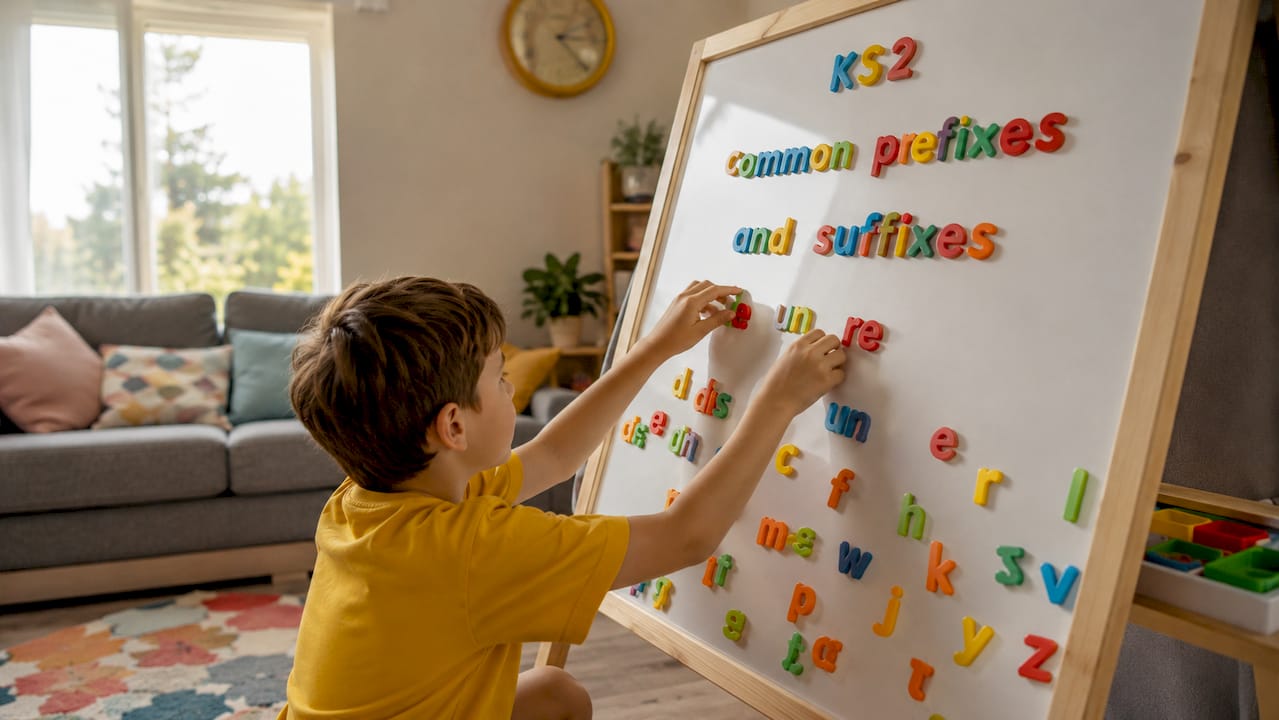

How prefixes and suffixes change words in KS2 English
Prefixes and suffixes do different jobs, and it helps to be clear about which does what.
Prefixes change meaning without changing the word's grammatical role. Adding dis- to agree gives you disagree, still a verb. Adding un- to kind gives you unkind, still an adjective. The part of speech stays the same; only the meaning flips.
Suffixes can change both meaning and grammatical role. This is where things get more interesting for KS2 learners:
- happy (adjective) + -ness = happiness (noun)
- teach (verb) + -er = teacher (noun)
- quick (adjective) + -ly = quickly (adverb)
Spelling changes are the trickiest part. When adding a suffix to certain root words, the spelling of the root shifts:
- Drop the silent e: make becomes making, hope becomes hopeful
- Change y to i: happy becomes happier, carry becomes carried
- Double the final consonant: run becomes running, big becomes bigger
Correctly applying these rules is central to Year 5 and Year 6 learning and directly relevant to SATs preparation. Children who miss these patterns tend to produce consistent spelling errors across their writing, not just in isolated tests.
Common prefixes and suffixes every KS2 learner should know
Common prefixes
| Prefix | Meaning | Example |
|---|---|---|
| un- | not / opposite | unhappy, unkind |
| dis- | not / opposite | disagree, dishonest |
| re- | again | rewrite, rebuild |
| mis- | wrongly | misspell, misread |
| pre- | before | preview, prepare |
| super- | above / beyond | superhero, supermarket |
| sub- | under | submarine, subheading |
| inter- | between | interrupt, international |
Common suffixes
| Suffix | Meaning / Effect | Example |
|---|---|---|
| -ed | past tense | walked, jumped |
| -ing | present participle | running, thinking |
| -ly | changes adjective to adverb | quickly, softly |
| -ness | state or condition | kindness, darkness |
| -ful | full of | helpful, careful |
| -less | without | hopeless, careless |
| -able / -ible | can be done | readable, sensible |
| -tion / -sion | act or process | action, decision |
| -er / -or | person who does | teacher, creator |
| -ment | state of being | enjoyment, movement |
Two types of suffixes appear in KS2 teaching. Inflectional suffixes (like -ed, -ing, -s) change tense or number without altering the word's grammatical category. Derivational suffixes (like -ness, -ful, -tion) create entirely new words, often changing the part of speech. Both matter for vocabulary development and reading comprehension.
How prefix and suffix learning progresses through KS2
The KS2 curriculum builds this knowledge in clear stages, and knowing the progression helps you pitch your support at the right level.
Lower KS2 (Years 3 and 4):
- Introduction to common prefixes: un-, dis-, mis-, re-
- Basic suffixes: -ed, -ing, -er, -est, -ly, -ful, -less
- Focus on recognizing how adding a prefix or suffix changes a root word's meaning
- Simple spelling rules for adding suffixes
Upper KS2 (Years 5 and 6):
- More complex suffix choices: -ance/-ence, -ible/-able, -ise/-ify/-ate
- Understanding when spelling changes are required before adding a suffix
- Combining multiple affixes, for example un + intention + al + ly = unintentionally
- Recognizing how suffixes affect pronunciation, particularly with -tion, -sion, and -can
Upper KS2 work builds directly on lower KS2 foundations. Children who missed or misunderstood the basics in Years 3 and 4 often struggles with the more nuanced suffix choices in Years 5 and 6. Catching gaps early makes a real difference.
Practical resources and activities for teaching prefixes and suffixes
The best KS2 grammar resources combine clear explanation with hands-on practice. Here are the most useful options:
- BBC Bitesize covers prefixes and suffixes with videos, quizzes, and worked examples, all free and curriculum-aligned. It is a reliable starting point for both classroom use and home revision.
- Twinkl offers teacher-made worksheets, PowerPoints, word mats, display posters, and matching card games, all mapped to the 2014 national curriculum.
- Teachit Primary provides interactive activities including prefix/suffix sorting tasks, word-builder games, and spot-the-mistake exercises with immediate feedback.
- Prefix/suffix sorting cards: children sort words into groups by prefix or suffix, reinforcing pattern recognition without rote memorization.
- Word-building games: give children a root word and a set of affixes; they compete to build the most real words in a set time.
- Spot-the-mistake exercises: present sentences with incorrect affixes and ask children to identify and correct the error.
Pro Tip: Try the Frayer Model for any affix your child finds tricky. Write the affix's meaning in one box, three example words in another, a quick drawing that captures the meaning in a third, and one original sentence in the fourth. This multisensory approach builds retention far better than a spelling list alone.
Teaching morphology in connected units, covering roots, prefixes, and suffixes together, lets children start building new words immediately rather than learning each element in isolation.
How Thepocketmoneygame supports prefix and suffix learning
Thepocketmoneygame is an adaptive learning platform built for children aged 5–11, covering spelling, maths, and reading with a reward system that pays children real pocket money for correct answers. That single feature changes the motivation equation entirely for many children.
Here is what makes it particularly useful for prefixes and suffixes practice:
- Curriculum alignment: the platform covers KS1 and KS2 statutory spelling lists, including the affix patterns children need to master across Years 3–6
- Adaptive difficulty: questions adjust to each child's level, so a Year 3 child working on un- and re- gets different practice from a Year 6 child tackling -ance/-ence
- Voice support: built-in audio reads questions aloud, supporting children with dyslexia or ADHD who find silent reading tasks harder
- Parent dashboard: you can track progress, adjust difficulty, and set daily question caps, keeping learning manageable
- Real-world use: the platform is used in Kent primary schools, validating its fit with UK curriculum expectations
Developed by a parent with ADHD and dyslexia, Thepocketmoneygame was built with neurodiverse learners in mind from the start. If your child finds traditional spelling practice frustrating, the reward-based approach often shifts that dynamic quickly.
How teachers assess prefix and suffix understanding in KS2
Assessment does not have to mean a formal test. The most useful methods give you a clear picture of what a child actually understands, not just what they can memorize the night before.
- Dictation tasks: read sentences aloud containing target affixes; children write them correctly, revealing both spelling accuracy and understanding of meaning
- Word-building challenges: provide a root word and ask children to add as many correct prefixes or suffixes as they can, then explain what each new word means
- Error analysis: give children a piece of writing with deliberate affix mistakes and ask them to find and correct each one; this tests application, not just recall
- Oral explanation: ask a child to explain what a prefix or suffix means in their own words; a child who can say "mis- means doing something wrongly, like misspelling" understands it at a deeper level than one who simply spells it correctly
- Reading comprehension tasks: use a passage containing unfamiliar words built from known affixes; ask children to infer meaning using the word parts as clues
Quick, low-stakes checks like these work well woven into everyday lessons rather than saved for end-of-unit tests.
Tips for parents to support children's learning at home
You do not need to be a grammar expert to help your child with affixes at home. A few consistent habits make a bigger difference than any single worksheet.
- Make it conversational: when your child encounters an unfamiliar word while reading, ask "do you spot a prefix or suffix in there?" before reaching for a definition
- Play word games: take turns adding prefixes or suffixes to a root word at the dinner table; whoever builds the most real words wins
- Keep a word wall: stick a piece of paper on the fridge and add one new prefix or suffix each week with two example words; revisit it regularly
- Use the KS2 spelling list as a reference so you know which affixes your child's year group is expected to master
- Little and often beats long sessions: ten minutes of focused practice three times a week tends to produce better retention than a single hour at the weekend
- Celebrate the process: when your child correctly identifies a suffix they have never seen before, that is worth acknowledging, even if the spelling is not perfect yet
Common mistakes children make with prefixes and suffixes
Knowing where children typically go wrong helps you address problems before they become habits.
1. Forgetting spelling changes before adding a suffix. This is the most frequent error. Children write makeing instead of making, or happyness instead of happiness, because they add the suffix without adjusting the root word first.
2. Treating any similar letter string as a prefix. Not every word beginning with re contains the prefix re-. Words like read or ready do not use re- as a prefix at all. Teaching children to check whether removing the letters leaves a real root word helps here.
3. Confusing -able and -ible. There is no single rule that covers every case, but a useful guide is that -able usually follows a complete root word (readable, washable) while -ible often follows a root that cannot stand alone (sensible, terrible).
4. Mixing up -ance and -ence. This is an upper KS2 challenge with no shortcut. Children need repeated exposure to specific words rather than a rule, since both endings sound identical in most accents.
5. Doubling consonants incorrectly. Children often double when they should not (jumppping) or fail to double when they should (runing). The rule applies when the root word ends in a single vowel followed by a single consonant and the suffix begins with a vowel.
Addressing these errors with targeted practice, rather than rewriting whole spelling lists, is far more efficient. Focus on the specific pattern causing the problem and give the child multiple chances to apply the correct rule across different words.
Key Takeaways
Prefixes and suffixes are the most transferable spelling skill in KS2: mastering a small set of affixes unlocks the meaning of hundreds of unfamiliar words.
| Point | Details |
|---|---|
| Prefixes change meaning only | Adding a prefix never changes the word's grammatical role, only its meaning. |
| Suffixes can change word class | Suffixes like -ness and -tion turn adjectives and verbs into nouns. |
| Spelling rules matter | Dropping the silent e and changing y to i are core Year 5 and 6 skills. |
| Curriculum builds in stages | Lower KS2 covers basic affixes; upper KS2 adds complex choices like -ance/-ence and -ible/-able. |
| Little and often works the best | Short, regular practice sessions build retention better than infrequent long ones. |
Recommended
- KS1 Phonics and Common Exception Words: A Parent's Complete Guide — The Pocket Money Game
- Blog | The Pocket Money Game — Tips for Parents, ADHD Learning & UK Curriculum
- Year 6 SATs: A Parent's Complete Preparation Guide — The Pocket Money Game
- Free Spelling & Maths Game for UK Children | London, Manchester, Birmingham & More