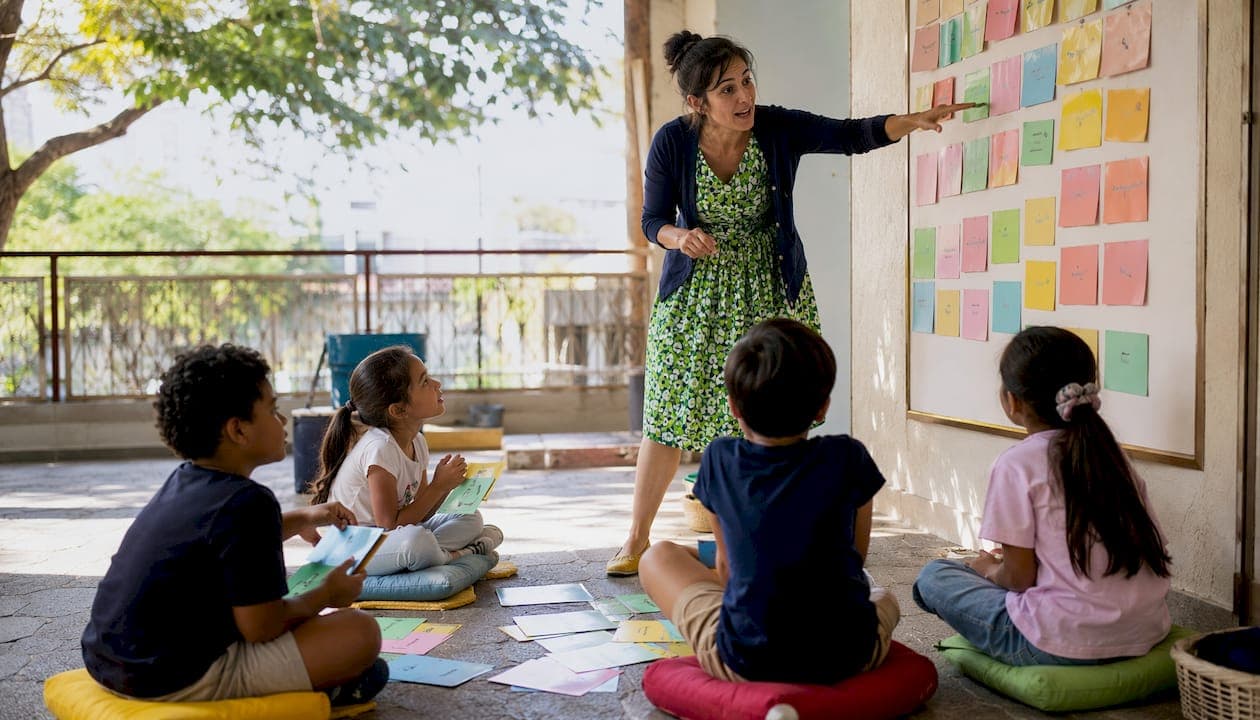
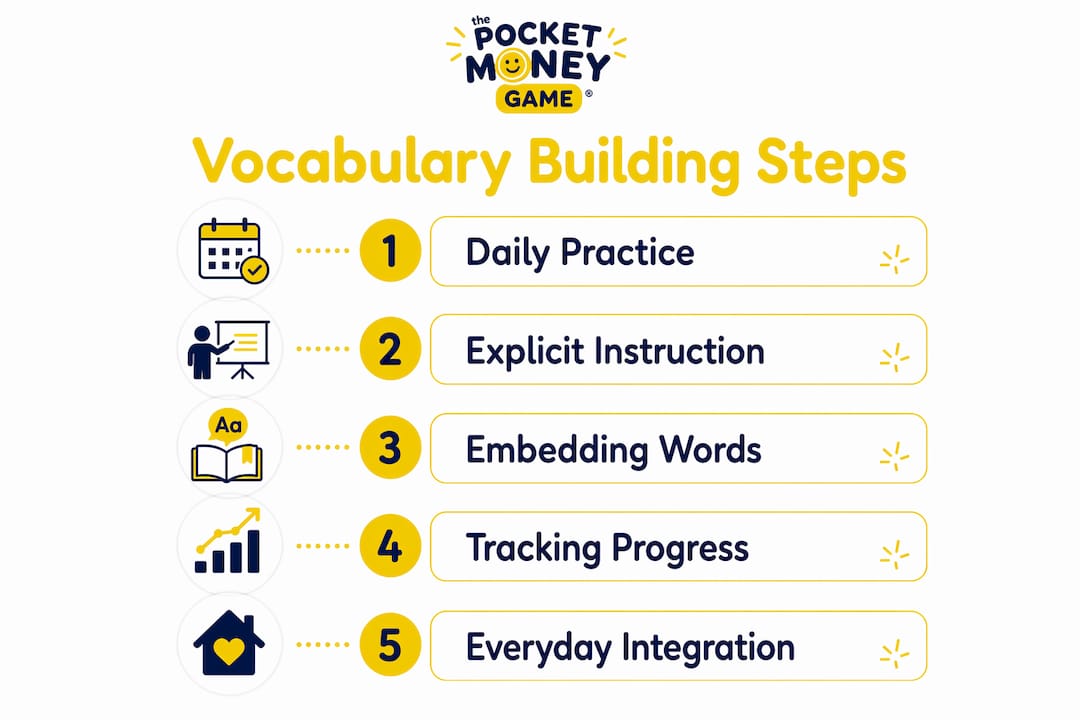
The most effective approach to vocabulary building in KS2 is short, daily practice that teaches words explicitly, then revisits them across different tasks throughout the week. Not one long lesson on Friday. Not a word list to memorize. Daily, varied, and connected to what children are already reading and learning.
Here's what that looks like in practice:
- Teach focused new words each week, linked to a current topic or class book
- Revisit each word multiple times across different activities: meaning, synonyms, context, word structure, and writing
- Mix explicit teaching with playful use so children build both understanding and confidence
- Target active vocabulary, not just recognition. The goal is words children reach for when they write and speak, not just words they can define when asked
- Keep sessions to short daily durations rather than one extended weekly lesson, which the Education Endowment Foundation identifies as the more effective model for retention
That structure is the backbone of everything that follows.
What do daily vocabulary strategies for KS2 actually look like?
The weekly routine that works best follows a simple rotating pattern. Each day targets a different aspect of the same set of words, so children meet them repeatedly without it feeling repetitive.
- Monday: Introduce words with meanings and visuals
- Tuesday: Synonym and antonym sorting
- Wednesday: Context clue activities using the words in short passages
- Thursday: Word building with prefixes, suffixes, and root words
- Friday: A short writing challenge using as many target words as possible
This approach works because of spaced repetition. Meeting the same words across varied tasks over several days moves them from short-term memory into long-term retention, which is exactly what spaced repetition research supports. Linking words to current curriculum topics, like Roman history or habitats, gives children a meaningful context that makes new vocabulary stick faster.
A few practical points worth keeping in mind:
- Limit target words per week to avoid overload
- Adjust the number and complexity for mixed-ability groups by using the same activity with different word lists
- Integrate vocabulary work into reading time, science, or history rather than treating it as a separate subject
Pro Tip: If you're a parent doing this at home, one synonym sort after reading together takes under five minutes and covers Tuesday's task in the routine above.
Which vocabulary activities and resources work best for KS2?
The activities that produce the most growth are the ones children can do repeatedly without getting bored. Variety in format keeps engagement up; consistency in the words keeps learning deep.
- Synonym and antonym sorting: Children swap overused words like "nice" or "big" for stronger alternatives. A simple word bank and a dull sentence to rewrite is all you need. Twinkl offers ready-made sorting activities aligned to the KS2 curriculum, saving planning time significantly.
- Context clue exercises: Give children a short passage with one bold unknown word and ask them to work out the meaning from surrounding text. This builds both vocabulary and reading comprehension at the same time.
- Word building with prefixes and suffixes: A grid with root words in one column and prefixes in another lets children build new words, check meanings, and write sentences. It connects phonics, spelling, and vocabulary in one task.
- The Frayer model: This graphic organizer asks children to record a word's definition, examples, non-examples, and a visual. It's particularly effective for neurodiverse learners because it anchors meaning through multiple entry points rather than a single definition.
- Vocabulary marketplace: An activity where children "barter" words in an imaginary market, trading simpler words for more ambitious ones. It sounds unusual, but playful vocabulary activities like this build genuine enthusiasm for language rather than reluctant compliance.
- Word riddles and vocabulary bingo: Low-prep games that work as starters or end-of-lesson activities. Bingo boards with nine vocabulary words, where children listen for definitions and mark their words, are especially good for auditory learners.
Pro Tip: Try "Vocabulary 7-Up" where children list seven synonyms for a common word like "happy" or "large." It's quick, competitive, and reveals exactly which children have a thin word bank.
What does research say about teaching vocabulary effectively?

The Education Endowment Foundation is clear on one point: explicit teaching of a new word is only the starting point. Children often understand far more words than they actively use, so the real work is moving words from passive recognition into expressive, confident use in speech and writing.
What the evidence supports:
- Short daily sessions of 5–10 minutes outperform longer, infrequent lessons for both retention and engagement
- Embedding words across multiple literacy tasks throughout the week, not just one lesson, is what secures deep understanding
- Multisensory approaches, including graphic organizers and visual supports, are particularly effective for children with diverse learning needs
- Curriculum integration produces stronger results than standalone vocabulary lessons because children connect new words to knowledge they already have
Explicit instruction is the entry point. Embedding is what creates mastery. That distinction shapes every practical strategy in this guide, and it aligns directly with what ELA skills research identifies as foundational for struggling learners across literacy subjects.
How does vocabulary develop across KS2 years?

Children in KS2 (Years 3–6) move through recognizable stages of vocabulary growth, and understanding those stages helps you pitch activities at the right level.
In Years 3 and 4, children are consolidating the vocabulary they've encountered in KS1 and beginning to meet Tier 2 words: academic words that appear across subjects but aren't common in everyday conversation, like "authority," "distinct," or "vulnerable." They need lots of exposure and repetition before these words feel natural.
By Years 5 and 6, children are ready to work with word relationships more independently. They can explore etymology, use a thesaurus purposefully, and begin to make deliberate word choices in their writing. The shift at this stage is from learning what a word means to understanding when and why to use it. That's the difference between a child who can define "melancholy" and one who reaches for it in a story instead of "sad." Supporting that shift requires activities that push beyond definition, into use, comparison, and creative application.
How can you track vocabulary growth in KS2 learners?
Assessment doesn't need to be formal to be useful. The most practical tracking methods are the ones you can embed into normal lessons without adding significant workload.
A simple word journal, where children record new words, their meanings, and a sentence using each one, gives you a running record of exposure and application. Reviewing journals weekly shows you which words have been internalized and which need revisiting. Low-stakes quizzes, like matching definitions to words or completing a sentence with the correct term, give quick snapshots of retention without the pressure of a formal test.
For a more structured approach, a class vocabulary tracker listing target words alongside a simple rating (not yet, getting there, got it) lets children self-assess and helps you identify gaps across the group. The KS2 statutory spelling list is a useful baseline for tracking curriculum-aligned vocabulary across Years 3–6.
How do you weave vocabulary into everyday subjects and routines?
The most durable vocabulary learning happens when words appear across multiple subjects, not just in English lessons. A child who meets the word "erosion" in geography, reads it in a class novel, and then uses it in a science report has encountered it in three different contexts. That repetition across subjects is what makes it stick.
Practically, this means:
- Display a "word of the week" linked to your current topic, visible in the classroom or at home on the fridge
- Use subject-specific glossaries in history, science, and geography so children build domain vocabulary alongside content knowledge
- Read aloud daily and pause briefly on unfamiliar words, modeling how to use context clues to infer meaning
- Encourage a thesaurus habit during writing tasks. Twinkl's thesaurus worksheet for KS2 is a straightforward way to introduce this skill at home or in class
For parents, the simplest integration is conversation. Asking "what's another word for that?" at the dinner table, or pointing out an interesting word in a book you're reading together, costs nothing and builds the habit of noticing language.
Thepocketmoneygame offers a fresh way to keep KS2 vocabulary practice going
If you're looking for something that keeps children genuinely motivated between lessons, Thepocketmoneygame takes a different approach to primary learning.
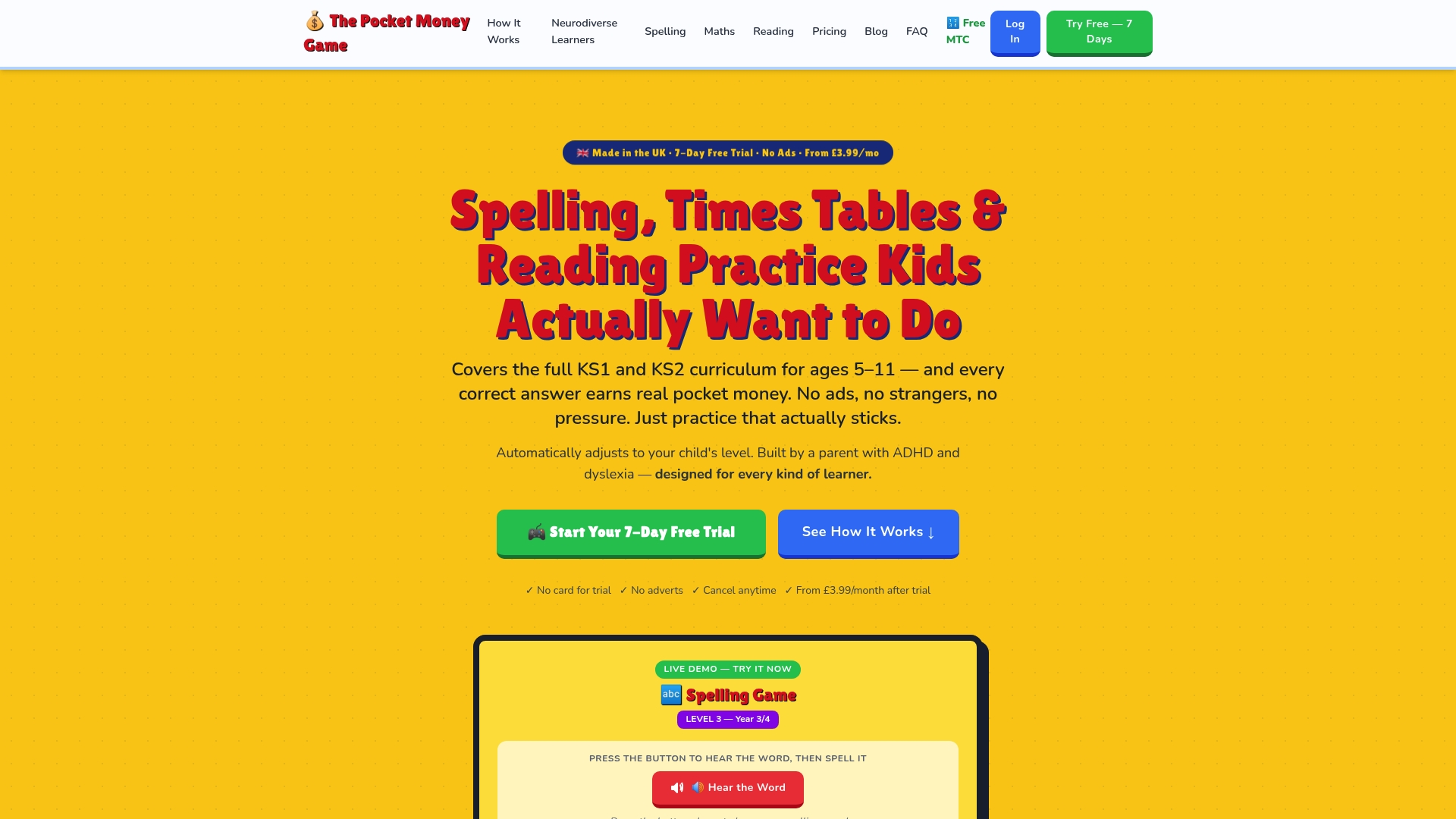
Children earn real pocket money for every correct answer, which means every spelling, reading, and vocabulary question carries a tangible reward. The platform covers KS1 and KS2 curriculum content with adaptive difficulty, voice support, and a parent dashboard that lets you track progress and adjust settings. It was built by a parent with ADHD and dyslexia, so it's designed from the ground up to work for children who don't thrive with traditional methods. For families supporting a child with diverse learning needs, the adaptive learning features make a real difference. You can explore the full platform at Thepocketmoneygame and see how it fits alongside the daily vocabulary routine you're already building.
Key Takeaways
The most effective vocabulary building in KS2 combines short daily sessions, spaced repetition, and curriculum-linked activities that move words from passive recognition into active, confident use.
| Point | Details |
|---|---|
| Daily sessions beat weekly lessons | Short daily tasks produce stronger retention than one extended weekly lesson. |
| Spaced repetition is the mechanism | Revisiting the same words across varied tasks each day moves them into long-term memory. |
| Active vocabulary is the goal | Children understand more words than they use; guided practice closes that gap. |
| Curriculum integration deepens learning | Linking vocabulary to history, science, or a class book creates meaningful connections that aid recall. |
| Thepocketmoneygame reinforces daily practice | Its reward-based, adaptive platform supports KS2 vocabulary and spelling with real motivation built in. |
Recommended
- Spelling Games for Kids KS1 & KS2 | Fun Practice, Real Progress
- Blog | The Pocket Money Game — Tips for Parents, ADHD Learning & UK Curriculum
- Spelling, Times Tables & Reading Practice Kids Actually Enjoy | The Pocket Money Game
- KS2 Statutory Spelling List: All 200 Words (Years 3–6) | The Pocket Money Game