
In the passive voice, the action happens to the subject rather than by it. The formula is simple: to be + past participle (+ optional "by" phrase). So "The dog chased the cat" (active) becomes "The cat was chased by the dog" (passive). That one swap is the whole idea, and everything else in this guide builds from it.
Key Takeaways
The passive voice is a deliberate writing tool formed with "to be" + past participle, and KS2 pupils who understand it as a stylistic choice write with more confidence and variety than those who learn it as a rule.
| Point | Details |
|---|---|
| Core formula | Passive = "to be" + past participle; the "by" phrase is always optional. |
| Conversion method | Identify subject, verb, object first; move the object to the front, then update the verb. |
| When to use it | Science reports, formal rules, and unknown actors are the three main KS2 contexts. |
| Neurodiverse learners | Color-coding, micro-tasks, and immediate feedback reduce working-memory load significantly. |
| Thepocketmoneygame | Short daily drills with instant feedback and real rewards make home practice sustainable for KS2 pupils. |
Table of Contents
- What is passive voice in KS2 English?
- How do you convert an active sentence into a passive one?
- KS2 practice: 10 sentences to convert
- Ready-to-run KS2 classroom activities
- Common mistakes pupils make and how to fix them
- When should pupils use the passive voice?
- Teaching passive voice to neurodiverse learners
- A teacher's honest take on passive voice at KS2
- Extra practice at home with Thepocketmoneygame
- Sources
What is passive voice in KS2 English?
BBC Bitesize puts it plainly: in the active voice, the subject does the action; in the passive voice, the subject is acted upon. Here are a few labeled pairs that show the difference at a glance.
| Active | Passive |
|---|---|
| The girl ate a strawberry. | A strawberry was eaten by the girl. |
| The teacher marked the books. | The books were marked by the teacher. |
| The chef has cooked the pasta. | The pasta has been cooked by the chef. |
The key vocabulary children need: subject (who or what the sentence is about), verb (the action), object (who or what receives the action), and agent (the doer, introduced by "by" in a passive sentence).
How to spot a passive sentence — a quick 3-point check:
- Look for a form of "to be" (is, are, was, were, has been, have been) sitting just before the main verb.
- Check that the main verb is a past participle (eaten, marked, cooked, written).
- Ask: "Is the thing receiving the action placed at the start of the sentence?" If yes, it is almost certainly passive.
PlanBee's classroom activities suggest a fun shortcut: try adding "by zombies" after the verb. "The cake was eaten by zombies" works, so it is passive. "The zombies ate" does not accept the tag, so it is active. Children love this test, and it sticks.
How do you convert an active sentence into a passive one?
Oak National Academy advises pupils to identify the subject, verb, and object before they touch the sentence. That single step prevents most errors. Here is the full method, step by step.
- Find the subject, verb, and object. ("The dog / chased / the cat.")
- Move the object to the front — it becomes the new subject. ("The cat…")
- Choose the right form of "to be" to match the tense of the original verb.
- Add the past participle of the main verb. ("…was chased…")
- Add "by" + the original subject if the agent matters. Drop it if it does not. ("…by the dog.")
"To be" forms at a glance
| Tense | "To be" form | Example passive |
|---|---|---|
| Present simple | is / are | The books are read every day. |
| Past simple | was / were | The window was broken yesterday. |
| Present perfect | has been / have been | The letters have been sent. |
BBC Bitesize confirms that the "by" phrase is always optional. If the agent is obvious, unknown, or unimportant, leave it out entirely.
Three worked examples across tenses:
- Present simple: "She waters the plants" → "The plants are watered (by her)."
- Past simple: "The builder fixed the roof" → "The roof was fixed by the builder."
- Present perfect: "They have finished the project" → "The project has been finished (by them)."
KS2 practice: 10 sentences to convert
Use this table for home practice or a quick classroom activity. Cover the answer column first, then check.
| Active sentence | Passive sentence (answer key) |
|---|---|
| The cat knocked over the vase. | The vase was knocked over by the cat. |
| The children planted the seeds. | The seeds were planted by the children. |
| The teacher read the story aloud. | The story was read aloud by the teacher. |
| Someone has stolen my bike. | My bike has been stolen. |
| The storm damaged the fence. | The fence was damaged by the storm. |
| The scientist discovered a new planet. | A new planet was discovered by the scientist. |
| The pupils have completed the test. | The test has been completed by the pupils. |
| The dog buried the bone. | The bone was buried by the dog. |
| A volunteer painted the mural. | The mural was painted by a volunteer. |
| The chef has prepared the meal. | The meal has been prepared by the chef. |
Extension prompts for confident pupils:
- Rewrite sentences 4 and 9 without the "by" phrase. Does the sentence still make sense? Why might a writer choose to drop the agent?
- Change sentences 2 and 6 into the present perfect passive. What changes, and what stays the same?
A quick teacher note: Sentences 4 and 9 are the most instructive. Sentence 4 ("Someone has stolen my bike") naturally drops the agent in the passive because the actor is unknown. Sentence 9 shows that even when the agent is known, a writer can omit it to shift focus onto the mural rather than the person who painted it.
Ready-to-run KS2 classroom activities
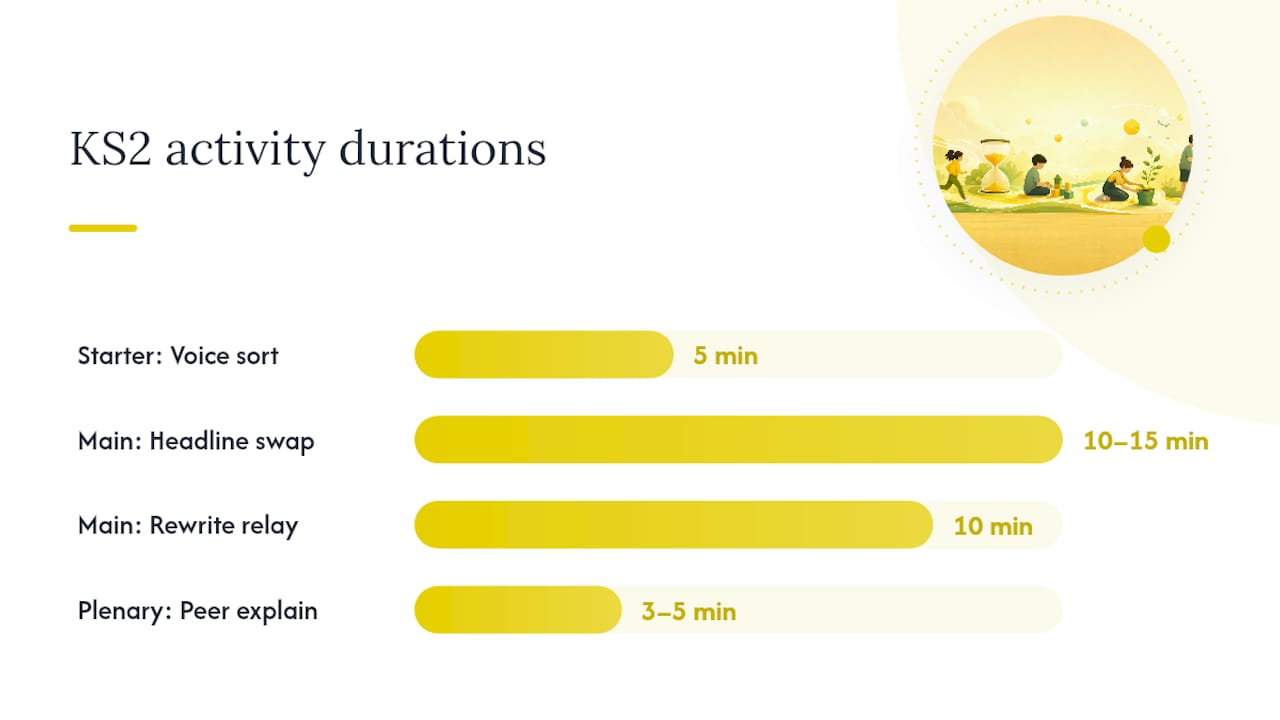
These activities fit a 5–20 minute slot and work equally well at home or in class.
-
Starter: Voice sort (5 minutes). Write six sentences on the board, three active and three passive, mixed up. Pupils sort them into two columns on mini whiteboards. Ask one pupil to explain how they spotted each passive sentence using the 3-point checklist.
-
Main: Headline swap (10–15 minutes). Give pupils five newspaper-style headlines written in the active voice ("Firefighters rescue family from blaze"). Their task: rewrite each as a passive headline ("Family rescued from blaze") and decide which version sounds more like a real headline, and why. This naturally surfaces the idea that passive can hide the agent for effect.
-
Main: Rewrite relay (10 minutes, pairs). Partner A writes an active sentence; Partner B converts it to passive and passes it back. Partner A checks the conversion using the 3-point checklist, then writes a new sentence. Three rounds, then swap roles. Works well as a low-stakes speaking-and-listening task too.
-
Plenary: Peer explain (3–5 minutes). Each pupil explains the passive voice to their partner using only one example sentence they wrote themselves. The listener gives a thumbs up if the explanation is clear. This mirrors the modeling approach recommended by Teachwire — I do, we do, you do — and consolidates understanding quickly.
Differentiation at a glance:
- Lower confidence: Provide sentence frames ("The ___ was ___ed by the ___.") and a word bank of past participles.
- Higher confidence: Challenge pupils to write a short science-report paragraph using only passive sentences, then discuss why scientists often write that way.
- Mixed ability: Use the headline swap activity for all, but give simpler headlines to pupils who need support and more complex multi-clause headlines to those who are ready.
Pro Tip: Run the "by zombies" test as a whole-class call-and-response during the starter. Say a sentence aloud, pupils add "by zombies" in their heads, then show thumbs up (passive) or thumbs down (active). It takes 90 seconds and wakes everyone up.
Common mistakes pupils make and how to fix them
Six errors come up again and again when children first tackle passive voice.
1. Treating any word after the verb as the object. A pupil might try to convert "She walked to school" and produce nonsense because "to school" is not an object. Oak National Academy's lessons address this directly: ask pupils "Who did it?" and "What received it?" before they move anything.
2. Using the wrong past participle. "The cake was ate" instead of "was eaten." A quick fix: keep a class list of irregular past participles on display. Pairing this with vocabulary-building practice for verb forms helps it stick.
3. Wrong "to be" form for the tense. "The books is read" instead of "are read." Remind pupils to check the original tense first, then match it to the helper table.
4. Keeping the original subject in the wrong place. "The cat the dog chased" — pupils sometimes forget to restructure the whole sentence. Encourage them to write the new subject first, then stop and add the verb before anything else.
5. Forgetting "to be" entirely. "The cake eaten by the chef" is a participial phrase, not a passive sentence. The auxiliary is not optional — only the "by" phrase is.
6. Adding "by" when the agent is unknown. Writing "My bike has been stolen by someone" sounds awkward. Teach pupils that "someone," "people," and "they" are signals to drop the agent entirely.
Mini editing checklist for self-marking:
- Does the sentence start with the receiver of the action?
- Is there a "to be" form before the past participle?
- Is the past participle spelled correctly?
- If there is a "by" phrase, does it name a specific, meaningful agent?
Pro Tip: When marking written work, circle the "to be" form and the past participle in green whenever a pupil gets the passive right. Positive marking of the two key components is faster than correcting errors and helps pupils see the pattern in their own writing.
When should pupils use the passive voice?
Passive voice is a deliberate stylistic choice, not a mistake to avoid. BBC Bitesize identifies three contexts where it genuinely serves the writer, and all three appear regularly in KS2 writing tasks.
- Science reports and investigations. "The liquid was heated to 100°C" sounds objective and formal. The scientist's identity is irrelevant; the process is what matters. Pupils writing up experiments should use passive voice to sound like real scientists.
- Formal rules and instructions. "Pupils are not allowed to run in the corridors." The passive removes personal blame and gives the rule a universal, authoritative tone. Children encounter this language every day in school.
- Unknown or unimportant actor. "The window was broken" tells us what happened without naming anyone. This is useful in narrative writing when a writer wants to create mystery or shift focus to the event itself.
A useful teacher prompt: ask pupils "Who is the most important character in this sentence — the doer or the receiver?" Their answer should drive the choice of voice.
Teaching passive voice to neurodiverse learners
Children with dyslexia, ADHD, or other processing differences can absolutely master passive voice. The key is reducing working-memory load and keeping each step small.
- Micro-tasks over full sentences. Start by asking pupils to identify only the past participle in a sentence, not convert the whole thing. One job at a time builds confidence before combining steps.
- Color-coding. Highlight the subject in yellow, the verb in blue, and the object in green. When converting, pupils physically move the green word to the front. The visual cue replaces the need to hold the whole sentence in working memory.
- Read-aloud and repeat. Reading the passive sentence aloud after writing it catches errors the eye misses. Voice support tools reinforce this for pupils who find silent reading harder.
- Chunked practice with immediate feedback. Five questions, check, five more. Short bursts with quick results keep attention focused and prevent the frustration that comes from a long worksheet with no feedback until the end. Reward-based learning can make these short bursts genuinely motivating.
- Sentence frames as scaffolding. "The ___ was ___ed by the ___." removes the structural decision so pupils can focus purely on the verb form.
Pro Tip: For pupils with ADHD, set a two-minute timer for each micro-task and celebrate finishing within the time. The timer externalizes the sense of urgency that ADHD brains often need, and the celebration keeps the session positive.
The I/We/You modeling approach works especially well here. The teacher demonstrates once (I do), works through an example with the class (we do), then the pupil tries independently (you do). For neurodiverse learners, the "we do" stage often needs to be longer and more explicit than it would be for the rest of the class.
A teacher's honest take on passive voice at KS2
There is a tendency in primary English teaching to treat passive voice as a Year 6 bolt-on — something you cover in the two weeks before SATs and then forget. That approach does children a disservice.
The passive voice is not a grammatical trick. It is a genuine writing tool that children already use instinctively in speech ("My phone got broken") long before they can name it. The job of a KS2 teacher or parent is not to introduce the concept from scratch but to give children the vocabulary to describe what they already do, and then to show them how to control it deliberately.
The single most effective shift I have seen in practice: stop asking "Is this sentence active or passive?" and start asking "Who do you want the reader to focus on?" That question makes voice a choice, not a rule. Children who understand it as a choice write with more confidence and more variety.
Extra practice at home with Thepocketmoneygame
Grammar practice works best in short, frequent bursts — exactly the kind of session that is hardest to sustain with a worksheet and a reluctant child. Thepocketmoneygame is built for precisely this: safe, no-download learning games that give children immediate feedback on every answer, with voice support for pupils who need to hear the sentence read aloud.

The platform covers KS1 and KS2 English across the UK curriculum, and its adaptive difficulty means children are always working at the right level — not bored by questions that are too easy, not defeated by ones that are too hard. Parents control the reward settings, so every correct answer (including those passive-to-active conversions) earns real pocket money. That tangible reward keeps children coming back for the next five-question burst without a fight. Start a free 7-day trial at Thepocketmoneygame and see how quickly short daily sessions add up.
Sources
- What are the active and passive voice? - KS2 English - BBC Bitesize
- Identifying the active and passive voice KS2 | Y6 English | Oak National Academy
- Active and Passive Voice KS2 | PlanBee
- Passive voice KS2 resources and teaching tips - Teachwire