
Modal verbs are the small helper words like can, must, and might that sit before a main verb to change how certain, forceful, or possible that action feels. Teach them by function and the whole topic clicks fast for Year 5 pupils.
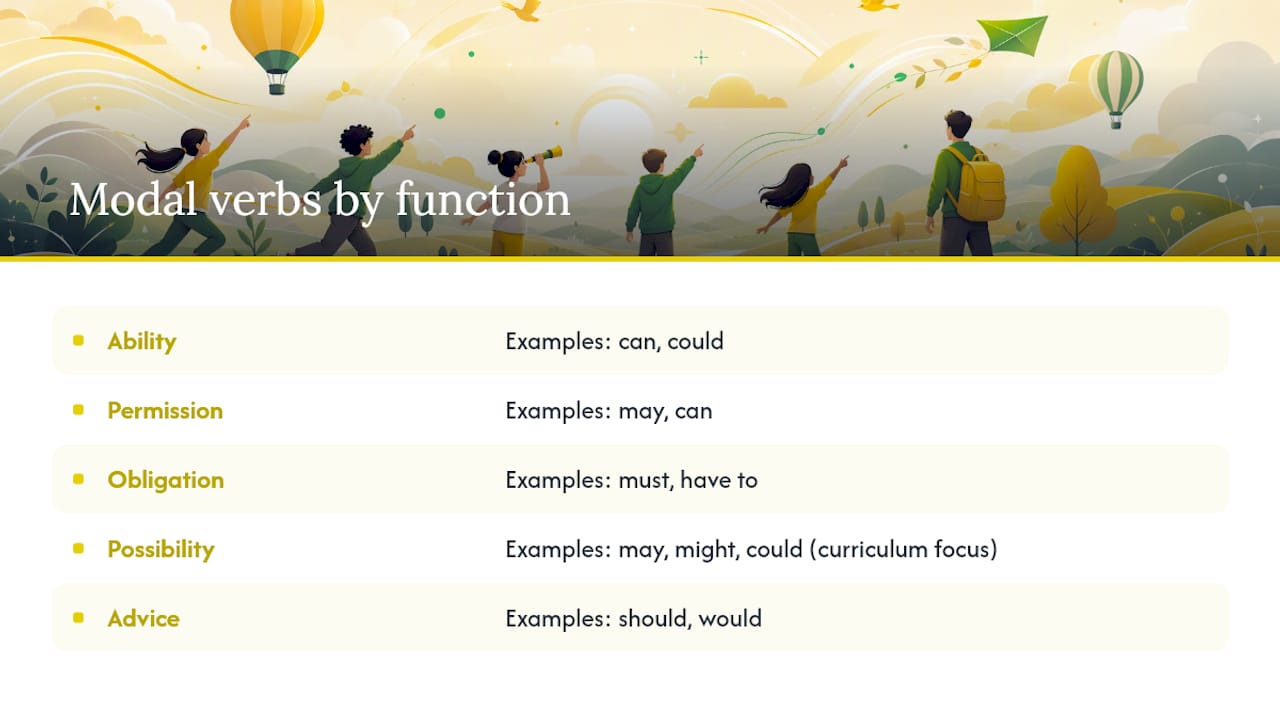
- Ability: can, could
- Permission: may, can
- Obligation: must, have to, should
- Possibility/certainty: might, may, will
Pro Tip: Introduce modals in these four function groups from day one, rather than as one long alphabetical list. Grouping by meaning helps pupils feel the difference between "must" and "should" instead of just memorizing words.
Key Takeaways
Modal verbs change the meaning or certainty of a main verb, and Year 5 pupils learn to use them to express degrees of possibility as set out in the National Curriculum.
| Point | Details |
|---|---|
| Definition first | A modal verb is an auxiliary verb that modifies a main verb's meaning, never acts alone. |
| Focus on ten core modals | Can, could, may, might, must, shall, should, will, would, and have to cover most Year 5 needs. |
| Teach by function | Group modals into ability, permission, obligation, possibility/certainty, and advice for faster understanding. |
| Watch common errors | Dropped base verbs and misplaced "not" are the two most frequent pupil mistakes. |
| Practice little and often | Short, game-based tasks with immediate feedback beat single long worksheets for retention. |
| Extend practice at home | Thepocketmoneygame offers curriculum-aligned, reward-based grammar practice sessions for Year 5 pupils. |
Table of Contents
- What Is a Modal Verb in KS2 English?
- Which Modal Verbs Do Year 5 Pupils Need to Know?
- What Do Modal Verbs Actually Show?
- What Mistakes Do Pupils Make With Modal Verbs?
- How Does the National Curriculum Test Modal Verbs?
- Classroom and At-Home Activities for Modal Verbs
- Quick KS2 Modal Verbs Practice Quiz
- Turn Classroom Learning Into Daily Practice at Home
- Frequently Asked Questions
- Sources
What Is a Modal Verb in KS2 English?
A modal verb is a type of auxiliary, or "helping," verb that changes the meaning of the main verb sitting next to it. Grammarly's breakdown of modal verbs confirms this group includes can, could, may, might, must, shall, should, will, would, and "ought to," and every one of them works the same way: it borrows meaning from a main verb rather than acting alone.
That's the part pupils often miss, and it's worth saying plainly on a classroom slide.
- Modal verbs never change form for different people (no "he cans," no "she musts").
- They always pair with the base form of a main verb ("might go," not "might going").
- Negatives form with "not" straight after the modal ("cannot," "should not").
- Questions flip the modal to the front of the sentence ("Should we go?").
Compare "I go to school" with "I must go to school." Same action, completely different weight. According to BBC Bitesize's guide to modal verbs, that shift in tone, rather than the action itself, is exactly what modal verbs exist to do.
Which Modal Verbs Do Year 5 Pupils Need to Know?
Ten modal verbs cover almost everything a Year 5 pupil will meet in reading or writing. Here's the core list with one plain example each:
- Can – She can swim.
- Could – He could run fast when he was younger.
- May – You may leave the table.
- Might – It might rain later.
- Must – Students must wear their uniform.
- Shall – Shall we begin?
- Should – You should check your spelling.
- Will – I will finish my homework tonight.
- Would – Would you like some water?
- Have to – We have to line up quietly.
Negatives matter just as much as the positives. Watch for contractions like can't, won't, shouldn't, and mustn't, since pupils often spell or use them incorrectly. If you're short on lesson time, focus first on can/can't, must/mustn't, and should/shouldn't. Those three pairs cover the widest range of everyday sentences and build the foundation for the rest of the list of modal verbs pupils will encounter in Year 5 and Year 6.
What Do Modal Verbs Actually Show?
Every modal verb signals one of five things: ability, permission, obligation, possibility or certainty, or advice. Oak National Academy's unit on modal verbs recommends teaching these functions side by side so pupils notice the contrast, not just the vocabulary.
- Ability: "She can play the piano." (skill or capability)
- Permission: "May I go outside?" (asking or granting)
- Obligation: "You must finish your work." (strong, non-negotiable)
- Possibility/certainty: "It might snow tomorrow." vs. "It will snow tomorrow." (uncertain vs. confident)
- Advice: "You should revise before the test." (a recommendation, not a rule)
The gap between must and should trips pupils up constantly. "You must wear a seatbelt" is a rule with no wiggle room; "You should wear a coat" is friendly advice they could ignore. That intensity difference, backed by Oak National Academy's function-based approach, is often the single biggest "aha" moment in a modal verbs lesson.
Pro Tip: Run a 5-minute sorting game: write ten modal sentences on cards and have pairs sort them into the five function columns on the whiteboard. Fast, visual, and it exposes misunderstandings immediately.
What Mistakes Do Pupils Make With Modal Verbs?
Four errors show up again and again in KS2 writing, and each one has a quick fix you can say out loud during marking.
- Mixing up "have to" and "must": Both signal obligation, but pupils sometimes use them as if they're interchangeable with "should." Say: "Have to and must are strong, like a rule. Should is a suggestion."
- Overusing "can" for permission: "Can I go?" is common speech, but formal writing prefers "may." Say: "Can is about ability. May is about permission. Which one do you mean?"
- Dropping the base verb: "She might swimming" instead of "She might swim." Say: "After a modal verb, use the plain form, no -ing, no -s."
- Misplacing "not": Writing "must go not" instead of "must not go." Say: "Not sits right after the modal, every time."
Pro Tip: Use real classroom rules to teach obligation versus advice. "You must line up quietly" (a rule) next to "You should bring a water bottle" (advice) makes the abstract concept concrete fast.
How Does the National Curriculum Test Modal Verbs?
The National Curriculum for England sets a clear Year 5 expectation: pupils should use modal verbs to indicate degrees of possibility. That single line shapes how modal verbs turn up in SPaG-style assessments.
Typical assessment items ask pupils to spot the modal verb in a sentence or to insert the modal that best changes a sentence's meaning or tone, a format echoed in Teachit's primary modal verb resources.
- "Underline the modal verb: 'We might visit the museum on Friday.'"
- "Rewrite this sentence to show certainty instead of possibility: 'It could rain tomorrow.'"
Both tasks take under two minutes and work well as a lesson starter or exit ticket.
Classroom and At-Home Activities for Modal Verbs
Short, active tasks beat worksheets alone for making modal verbs stick, and BBC Bitesize's classroom suggestions lean heavily on game-based practice for exactly that reason. Here are six you can run this week:
- Charades: Act out a sentence using a modal verb (e.g., "I must tidy my room") and have classmates guess the full sentence. Five minutes, whole class.
- Dice sentence-maker: Number six modal verbs one to six, roll a die, and build a sentence around whatever comes up. Ten minutes in pairs.
- Role-play dialogues: Pupils write and perform a short exchange using at least three different modals ("May I...", "You should...", "I will..."). Fifteen minutes.
- Modal-verb storytelling chain: Each pupil adds one sentence to a group story, and every sentence must include a modal verb. Ten minutes.
- Modal-verb debate: Split the class and argue for or against a classroom rule using obligation and advice modals. Fifteen minutes.
- Quick SPaG challenge: A timed sheet of five sentences where pupils insert the correct modal. Five minutes.
Differentiate by adjusting sentence complexity: lower-ability pupils work with single-clause sentences and a word bank, middle-ability pupils build compound sentences, and higher-ability pupils compare two modals in one sentence for tone. For pupils with ADHD or dyslexia, keep tasks short, add voice support where possible, and use small, immediate rewards to sustain focus, an approach Twinkl's teaching resources also point to through printable word mats that reduce working-memory load.
A laminated word mat listing all ten modal verbs by function makes a simple, reusable classroom display or take-home worksheet.
Pro Tip: Pair every practice activity with immediate feedback. Waiting until the next day to correct a modal verb error means the pupil has already half-forgotten why they chose it.
Quick KS2 Modal Verbs Practice Quiz
Try these with your class or at home, then check answers below.
- Identify the modal verb: "You should check your work before handing it in."
- Choose the correct modal: "It ___ rain later." (might/must)
- Rewrite for certainty: "She could win the race."
- Fix the error: "He must to finish his homework."
- Identify the function: "May I borrow your pencil?"
Answers: 1) should. 2) might (possibility, not certainty). 3) "She will win the race." 4) "He must finish his homework" (no "to" after must). 5) Permission.
Turn this into a quick board game by writing each question on a card and having pupils draw one per turn, answering aloud before moving their piece.
A Small Change That Made a Big Difference
One parent noticed her daughter kept confusing "must" and "should" in homework. Switching to real household rules ("You must brush your teeth" vs. "You should tidy your room") made the distinction click within a week.

Turn Classroom Learning Into Daily Practice at Home
Grammar concepts like modal verbs need repetition to stick, and that's exactly where short, rewarding practice sessions outperform a single weekly worksheet. Ten focused minutes a day, with instant feedback on every answer, does more for retention than one long homework block on a Sunday night.
Look for practice that keeps items short, confirms right or wrong answers immediately, and lets parents control both difficulty and rewards, since that combination matters most for children who lose focus quickly or need extra encouragement to keep going. Thepocketmoneygame's platform maps directly to the primary National Curriculum, so grammar practice at home reinforces exactly what's being taught in the Year 5 classroom rather than pulling in a different direction. The reward system pays real pocket money for correct answers, which gives reluctant grammar learners a reason to actually finish the session instead of abandoning it halfway through. If your child struggles to sit still for traditional homework, the ADHD and dyslexia-friendly design with voice support is worth a look too. Start a free trial today and see how modal verb practice fits into a few minutes each evening.
Frequently Asked Questions
What is a modal verb in simple terms for KS2? A modal verb is a helper word like can, must, or might that sits before a main verb and changes how certain, forceful, or possible that action sounds.
What are the 9 or 10 modal verbs taught at KS2? Can, could, may, might, must, shall, should, will, would, and have to make up the standard KS2 list.
How do you teach modal verbs to Year 5 pupils? Group them by function (ability, permission, obligation, possibility, advice) rather than alphabetically, then use short games like dice sentence-makers or charades to build fluency.
What's the difference between "must" and "should"? "Must" signals a strong, non-negotiable obligation, while "should" offers advice the listener could reasonably ignore.
Are modal verbs part of the National Curriculum? Yes. The National Curriculum specifically requires Year 5 pupils to use modal verbs to show degrees of possibility.
Sources
- National Curriculum in England: English programmes of study
- Using modal verbs | Oak National Academy
- What is a Modal Verb? | Twinkl teaching wiki