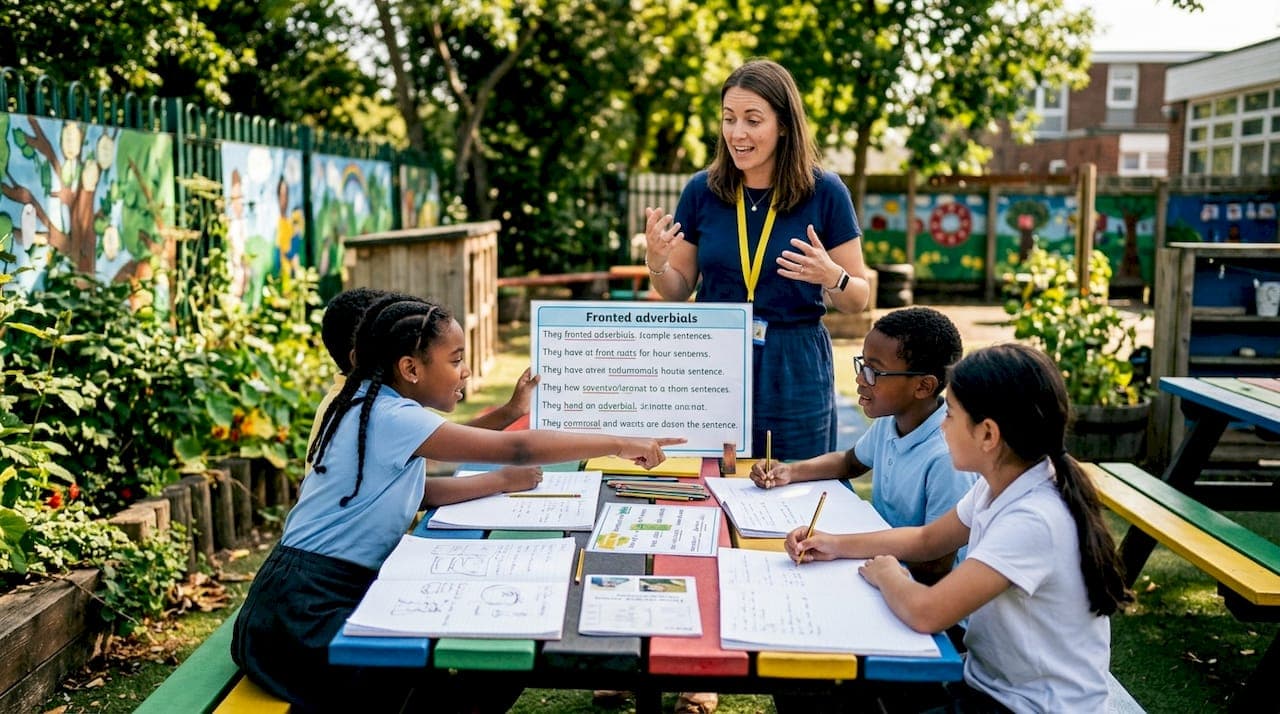
A fronted adverbial is an adverbial word or phrase moved to the start of a sentence, and it must be followed by a comma. That comma rule is the single most important thing KS2 children need to remember. Fronted adverbials are introduced in Year 4 and expected to be used confidently by Year 6, when they appear on the SATs Grammar, Punctuation and Spelling (GPS) paper.
Here is the concept in one quick before/after:
- Before: The dog ran across the field.
- After (fronted adverbial): Across the field, the dog ran.
The adverbial phrase "Across the field" has moved to the front. The comma follows it. Simple.
Table of Contents
- What exactly is a fronted adverbial in KS2?
- The four types of fronted adverbials with KS2 examples
- How to teach fronted adverbials in a KS2 classroom
- Ready-to-use practice tasks with model answers
- Where fronted adverbials sit in the KS2 curriculum
- Common mistakes children make and how to fix them
- Why fronted adverbials genuinely improve children's writing
- Key Takeaways
- The thing most teachers and parents get wrong about fronted adverbials
What exactly is a fronted adverbial in KS2?
An adverbial is any word, phrase, or clause that tells us when, where, how, or how often something happens. Normally, it sits after the verb. A fronted adverbial is simply that same adverbial shifted to the beginning of the sentence, before the verb, to add variety and effect.
According to the Cambridge Dictionary, a fronted adverbial is "a word or phrase that is put at the start of a sentence and that operates as an adverb in that sentence." The example they give: "Later today, there will be a meeting" — where "later today" is the fronted adverbial.
Three forms it can take:
- Single word: — Suddenly, the lights went out.
Oak National Academy lessons emphasize this single-word → phrase → clause progression, and it is a useful teaching ladder.
The comma rule: A comma follows the fronted adverbial before the main clause begins. This applies even to short single-word openers like "Slowly, he turned around." The comma signals where the opener ends and the main sentence starts.
Distinguishing fronted adverbials from subordinate clauses: A subordinate clause contains its own verb ("When the storm arrived, we stayed inside"). A fronted adverbial phrase does not ("In the storm, we stayed inside"). Teach children to ask: "Does my opener have a verb in it?" If yes, it is a clause. If no, it is a phrase. Both count as fronted adverbials when placed at the front, but knowing the difference helps children write with more control.

The four types of fronted adverbials with KS2 examples
Four main types are taught in KS2. Each answers a different question about the verb.
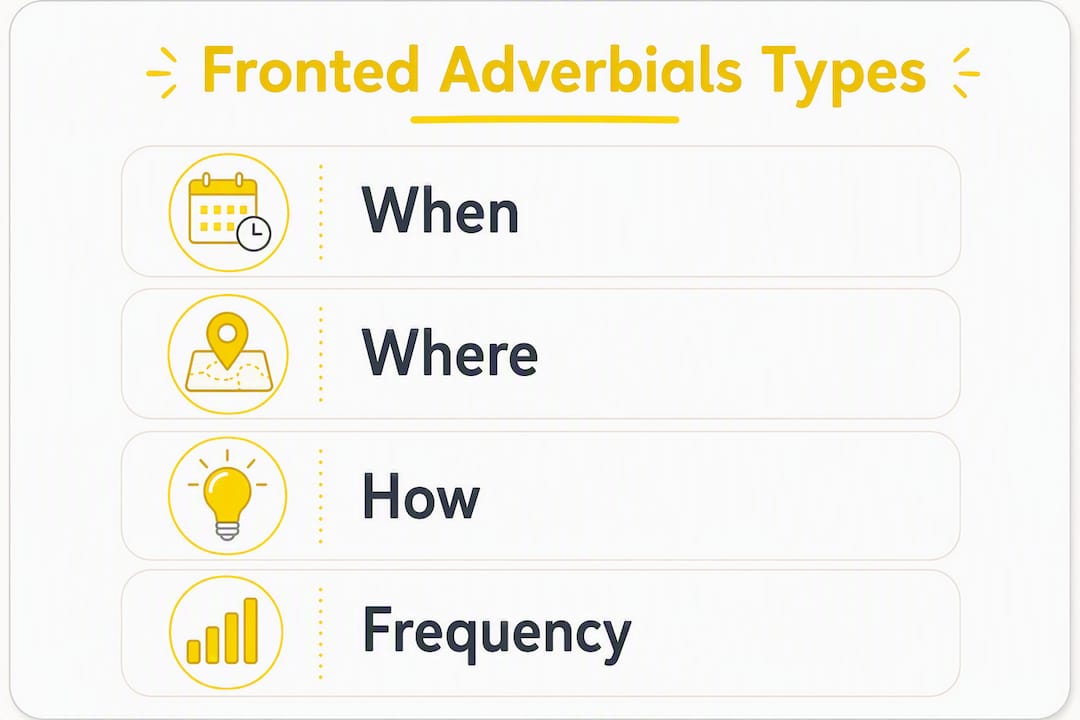
| Type | Prompt question | Example starters |
|---|---|---|
| Time | When? | Later that day, / As the sun set, / At midnight, |
| Place | Where? | Across the field, / Deep in the forest, / At the top of the hill, |
| Manner | How? | With great care, / As quietly as a mouse, / Slowly and carefully, |
| Frequency | How often? | Every morning, / Once a week, / Again and again, |
Time examples (when?):
- Simple: Soon, the lesson began.
- Intermediate: Later that afternoon, the class went outside.
- Complex: As the last bell of the day rang, the children cheered.
Place examples (where?):
- Simple: Outside, it was raining.
- Intermediate: Deep in the forest, a fox was sleeping.
- Complex: At the very top of the crumbling tower, a light flickered.
Manner examples (how?):
- Simple: Carefully, she opened the box.
- Intermediate: With shaking hands, he reached for the door.
- Complex: As silently as she could manage, she crept down the stairs.
Frequency examples (how often?):
- Simple: Daily, they practised their spellings.
- Intermediate: Every single morning, he fed the birds.
- Complex: Time after time, she tried to solve the puzzle.
Quick conversion activity: Give children plain sentences and ask them to move the adverbial to the front. "The cat slept in the sun all afternoon" becomes "All afternoon, the cat slept in the sun." This single task builds recognition and production at the same time.
How to teach fronted adverbials in a KS2 classroom
A 15-minute mini-lesson
Learning objective: Children can identify and write a fronted adverbial with a comma.
- Starter (2 min): Write three sentences on the board. Ask: "Which word or phrase tells us when, where, or how?" Circle it together.
- Modelling (4 min): Take one circled phrase and move it to the front. Say aloud: "I'm going to put this at the start. Now I need a comma — because my opener has finished and my main sentence is about to begin." Write it, pause dramatically at the comma.
- Guided practice (4 min): Give pairs two sentences to transform. They write the fronted version on mini whiteboards and hold them up.
- Independent task (3 min): Children write two original sentences using a fronted adverbial of their choice (time or place to start).
- Plenary (2 min): One child reads their sentence aloud. Class listens for the natural pause. Ask: "Where does the comma go?"
Warm-ups that actually work
Read-aloud pause drill: Read a sentence with a fronted adverbial aloud and ask children to clap when they hear the natural pause. That clap marks the comma. This audible cue is one of the most reliable ways to drill punctuation without worksheets.
Sentence surgery: Write a sentence on the board with the adverbial at the end. Children physically come up and "cut" the phrase out (using scissors on a printed strip) and tape it to the front. Kinesthetic, memorable, and fast.

Oral starters: Call out a type ("Give me a place opener!") and children respond with a phrase. Build a class bank on the board.
Differentiation
Lower-attaining pupils benefit from a word mat with ready-made sentence starters. Using a word bank reduces blank-page anxiety and lets children focus on placement and punctuation rather than vocabulary retrieval. Offer sentence frames: "________, the character ________."
For more able writers, push beyond the phrase. Ask them to write a fronted clause and then explain what effect it creates. Why did they choose that opener? Does it build tension or slow the pace?
Pro Tip: Scanning a class novel or guided reading text for fronted adverbials takes five minutes and shows children how real authors use them. Highlight them together, then discuss the effect. This links grammar to reading and makes the term feel purposeful, not just testable.
Ready-to-use practice tasks with model answers
1. Identify task (5 minutes)
Underline the fronted adverbial in each sentence and add the missing comma where needed.
- Deep in the cave the explorers found gold. → Deep in the cave, the explorers found gold.
- Every evening she read to her little brother. → Every evening, she read to her little brother.
- With a loud crash the vase fell to the floor. → With a loud crash, the vase fell to the floor.
2. Transform task (10 minutes)
Rewrite each sentence so it begins with a fronted adverbial.
- The children laughed loudly in the playground. → In the playground, the children laughed loudly.
- She finished her homework before dinner. → Before dinner, she finished her homework.
- He walked slowly through the snow. → Slowly, he walked through the snow.
3. Extend task (15 minutes, SATs-style)
Write a short paragraph (4–6 sentences) describing a character arriving somewhere. Use at least two different types of fronted adverbial and vary your openers.
Model answer: As the sun dipped below the hills, Maya reached the old gate. With trembling fingers, she pushed it open. Inside, the garden was silent. Every few seconds, a leaf fell from the oak tree above her.
Home practice ideas for parents (no prep needed)
- Spot-the-adverbial: While reading a bedtime story, pause and ask your child, "Does that sentence start with a when, where, or how word?"
- Sentence-addition game: You say a plain sentence; your child adds a fronted adverbial to the front. Take turns.
- Timed challenge: Set a two-minute timer. How many fronted adverbials can your child write? Count them together.
Marking quickly: Look for three things: (1) the opener answers when/where/how/how often, (2) a comma follows it, (3) the main clause makes sense after it. Peer review works well here — children spot missing commas in each other's work faster than in their own.
Where fronted adverbials sit in the KS2 curriculum
Fronted adverbials are introduced in Year 4 as part of the UK National Curriculum English programme of study. By Year 6, pupils are expected to use them confidently and purposefully, and they appear directly on the SATs GPS paper.
| Year | Expected outcome |
|---|---|
| Year 4 | Introduced; can identify and write a fronted adverbial with a comma |
| Year 5 | Uses a range of types (time, place, manner, frequency) in independent writing |
| Year 6 | Varies openers purposefully for effect; punctuates correctly; ready for SATs GPS |
Marking rubric (3-point scale):
- 1 point: Attempts a fronted adverbial but comma is missing or the opener is irrelevant to the sentence.
- 2 points: Correct type, correct punctuation, used in context.
- 3 points: Varied use across a piece with purposeful effect — builds mood, tension, or clarity.
SATs-style prompt: "Rewrite this sentence so it begins with a fronted adverbial: 'The knight rode bravely into the battle.'"
Model answer: Bravely, the knight rode into the battle. or Into the battle, the knight rode bravely.
BBC Bitesize provides short interactive examples that closely mirror how exam-style questions present fronted adverbials — worth bookmarking for Year 6 revision.
Common mistakes children make and how to fix them
Children make the same errors repeatedly. Knowing them in advance saves a lot of marking time.
- Forgetting the comma. "In the morning the birds sang." Fix it by reading aloud and clapping at the pause. The clap = the comma. Drill this orally before asking for written work.
- Confusing fronted adverbials with subordinate clauses. Both can start a sentence, but a subordinate clause has its own verb. Teach the verb test: "Does your opener have a verb? Yes → it's a clause. No → it's a phrase." Both are valid fronted adverbials, but children need to know the difference for GPS questions.
- Overusing the same opener. "Suddenly" appears in every sentence. Show children the four-type table and challenge them to use a different type each paragraph.
- Thinking only long phrases count. Children sometimes write "In the dark and stormy night with thunder crashing," believing longer is better. A single word like "Suddenly," works perfectly. Quality and variety beat length.
Fix-it mini-lesson (5 minutes): Write three "broken" sentences on the board — one missing a comma, one with the adverbial at the end, one with a repeated opener. Children correct them in pairs, then share. Fast, focused, and effective.
Pro Tip: The verb test is the clearest way to help children distinguish a fronted adverbial phrase from a subordinate clause. Write "When the bell rang" and "In the morning" side by side. Ask: "Which one has a verb?" Once children can answer that reliably, they understand the structure, not just the label.
Why fronted adverbials genuinely improve children's writing
Teachit's editorial guidance links fronted adverbials directly to sentence sophistication — they allow children to vary structure, build atmosphere, and improve narrative flow. That is not just exam-speak. It is something you can see on the page.
Compare these two short extracts:
Without fronted adverbials: The wolf crept through the forest. It was dark. The wolf stopped. It heard a sound.
With fronted adverbials: Deep in the forest, the wolf crept forward. In the darkness, it stopped. Without warning, a sound broke the silence.
The second version slows the reader down, builds tension, and feels like a story. The grammar is doing real work. That shift from flat sentences to atmospheric prose is exactly what KS2 teachers are trying to unlock, and fronted adverbials are one of the most teachable tools for getting there.
For narrative writing, use them to build suspense or slow the pace. For informational writing, time and frequency openers ("Each year, / In recent decades,") add structure and signal sequence. Teach children to choose their opener type based on the effect they want, not just to tick a grammar box.
Key Takeaways
Fronted adverbials are introduced in Year 4, assessed in Year 6 SATs, and require a comma after the opener every time.
| Point | Details |
|---|---|
| Core definition | An adverbial moved to the start of a sentence, always followed by a comma. |
| Four types to teach | Time, Place, Manner, and Frequency — each answers a different question about the verb. |
| 15-minute lesson structure | Starter, modelling, guided practice, independent task, plenary — fits any literacy slot. |
| SATs readiness check | Use the 3-point rubric: attempt (1), correct with punctuation (2), varied for effect (3). |
| Fastest home practice | Read-aloud pause drill and sentence-addition game require zero preparation. |
The thing most teachers and parents get wrong about fronted adverbials
Here is what I see happen most often: children learn the label, write "Suddenly," at the start of every sentence, and teachers mark it correct. Technically, it is. But the goal was never just to tick a grammar box.
The real value of teaching fronted adverbials is giving children a tool for effect. When a child understands that "In the dead of night," slows a reader down and "Instantly," speeds them up, they are making authorial choices. That is the shift from grammar exercise to genuine writing skill.
My practical advice: spend one lesson on identification, one on transformation, and then fold fronted adverbials into every piece of independent writing for a half term. Do not treat it as a standalone unit. The children who use them well by Year 6 are the ones who have been nudged to try a different opener every week, not the ones who completed a worksheet once in Year 4.
For parents, the sentence-addition game at home is genuinely worth five minutes a week. You say a sentence; your child adds a fronted adverbial. No books, no prep, no stress. If your child is finding the comma tricky, try Thepocketmoneygame's educational games that motivate kids to learn — short, rewarding practice sessions that build the kind of habit that sticks. For KS2 vocabulary building that feeds richer fronted adverbials, that resource is worth a look too.
Grammar does not have to feel like a chore. Give children the words, show them the effect, and let them play with it.