
An expanded noun phrase is a noun plus one or more modifiers that add detail before or after it. According to BBC Bitesize, these phrases commonly include a determiner, one or more adjectives, and the noun itself, and they may extend further with a prepositional phrase or relative clause. Here is a quick labelled example:
The [determiner] enormous, crumbling [adjectives] castle [noun] on the hill [post-modifier]
The National Curriculum in England places noun-phrase work across all primary years, with expanded noun phrases appearing explicitly in KS2 expectations and in SATs Grammar, Punctuation and Spelling (GPS) papers from Year 3 onward. If your child or class is anywhere in Years 3–6, this is a term they will meet regularly.
At a glance:
- An expanded noun phrase adds detail to a noun using pre-modifiers (before) and/or post-modifiers (after).
- It contains no finite verb. Add a verb and it becomes a clause, not a phrase.
- It appears in KS2 SATs GPS papers in both identification and cloze formats.
Key Takeaways
Teaching expanded noun phrases well means connecting the grammar label to real writing habits across all four KS2 years, not just drilling identification for SATs.
| Point | Details |
|---|---|
| Core definition | A noun plus pre- and/or post-modifiers, with no finite verb present. |
| Year-by-year focus | Move from simple adjectives (Year 3) to combined pre- and post-modification (Year 5–6). |
| Most common pupil error | Adding a verb to the phrase, which turns it into a clause, not a phrase. |
| Key classroom strategy | Use the verb test on mini whiteboards for a fast, whole-class formative check. |
| Thepocketmoneygame | Supports home vocabulary and spelling practice with adaptive, curriculum-aligned activities and a real-reward motivation model. |
Table of Contents
- How are expanded noun phrases built in KS2?
- Expanded noun phrase examples KS2 teachers can use in class
- What does KS2 progression look like year by year?
- Practical activities and resources for teaching noun phrases
- Teaching tips, common mistakes, and how to support all learners
- A ready-to-teach 20-minute lesson plan
- The part of teaching expanded noun phrases that most guides miss
- Thepocketmoneygame makes home practice feel like a reward, not a chore
- Sources
How are expanded noun phrases built in KS2?
Resourcefully explains that modifiers fall into two categories: pre-modification and post-modification. Understanding the difference is the foundation of teaching this skill accurately.
Pre-modification places words before the noun: determiners (a, the, some), adjectives (tall, ancient, glittering), and numbers (three, first). These are the building blocks most pupils meet first.
Post-modification places words after the noun: prepositional phrases (on the windowsill, beneath the dark water) or relative clauses (who had never smiled, that nobody dared open). This is where writing starts to sound genuinely sophisticated.
| Type | What it adds | Pupil-friendly example |
|---|---|---|
| Pre-modification | Determiners, adjectives, numbers before the noun | the three rusty keys |
| Post-modification | Prepositional phrase or relative clause after the noun | the keys on the old wooden table |
| Combined | Both pre- and post-modification together | the three rusty keys on the old wooden table |
A critical technical point: an expanded noun phrase contains no finite verb. The moment you add one, the structure becomes a clause. This distinction is explicitly tested in KS2 SATs GPS papers and trips up many pupils.
Pro Tip: Ask pupils to apply the "verb test." Say: "Can you find a doing or being word in this group of words?" If yes, it is a clause. If no, it is a phrase. Thirty seconds, no worksheet needed.
Expanded noun phrase examples KS2 teachers can use in class
Clear, labelled examples are the fastest way to build pupil understanding. Read these aloud or display them on the board.
- A dog → the scruffy, brown dog [determiner + adjective + adjective + noun: simple pre-modification]
- The house → the old house at the end of the lane [determiner + adjective + noun + prepositional phrase]
- A girl → the quiet girl with the silver backpack who never spoke [determiner + adjective + noun + prepositional phrase + relative clause]
- Rain → the cold, relentless rain that hammered the windows all night [determiner + adjectives + noun + relative clause]
- A box → a small, battered wooden box hidden beneath the floorboards [determiner + adjectives + noun + post-modifier]
Notice the comma between cold and relentless in the fourth example. When two coordinate adjectives both describe the noun independently, a comma separates them. A quick test: if you can swap the adjectives or insert "and" between them without losing meaning, use the comma.
Mini activity (5 minutes): Write a bare noun on the board: the door. Ask pupils to expand it in three rounds. Round 1: add one adjective. Round 2: add two adjectives. Round 3: add a post-modifier. Share and compare. This works as a starter or a quick-fire plenary.

What does KS2 progression look like year by year?
The National Curriculum builds noun-phrase skills progressively across KS2. Here is how that maps to classroom expectations:
- Year 3: Pupils use simple pre-modification confidently. Focus on determiners and one or two adjectives. Goal: write the tall, dark tree without prompting.
- Year 4: Pupils choose adjectives purposefully and begin adding simple post-modifiers (prepositional phrases). Goal: write the tall, dark tree beside the river and explain why each word earns its place.
- Year 5: Pupils combine pre- and post-modification, including relative clauses. Resourcefully notes this is the developmental shift that separates competent description from genuinely fluent writing. Goal: write the tall, dark tree beside the river that nobody dared climb.
- Year 6: Pupils judge concision. Year 6 teaching guidance emphasizes that pupils should select only necessary information and avoid over-expansion. SATs GPS papers test identification and purposeful use. Goal: edit an over-expanded phrase down to its most precise form.
| Year | Expected skills | Assessment cue |
|---|---|---|
| Year 3 | Pre-modification with determiner + 1–2 adjectives | Can pupils write a phrase with no verb? |
| Year 4 | Adjective choice + simple prepositional post-modifier | Do adjectives add meaning, not just length? |
| Year 5 | Combined pre- and post-modification, relative clauses | Can pupils identify the noun head in a complex phrase? |
| Year 6 | Concise, purposeful expansion; GPS identification tasks | Can pupils cut unnecessary modifiers from a given phrase? |
The 2025 KS2 GPS Paper 1 includes both multiple-choice identification and cloze-style questions on expanded noun phrases, so Year 6 pupils benefit from practicing both formats.
Practical activities and resources for teaching noun phrases
These activities move from whole-class to independent practice and take between 5 and 20 minutes each.
- Noun phrase auction (10 minutes): Display six expanded noun phrases, some over-stuffed, some precise. Pupils "bid" on the best one and justify their choice. Drives purposeful adjective discussion without a worksheet.
- Expand and contract (15 minutes): Give pupils a complex phrase and ask them to strip it to its bare noun, then rebuild it differently. Works well as a paired task.
- Spot it in a text (10 minutes): Use a short passage from a class novel. Pupils underline every expanded noun phrase and label the noun head. Connects grammar to real reading, which is exactly what KS2 reading comprehension guidance recommends.
- Sentence upgrade (5 minutes, starter): Project a dull sentence: A man walked into a room. Pupils rewrite it using one expanded noun phrase. Share three versions aloud.
- Post-modifier challenge (20 minutes, independent): Pupils write a short descriptive paragraph using at least two post-modifiers. Self-assess against a checklist: noun head identified, no verb in the phrase, post-modifier adds new information.
Printable worksheet types to look for:
- Identification worksheets (circle the expanded noun phrase)
- Expansion tasks (add modifiers to a bare noun)
- Editing tasks (cut unnecessary modifiers for concision)
- Sorting cards (pre-modification vs post-modification)
Key UK resources:
- BBC Bitesize offers a clear pupil-facing definition with interactive examples, ideal for home learning or a classroom display.
- Twinkl provides progressive activities and word banks, and recommends starting with simple adjective expansion before introducing post-modification.
- Englicious includes an interactive noun phrase generator that works well as a lesson starter or guided exploration task.
- Teachwire collects classroom-tested activity ideas from primary practitioners.
Differentiation:
- Higher attainers: Challenge them to use a relative clause post-modifier and then justify every word. Ask: "What would be lost if you removed this modifier?"
- Pupils needing support: Provide a sentence frame (The ___ [adjective] ___ [noun] ___ [prepositional phrase]) and a word bank. Reduce the number of modifiers required before building up.
- Neurodiverse learners: Color-code the components (yellow for determiner, green for adjective, blue for noun, orange for post-modifier). Visual chunking reduces working memory load significantly.
Teaching tips, common mistakes, and how to support all learners
The single most common error pupils make is adding a verb and calling the result an expanded noun phrase. The dog that was barking is a noun phrase with a relative clause, but the dog barked is a clause. Pupils conflate the two constantly. A short script that helps: "Does this group of words have a main verb doing the action? Then it is a clause, not a phrase."
A second common pitfall is adjective stacking: the big, tall, dark, scary, old, crumbling castle. Resourcefully notes that moving from adjective stacking to purposeful post-modification is a key developmental step. Teach pupils to ask: "Does each word earn its place?" If two adjectives say roughly the same thing, cut one.
Practical tips for the classroom:
- Use published authors as models. Find an expanded noun phrase in a class text and ask: "Why did the author choose this modifier and not another?"
- Teach the comma rule for coordinate adjectives early. It comes up in GPS papers and pupils who understand it write more confidently.
- Build vocabulary before expecting expansion. Pupils cannot choose precise adjectives from a thin word bank.
- For pupils with dyslexia or ADHD, audio prompts and sentence frames reduce anxiety around the writing task itself, letting them focus on the grammar.
Pro Tip: For a quick 5-minute formative check, ask pupils to write one expanded noun phrase on a mini whiteboard. Scan the room: no verb = phrase (correct); verb present = clause (needs reteaching). You get whole-class data in under a minute.
Year 6 guidance makes a point worth emphasizing: not every sentence needs an expanded noun phrase. Teaching when not to expand is as important as teaching how to expand. Variety in sentence structure is what makes writing cohesive, and over-expansion can make prose cumbersome.
A ready-to-teach 20-minute lesson plan
Learning objective: Pupils can write an expanded noun phrase using both pre- and post-modification.
Success criteria (pupil-facing):
- I can identify the noun head in a phrase.
- I can add at least one adjective before the noun.
- I can add a prepositional phrase or relative clause after the noun.
- I can check that my phrase contains no main verb.
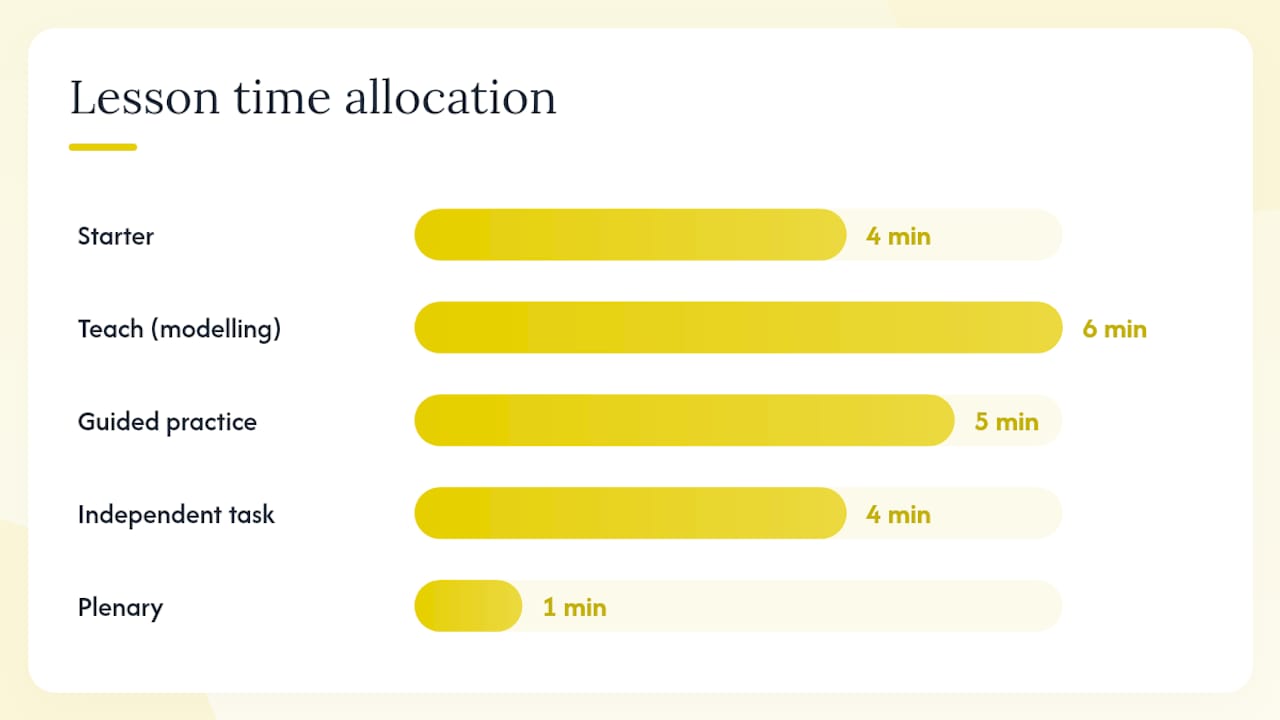
- Starter (4 minutes): Display a cat. Ask pupils to expand it in 60 seconds on mini whiteboards. Share three examples. Identify which have a post-modifier.
- Teach (6 minutes): Model building a cat → the sleek, black cat → the sleek, black cat with amber eyes that glowed in the dark. Label each component aloud. Apply the verb test to confirm it is still a phrase.
- Guided practice (5 minutes): Give pairs a bare noun (the storm, a letter, the garden). They build an expanded version together using a color-coded sentence frame.
- Independent task (4 minutes): Each pupil writes two expanded noun phrases independently, then circles the noun head and underlines the post-modifier.
- Plenary (1 minute): One pupil reads their phrase. Class votes: phrase or clause? Correct together if needed.
Assessment: Collect the independent task as a formative record. Look for: noun head present, at least one pre-modifier, at least one post-modifier, no finite verb.
The part of teaching expanded noun phrases that most guides miss
Here is something worth saying plainly: the grammar label matters far less than the writing habit. Pupils who can recite the definition of an expanded noun phrase but never use one in free writing have learned a test skill, not a writing skill. The goal is transfer.
The most effective teachers treat expanded noun phrases as a reading skill first. When pupils spot them in a novel, a newspaper headline, or a picture book caption, they internalize the structure through exposure before they are asked to produce it. That sequence, notice then imitate then adapt, is what actually moves writing forward. Worksheets that ask pupils to identify phrases in isolation are useful for GPS preparation, but they are not sufficient on their own.
There is also a tendency to front-load this teaching in Year 3 and then assume it is "done." The Resourcefully insight that post-modification separates good description from fluent description is a reminder that this skill has a ceiling most KS2 pupils have not reached yet. Year 5 and Year 6 pupils still need deliberate practice, just at a higher level of precision and concision.
Thepocketmoneygame makes home practice feel like a reward, not a chore
If you want your child to keep practicing literacy skills between lessons, Thepocketmoneygame offers educational games that actually motivate kids to engage. Children aged 5–11 earn real pocket money for correct answers, which turns spelling and reading practice into something they ask to do rather than avoid.
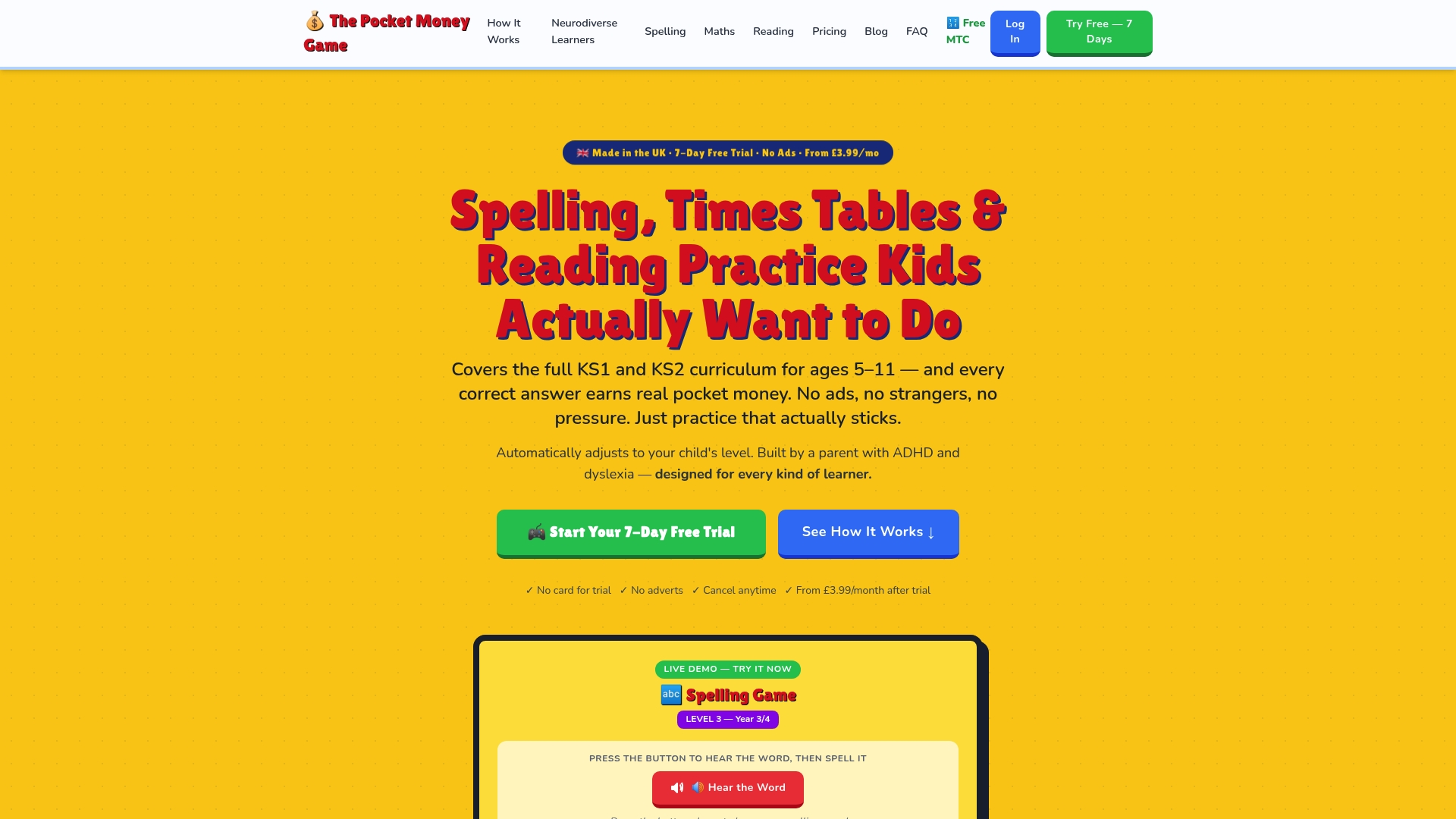
- Adaptive practice: the platform adjusts difficulty to your child's level, so they are always working at the right stretch.
- Parent control: you set the reward amount and daily question cap, keeping everything age-appropriate and budget-friendly.
- KS1/KS2-aligned content: spelling, reading, and vocabulary activities map to the UK curriculum, supporting the descriptive vocabulary children need for noun-phrase work.
Start a free 7-day trial at Thepocketmoneygame and see whether it fits your family's routine.
Sources
- Expanded Noun Phrases Explained | Resourcefully
- Gov
- What is an expanded noun phrase? - KS2 English - BBC Bitesize
- Year 6 – Autumn Block 1 – Ready to Write – Expanded Noun Phrases (PPT) — St Nicholas New Romney
- Assets