
Year 2 common exception words are the 64 statutory "tricky" words that children in England must be able to read and spell by the end of Year 2, as set out in the Department for Education's English Appendix 1. These words appear constantly in reading and writing, yet they don't follow standard phonics rules, so children can't simply sound them out. They need to be learned by sight through repeated, varied practice.
Your three immediate next steps:
- Download or copy the full list below and keep it somewhere visible at home or in the classroom.
- Make a desk word mat or fridge chart so your child sees the words every day, not just during spelling sessions.
- Schedule five minutes of daily practice — short and consistent beats long and occasional every time.
Table of Contents
- What are the Year 2 common exception words? (Full statutory list)
- How to use the Year 2 list in class and at home
- Fun games and activities that actually build spelling confidence
- Why these words are tricky and which teaching methods actually work
- Printable resources and formatting tips for different learners
- How a spelling app can support daily practice at home
- What should your child know by the end of Year 2?
- Common problems when teaching Year 2 exception words and quick fixes
- Key Takeaways
- Why the word mat on the fridge matters more than you think
- Thepocketmoneygame makes daily spelling practice something kids actually want to do
- Useful sources and downloads
What are the Year 2 common exception words? (Full statutory list)
The DfE's statutory list contains 64 words for Year 2. You may occasionally see 63 on some school printouts — that difference usually comes down to formatting or grouping choices rather than a genuine disagreement with the DfE. When in doubt, cross-check with the official English Appendix 1.
Here is the complete Year 2 list, arranged alphabetically for easy reference:
| # | Word | # | Word | # | Word | # | Word |
|---|---|---|---|---|---|---|---|
| 1 | because | — | floor | — | most | — | should |
| 2 | behind | 18 | found | — | mother | — | sister |
| 3 | both | — | friend | — | Mr | — | small |
| 4 | break | — | great | — | Mrs | — | steak |
| 5 | brother | — | half | — | most | — | sugar |
| 6 | busy | — | have | — | move | — | sure |
| 7 | child | — | heard | — | only | — | their |
| 8 | children | 24 | here | 40 | own | — | there |
| — | Christmas | — | hold | — | parent | 57 | these |
| 10 | class | 26 | improve | 42 | path | 58 | they |
| 11 | climb | 27 | kind | 43 | people | 59 | told |
| 12 | cold | 28 | last | 44 | plant | 60 | water |
| 13 | door | 29 | laughed | 45 | poor | 61 | where |
| 14 | every | 30 | love | 46 | pretty | 62 | who |
| 15 | everybody | 31 | many | 47 | prove | 63 | whole |
| 16 | find | 32 | mind | 48 | school | 64 | wild |
A note on small variations: Words like because, sugar, climb, door, floor, and poor appear on virtually every version of the list. If your school's printout differs slightly, it's almost always a grouping decision, not an error. The DfE appendix is the definitive source.
You can print this table directly, or find formatted word mats and flashcard sets through trusted teacher resource sites. The KS1 phonics and common exception words parent guide on Thepocketmoneygame also explains why each of these words sits outside normal phonics patterns, which is genuinely useful context before you start teaching them.
How to use the Year 2 list in class and at home
The most effective thing you can do with this list is make it visible. Children who see these words regularly, in multiple contexts, build recognition far faster than those who only encounter them during a weekly spelling test.
In the classroom:
- Laminate a copy as a desk word mat so children can glance at it during independent writing without interrupting their flow.
- Add a working-wall display at eye level, grouped by pattern or letter cluster rather than alphabetically, so children start to notice connections.
- Keep a separate "spelling area" with the list posted alongside any current focus words from your phonics scheme.
At home:
- A fridge chart works surprisingly well. Put it at your child's eye height and point to a word whenever you walk past together.
- Stick a small copy inside the front cover of their reading book so it's there every time they sit down to read.
- A quick daily practice session without flashcards — five minutes, no special equipment — is enough to build real progress over a half-term.
Differentiating for your class:
Children who already know half the list confidently should focus only on their personal gap words rather than the full 64. Pair borderline words (ones they can sometimes read but not spell) with their phonics knowledge first — if a child knows the "igh" pattern, find, kind, and mind become much more accessible.
Pro Tip: Rotate a set of five to eight focus words each week rather than drilling all 64 at once. By the end of a half-term, most children will have cycled through the full list at least twice, and the repetition feels manageable rather than relentless.
Fun games and activities that actually build spelling confidence
The best activities for Year 2 tricky words are short, low-prep, and easy to adapt. Here are four that work well in both classrooms and at home.
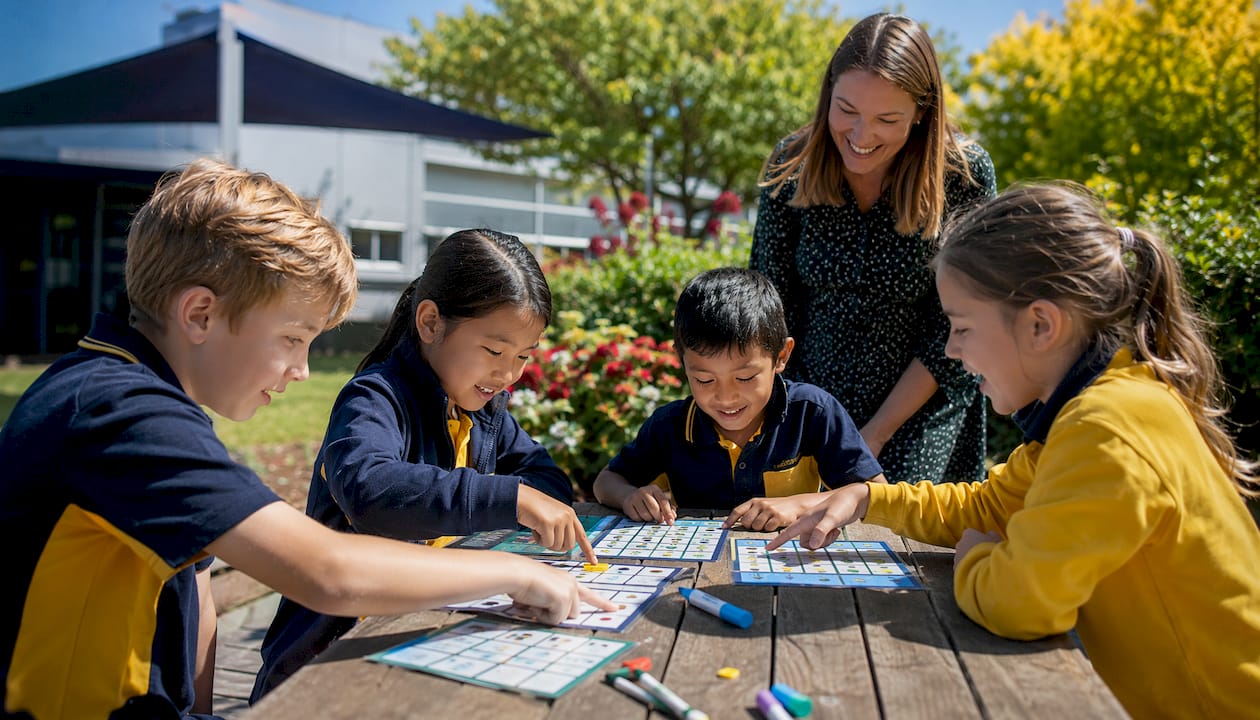
Tricky word bingo
Write 16 words from the list onto a simple 4x4 grid (one grid per player, with different arrangements). Call words aloud or hold up a card. The first player to cross off a full row wins. This works for recognition practice, and you can flip it for spelling practice by calling a definition or using the word in a sentence instead of saying it directly.
Word treasure hunt
Hide 10 printed words around the room. Children find each one, read it aloud, and write it from memory before moving to the next. The physical movement helps — especially for children who struggle to sit still for traditional spelling drills. For a quicker version at home, simply ask your child to find three words from their reading book that appear on the Year 2 list.
Write and race
Call out a word. Children write it as fast as they can, then hold up their whiteboards or paper. Check together. The goal isn't speed for its own sake — it's the immediate feedback loop. Children who write it wrong see the correct version straight away and rewrite it correctly before moving on. That correction step is where the learning actually happens.
Sentence challenge
Give children a word and ask them to write one sentence using it correctly. This is harder than it sounds for words like because or their, and it catches children who can spell a word in isolation but misuse it in context. For weaker pupils, provide a sentence frame: "I was late because _____." Stronger pupils write their own.
Quick embedded assessment: During any of these activities, keep a simple tally of which words each child gets wrong. After two sessions, you'll have a clear picture of individual gap words without needing a separate test.
For neurodiverse learners, keep the rules simple, reduce the word count per session, and allow verbal responses as an alternative to written ones. Spelling games for KS1 and KS2 that offer immediate feedback are particularly helpful for children who find written practice frustrating.
Why these words are tricky and which teaching methods actually work
Common exception words break standard phonics rules. Because doesn't follow the "long e" pattern. Sugar has a "sh" sound spelled with "s." Climb ends with a silent "b." A child who has been taught to decode phonetically will try to apply those rules and get stuck — or worse, learn a wrong pronunciation that sticks.
The answer isn't to abandon phonics. It's to teach these words as a separate category alongside phonics, using methods that build automatic recognition rather than effortful decoding.
What works in practice:
- Look, say, cover, write, check — the classic method works because it forces retrieval rather than copying. The "cover" step is the one most children skip when left to their own devices; make sure it happens.
- Multi-sensory practice — writing words in sand, tracing them on a partner's back, or building them with letter tiles adds a physical memory layer that purely visual practice misses.
- Spaced retrieval — revisiting words after a gap (one day, then three days, then a week) produces much better long-term retention than massed practice in a single session. Small, frequent daily exposures of two to five minutes outperform infrequent longer sessions.
- Meaningful sentence contexts — children remember words they've used in sentences they care about far longer than words they've only spelled in isolation.
Framing these as "tricky words" or "red words" — rather than words children are getting wrong — shifts the emotional tone of practice entirely. When a child understands that everyone finds these words hard because they break the rules, the frustration drops and the effort goes up. Classroom practitioners consistently find that playful, low-stakes practice with positive framing produces better engagement and faster progress than correction-heavy drilling. (Twinkl teaching notes)
Teachers typically combine explicit instruction (here's why this word is tricky) with overlapping retrieval practice and multi-sensory activities, moving words gradually from effortful recall into automatic recognition. That last step — automaticity — is the real goal, because a child who has to stop and think about how to spell their mid-sentence loses the thread of what they were writing.
Printable resources and formatting tips for different learners
A well-made printable can do a lot of work quietly in the background. A poorly formatted one gets ignored. Here's what actually makes a difference.
File formats and sizing:
- A4 word mats work well for desks and working walls. Print at 100% scale; anything smaller makes the text hard to read at a glance.
- Mini flashcards (six to a page, cut apart) are better for games and home practice because children can handle them physically.
- For classroom posters, A3 at a minimum — A4 gets lost on a busy working wall.
Font and layout choices:
- Use a clear, print-style font rather than a cursive or decorative one. Children learning to read and spell need to see the letters in the form they'll encounter in books.
- Minimum 14pt for desk mats, 18pt for flashcards, 24pt or larger for wall displays.
- High contrast matters: black text on white or pale yellow is easiest to read. Avoid dark backgrounds with light text for everyday reference materials.
Accessibility adjustments:
- For children with dyslexia or visual processing difficulties, increase letter spacing and line spacing beyond the default. A font like Arial or Verdana is more accessible than serif fonts for many dyslexic readers.
- Laminating desk mats lets children trace words with their finger or a dry-erase marker, adding a tactile element without extra prep.
- Black and white versions are practical for mass printing and work just as well for learning purposes. Color is nice but not necessary.
Pro Tip: Print two copies of the word mat — one for school and one for home. Consistency between environments means children see the same visual layout in both places, which reinforces memory rather than creating confusion.
For children who need additional support with formatting or dyslexia-friendly approaches, the guide to helping dyslexic children practice spelling words on Thepocketmoneygame covers specific adjustments in detail.
How a spelling app can support daily practice at home
Printables and classroom activities do the heavy lifting during the school day. At home, the challenge is consistency — getting a tired seven-year-old to practice spelling after school takes more than a worksheet on the kitchen table.
This is where a focused app helps most. Immediate feedback, short sessions, and a reward loop keep children engaged when motivation is low. The key is choosing one that maps to the actual Year 2 statutory list rather than a generic word bank.
Thepocketmoneygame is built specifically for KS1 and KS2 UK curriculum spelling, including the Year 2 common exception words. Its KS1 spelling practice resources align directly to the statutory list, so children practice the words that actually matter for their year group.
Key features that make it work for Year 2 practice:
- Adaptive difficulty — the app adjusts to each child's current level, spending more time on words they get wrong and less on ones they've mastered.
- Voice support — words are read aloud, which helps children who struggle to decode written instructions independently.
- Parent-controlled rewards — children earn real pocket money for correct answers, which parents set and control. For many children, especially those who find spelling frustrating, this changes the entire emotional experience of practice.
- Progress dashboard — parents can see exactly which words their child is getting right and which ones need more work, without having to run their own assessments.
- Multi-child profiles — useful for families with more than one child at primary school age.
A simple home session plan:
- Set out the desk word mat (physical copy) while your child gets settled.
- Run 5–10 minutes on the app, focusing on the current week's focus words.
- After the session, ask your child to write three of the words they practiced from memory, without looking at the mat.
That third step — retrieval without support — is where the real consolidation happens. The app does the repetition; the final write-from-memory step confirms it's actually stuck.
Pro Tip: Keep app sessions to 10 minutes maximum for Year 2 children. Short and daily is the goal. A child who does 8 minutes every weekday will outperform one who does 40 minutes on a Sunday.
What should your child know by the end of Year 2?
By the end of Year 2, children in England are expected to both read and spell all 64 statutory common exception words accurately. This is a DfE expectation, not just a school target. Reading them is usually achieved first; spelling them reliably in independent writing takes longer and is the harder benchmark.
A simple four-point progress check (takes about five minutes):
| Check | What to do | What it tells you |
|---|---|---|
| Recognition | Show each word on a card; child reads it aloud | Which words they can decode on sight |
| Spelling in isolation | Say the word; child writes it without support | Which words are in automatic memory |
| Use in a sentence | Child writes a sentence using the word correctly | Whether they understand meaning and usage |
| Spelling under dictation | Read a short sentence aloud; child writes it | Real-world spelling accuracy under normal conditions |
Run this check at the start of a half-term to identify gap words, then again at the end to measure progress. You don't need to test all 64 at once — 10 to 15 words per session is enough.
Pacing recommendations:
- Daily practice: 5 minutes, five days a week.
- Weekly mini-assessment: 5 words from the current focus set, written from dictation.
- Half-termly full review: work through the complete list to catch any words that have slipped.
Children who are on track will typically read most of the list confidently by mid-Year 2 and spell the majority accurately by the summer term. If a child is still struggling with more than a third of the list by Easter, it's worth having a conversation with their class teacher about targeted support.
Common problems when teaching Year 2 exception words and quick fixes
Even with the best routines in place, practice can stall. Here are the problems that come up most often and what to do about them.
Over-reliance on decoding. Some children try to sound out every word phonetically, even after being told a word is an exception. The fix is to explicitly label the tricky part: "The 'ea' in break says 'ay' — that's the tricky bit, everything else is normal." Naming the exception makes it memorable.
Practice fatigue. If a child groans every time spelling comes up, the sessions are probably too long or too repetitive. Cut the session to three minutes, change the activity format, and reduce the word count to five per session. Fatigue is a signal to change the approach, not to push harder.
Confusing homophones. Their, there, and they're cause problems well beyond Year 2. For now, focus on their and there as the two Year 2 list words, and use a simple visual anchor: "there has 'here' inside it — it's about a place."
Uneven progress across the list. Almost every child has a cluster of words they just can't retain. Rather than cycling through the full list repeatedly, isolate those specific words and practice them daily for two weeks. Concentrated repetition on a small set works better than spreading effort thinly.
Red flags for additional support:
- A child who cannot read more than half the list by the end of Year 2, despite consistent practice.
- Persistent reversal of letters in words they've practiced many times.
- Significant difficulty retaining words from one session to the next, even with multi-sensory approaches.
If you're seeing these signs, speak to the class teacher about a dyslexia screening or a referral to the school's SENCO. Early identification makes a real difference. The guide to helping a child who is behind at school on Thepocketmoneygame has practical next steps for parents in this situation.
Key Takeaways
The statutory Year 2 common exception words must be read and spelled accurately by the end of Year 2, and daily five-minute practice with visible word mats produces the fastest, most lasting results.
| Point | Details |
|---|---|
| Official list size | The DfE statutory list contains 64 Year 2 common exception words per English Appendix 1. |
| Daily practice beats long sessions | Two to five minutes of daily practice with spaced retrieval outperforms infrequent longer sessions. |
| Multi-sensory methods work best | Combine look, say, cover, write, check with physical activities to move words into automatic recall. |
| Track progress with four checks | Use recognition, isolation spelling, sentence use, and dictation to identify gap words each half-term. |
| Thepocketmoneygame for home practice | The app maps to the KS1 statutory list, adapts to each child's gaps, and uses parent-controlled rewards to keep practice consistent. |
Why the word mat on the fridge matters more than you think
Most of the advice around Year 2 tricky words focuses on formal practice: spelling tests, worksheets, structured sessions. Those things matter. But the single most underrated strategy is passive exposure — simply making the words visible in the spaces where children spend time.
A child who glances at a fridge chart while eating breakfast, sees a working-wall display during independent writing, and hears a word used correctly in conversation is getting multiple low-effort exposures every day. That accumulation is what moves a word from "I sort of know it" to "I just know it." The formal practice sessions are where you test and consolidate; the visible supports are where the familiarity builds quietly in the background.
There's also something worth saying about anxiety. Many children who struggle with spelling have already decided they're "bad at it" by the time they reach Year 2. Framing these words as genuinely tricky — not as words they should already know — removes a layer of shame from the process. When a child understands that because breaks the rules for everyone, not just for them, they approach practice differently. That shift in framing costs nothing and changes everything.
The progression question is worth keeping in mind too. Year 2 common exception words are the foundation, but they're not the ceiling. Once a child has these 64 words secure, the KS2 statutory spelling list of 200 words across Years 3–6 is the next stage. Getting Year 2 right makes that transition significantly smoother.
Thepocketmoneygame makes daily spelling practice something kids actually want to do
Knowing the Year 2 list is one thing. Getting a six- or seven-year-old to practice it consistently at home is another. Thepocketmoneygame was built specifically for this problem — by a parent who understood firsthand how hard it is to motivate a child who finds spelling frustrating.
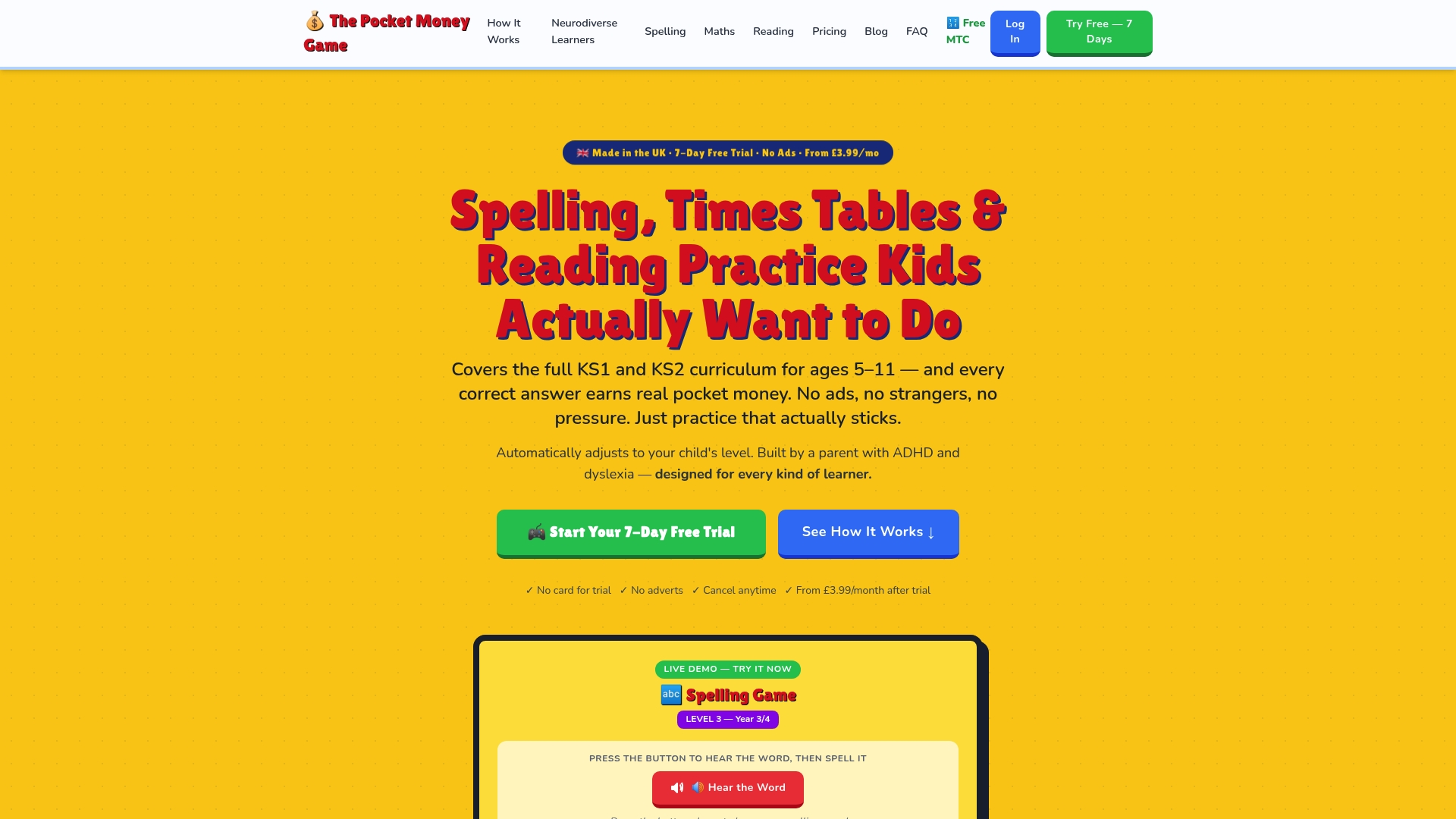
The app covers KS1 spelling including the Year 2 common exception words, with adaptive practice that focuses on each child's actual gap words rather than cycling through words they already know. Children earn real pocket money for correct answers, with parents setting the reward amounts and daily question limits through a parent dashboard. Voice support means children who struggle to read instructions independently can still use it without help. There are no hidden costs and no long-term lock-in — just a 7-day free trial to see whether it works for your child before you commit to anything.
Start your free trial today and see which Year 2 words your child already knows — and which ones need a little more time.
Useful sources and downloads
- DfE English Appendix 1 (statutory spelling lists): Primary National Curriculum PDF — the primary source for all Year 2 common exception words.
- Oxford Owl (Year 2 word list summary): Oxford Owl common exception words — trusted publisher summary of the statutory 64-word list with examples.
- Twinkl (classroom resources and word mats): Year 2 common exception words resources — printable word mats, flashcards, activity booklets, and assessment tools.
- Thepocketmoneygame — KS1 practice guide: How to practice KS1 common exception words at home — step-by-step parent guide for daily sessions without flashcards.
- Thepocketmoneygame — phonics and exception words: KS1 phonics and common exception words parent guide — explains why exception words sit outside phonics rules and how to teach them alongside a phonics scheme.
Recommended
- How to Practise KS1 Common Exception Words at Home (No Flashcards) | The Pocket Money Game
- Year 5 and 6 Spellings: Master the Full Word List
- KS1 Phonics and Common Exception Words: A Parent's Complete Guide — The Pocket Money Game
- KS2 Statutory Spelling List: All 200 Words (Years 3–6) | The Pocket Money Game