
The Year 5 and 6 spellings list is defined as 100 statutory words from England's National Curriculum that every child must spell confidently by the end of Key Stage 2. These words are formally tested in KS2 SATs, making them one of the most concrete literacy benchmarks your child will face in primary school. The list includes complex, multi-syllabic words like accommodate, awkward, and apparent, many of which trip up even confident readers. The good news is that with the right strategies, these words are very learnable.
1. What are the year 5 and 6 spellings?
The statutory list includes 100 words such as accommodate, accompany, aggressive, amateur, ancient, apparent, appreciate, attached, available, average, and awkward. That is just the start of the alphabet. The full list runs through words like prejudice, privilege, relevant, restaurant, rhyme, and yacht. These words share a common trait: they cannot be reliably spelled by sounding them out alone.
Many of these words carry silent letters, double letters, or Latin and French roots that make them genuinely tricky. A child who has been taught phonics well will still stumble on words like conscience or sufficient because the letter patterns break standard phonics rules. Knowing the list exists is the first step. Knowing why the words are hard is what helps you teach them.

You can find the full KS2 statutory list covering all 200 words across Years 3 to 6 in one place, which makes planning much easier.
2. How to use morphological rules to decode tricky words
Morphology is the study of word parts, and it is one of the most powerful tools for spelling. Rather than memorizing each word in isolation, children learn to recognize patterns across groups of words. Learning suffix rules alongside the statutory list builds transferable skills that apply to new words well beyond the list itself.
The Year 5 and 6 list is rich with suffix patterns. The key ones to teach are:
- -able / -ible: adorable, possible, responsible, comfortable
- -ant / -ance / -ancy: relevant, relevance, hesitant, hesitancy
- -ent / -ence / -ency: apparent, conscience, sufficient, sufficiency
- -cious / -tious: conscious, ambitious, suspicious, cautious
- -cial / -tial: official, artificial, essential, partial
Once a child sees that relevant and relevance share the same root, spelling both becomes far less random. The suffix just changes the word's job in a sentence. That click of recognition is worth more than ten rounds of rote copying.
Pro Tip: Use dictation sentences that include two or three words from the same suffix family. For example: "The relevant evidence was sufficient." This shows children how the pattern works in real writing, not just on a list.
3. Top interactive activities for spelling practice at home
Rote memorization is the least effective way to learn spelling words. Interactive methods like word searches and "correct the mistake" worksheets turn practice into something children actually want to do. They also reveal which words need more attention without making the child feel put on the spot.
Here are the most effective activity types for Year 5 and 6 spelling practice:
- Word searches: Children scan for the correct spelling, which builds visual recognition without pressure.
- Crossword puzzles: Clues force children to think about meaning and spelling together.
- "Correct the mistake" worksheets: Children spot and fix deliberate errors, which sharpens proofreading instincts.
- Dictation sentences: A parent reads a sentence aloud and the child writes it. This mirrors the actual SATs spelling paper format.
- Digital spelling games: Platforms with fun spelling games online keep children engaged through rewards and immediate feedback.
- Downloadable activity packs: Printable packs grouped by suffix or theme let you work through the list in manageable chunks.
The goal is to make contact with the words frequent and low-stakes. Ten minutes of a word game beats thirty minutes of copying the same word five times.
Pro Tip: Rotate activity types across the week. Monday dictation, Wednesday word search, Friday game. Variety keeps motivation up and prevents the "not spelling again" groan.
4. Common challenges with Year 5 and 6 spellings and how to fix them
The biggest challenge is that many of these words break the phonics rules children have spent years learning. Phonics grounding alone can make some words harder because children apply a rule that simply does not fit. Yacht sounds nothing like it looks. Conscience has a silent c that phonics never prepared them for.
Here are the four most common stumbling blocks and how to address each one:
- Silent letters: Words like knight, rhyme, and conscience need to be taught as visual patterns, not sounds. Try drawing attention to the silent letter in a different color when writing it out.
- Double letters: Words like accommodate (two cs, two ms) and aggressive trip up children who guess one of each. A memory trick helps: "It takes two cs and two ms to accommodate a large crowd."
- Latin and French roots: Words like restaurant (French) and amateur (French) have letter combinations that feel foreign because they are. Briefly explaining the origin makes the spelling feel logical rather than arbitrary.
- ie / ei combinations: Believe, receive, achieve, and conceive follow a pattern that many children mix up. The classic rule "i before e except after c" holds for most of these, but exceptions like weird need flagging separately.
Breaking complex words into syllables helps children decode and spell them properly. Accommodate is far less intimidating than accommodate as one block. Work through 10–15 words at a time rather than the full list at once.
5. How to weave spelling into daily reading and writing
Isolated spelling drills have a short shelf life. Children learn a word for Friday's test and forget it by Monday. Integrating statutory words into reading and writing makes the learning stick because the child uses the word in a real context.
The most practical approach is to pick five words from the list each week and look for them in whatever your child is already reading. When a child spots mischievous in a novel, that word becomes memorable in a way no worksheet can replicate. Ask them to use two or three of the week's words in a short piece of creative writing. The story does not need to be long. A paragraph is enough.
Word families extend this further. If your child is working on appreciate, introduce appreciation and appreciative in the same week. Understanding etymology and phonetic patterns aids retention far more than rote memorization. When a child understands that appreciate comes from the Latin pretium (price or value), the word suddenly has a story behind it.
Pro Tip: Keep a "word of the week" sticky note on the fridge. Write one statutory spelling word on it each Monday. By Friday, the whole family has seen it dozens of times without any formal study.
6. Comparing spelling support methods: what works for which child
Not every child responds to the same approach. The table below compares four common methods across the factors that matter most at home.
| Method | Interactivity | Stress level | Best for |
|---|---|---|---|
| Traditional flashcards | Low | Medium | Visual learners who like repetition |
| Dictation exercises | Medium | Medium to high | Children preparing for SATs format |
| Spelling games and puzzles | High | Low | Children who disengage from formal study |
| Digital apps with rewards | High | Low | Children who need motivation and instant feedback |
Rigid weekly spelling tests can make learning negative for children who already feel anxious about literacy. The goal is comfort and confident use in creative writing, not a perfect score every Friday. If your child dreads test day, switch to games and contextual writing for a few weeks. You will likely see more progress, not less.
Children with ADHD or dyslexia benefit most from high-interactivity, low-stress methods. Immediate feedback and voice support, features built into platforms like Thepocketmoneygame, reduce the frustration that comes from not knowing if an answer is right. If your child struggles with spelling homework motivation, the method matters as much as the content.
Key Takeaways
The most effective approach to Year 5 and 6 spellings combines morphological rule teaching, interactive low-stress activities, and daily contextual practice rather than rote memorization or high-pressure weekly tests.
| Point | Details |
|---|---|
| Know the statutory list | The 100-word National Curriculum list is tested in KS2 SATs and covers complex, multi-syllabic words. |
| Teach suffix patterns | Rules like -able/-ible and -ent/-ence apply across many words, building skills beyond the list. |
| Use interactive activities | Word searches, dictation, and spelling games reduce stress and improve retention. |
| Break words into syllables | Splitting ac-com-mo-date into parts makes difficult words far less daunting. |
| Integrate into daily life | Using statutory words in reading and creative writing builds lasting memory. |
What I've learned from watching children struggle with these words
I have seen a lot of children sit down with the Year 5 and 6 word list and immediately shut down. The list looks long. The words look hard. And if a child has already decided they are "bad at spelling," that list feels like proof.
The thing most parents miss is that spelling is not a talent. It is a skill built from pattern recognition, and patterns can be taught. The children I have seen make the most progress are not the ones who studied hardest. They are the ones whose parents made the process feel safe. No red pen. No sighing. No "we've been over this." Just calm, consistent exposure.
The statutory list exists as a benchmark, not a punishment. Home educators especially benefit from treating it flexibly, using the words in conversation, in stories, in games, rather than as a weekly test to pass or fail. When a child uses mischievous correctly in a sentence they wrote themselves, that is worth more than spelling it right on a Friday test and forgetting it by Sunday.
Thepocketmoneygame was built with exactly this in mind. The reward-based model means children get positive feedback for every correct answer, which keeps them coming back. That consistency, repeated low-stakes contact with the right words, is what actually moves the needle.
— Neil
How Thepocketmoneygame supports spelling practice at home
Thepocketmoneygame is a reward-based learning platform built for children aged 5–11, with spelling games aligned to the KS2 statutory word lists, including the Year 5 and 6 list. Children earn real pocket money for correct answers, which turns practice into something they ask to do rather than avoid.
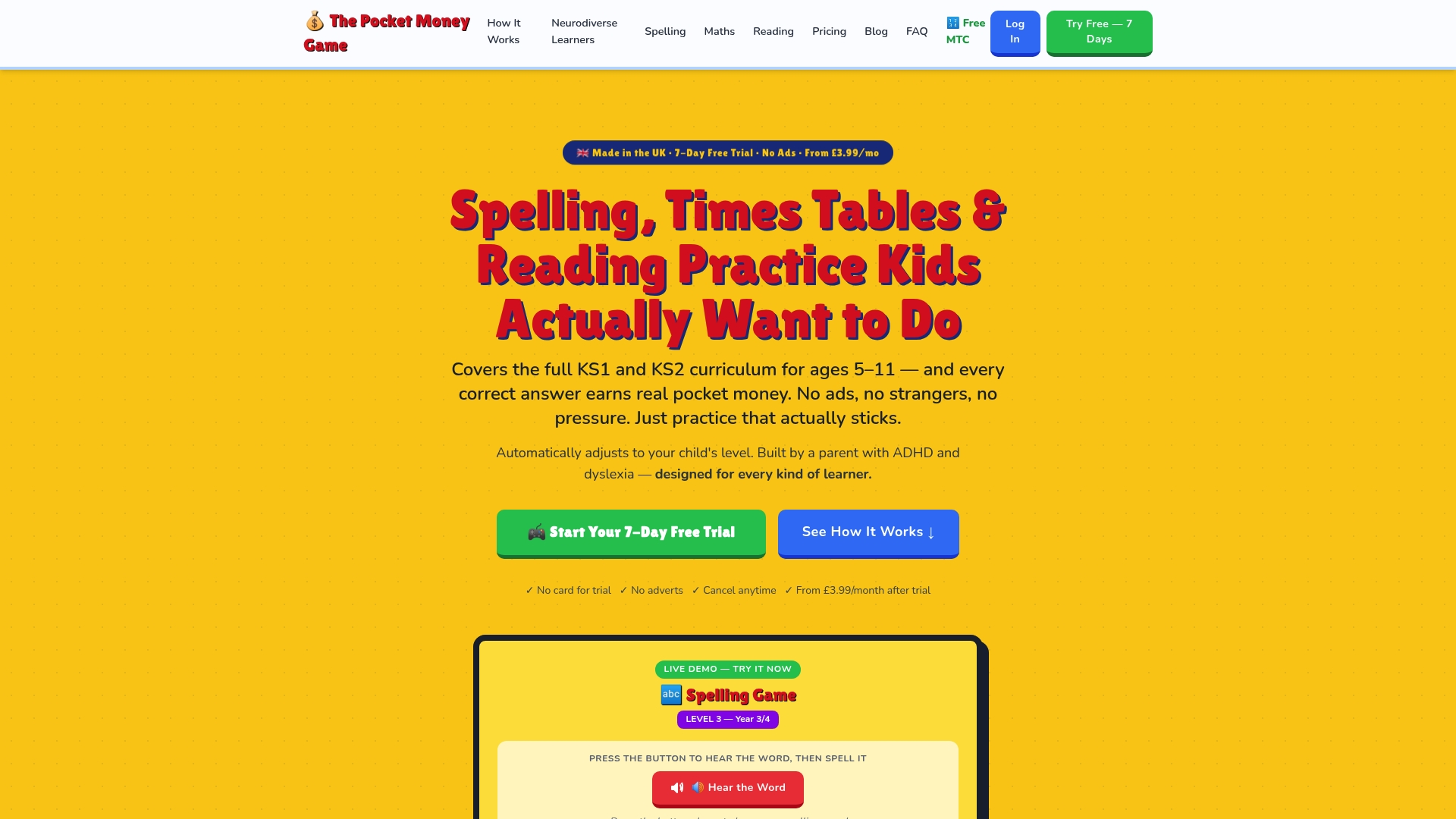
The platform was developed by a parent with ADHD and dyslexia, so it is built around the needs of children who find traditional methods frustrating. Voice support, immediate feedback, and adjustable difficulty mean every child can work at their own pace. Parents keep full control over settings and rewards. If you want spelling practice kids actually enjoy, Thepocketmoneygame is worth trying today.
FAQ
What words are on the Year 5 and 6 spelling list?
The statutory list contains 100 words including accommodate, aggressive, amateur, conscience, prejudice, privilege, relevant, restaurant, and yacht. These words feature silent letters, double letters, and Latin or French roots.
How are Year 5 and 6 spellings tested?
Year 6 spellings are formally assessed in the KS2 SATs spelling paper, where children hear words in sentences and write them down. The test focuses on complex, multi-syllabic words from the statutory list.
What is the best way to practice Year 5 and 6 spellings at home?
The best approach combines dictation exercises, interactive games, and using the words in creative writing. Stress-free, positive practice builds more confidence than high-pressure weekly tests.
Why do phonics-trained children still struggle with these words?
Many Year 5 and 6 words contain exceptions to standard phonics rules, such as silent letters and French-origin letter patterns. Phonics alone cannot decode words like yacht or conscience, so morphological and etymological teaching is needed alongside phonics.
How many words should children practice at a time?
Working through 10–15 words at a time, grouped by suffix or theme, is more effective than tackling the full list at once. Smaller groups allow deeper learning and reduce the chance of children feeling overwhelmed before they start.
Recommended
- KS2 Statutory Spelling List: All 200 Words (Years 3–6) | The Pocket Money Game
- Spelling Games for Kids KS1 & KS2 | Fun Practice, Real Progress
- KS1 Phonics and Common Exception Words: A Parent's Complete Guide — The Pocket Money Game
- Blog | The Pocket Money Game — Tips for Parents, ADHD Learning & UK Curriculum