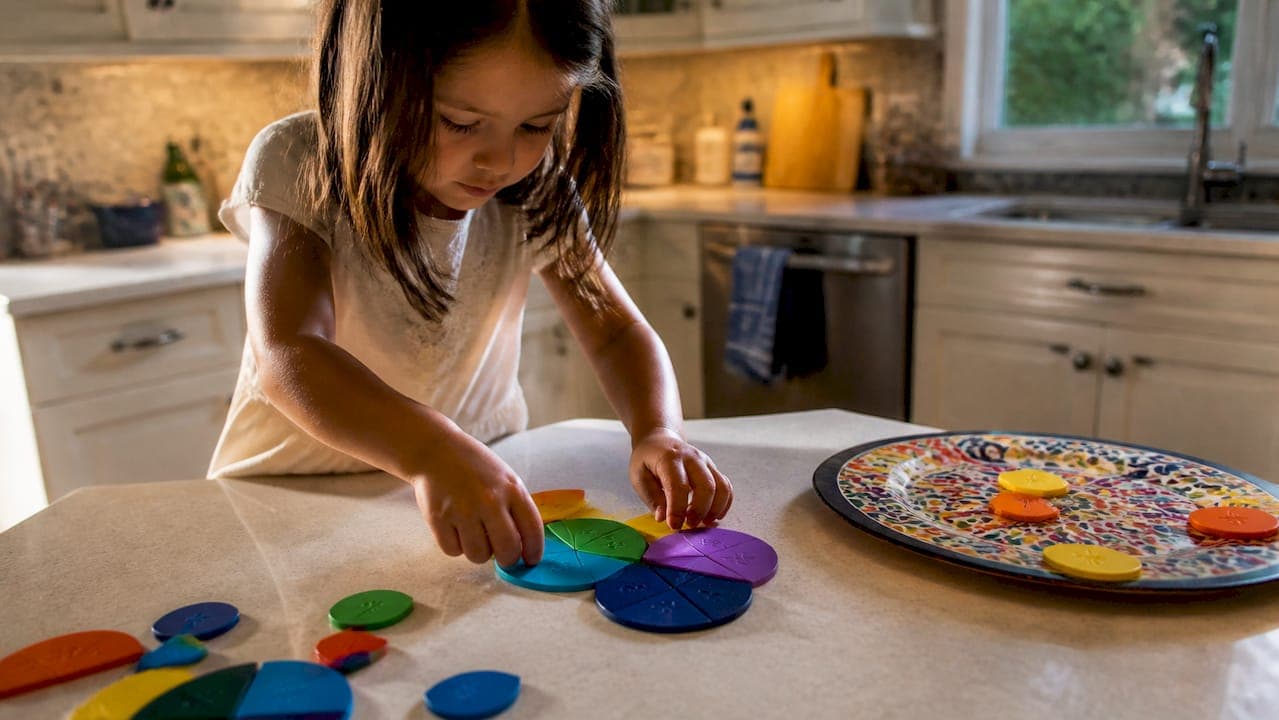
Equivalent fractions are two or more fractions that name the same amount even though their numerators and denominators look different. 1/2, 2/4, and 3/6 are all equivalent because they mark the exact same point on a number line and represent the exact same slice of a whole, whether that whole is a pizza, a ribbon, or a bag of marbles.
Here are three quick examples you can show a child right now:
- 1/2 = 2/4 = 3/6 (multiply top and bottom by 2, then by 3)
- 1/3 = 2/6 = 4/12 (multiply by 2, then by 4)
- 6/8 = 3/4 (divide top and bottom by 2)
In the KS2 curriculum, equivalent fractions sit at the heart of fraction fluency. Once a child genuinely understands why 2/4 and 1/2 are the same value, comparing fractions, simplifying, and adding fractions with different denominators all get noticeably easier. Skip this step, and every fraction topic after it turns into memorized tricks instead of real understanding.
Key Takeaways
Equivalent fractions are the same value written differently, and mastering them by Year 6 depends on understanding proportional scaling, not memorizing doubling patterns.
| Point | Details |
|---|---|
| Same value, different form | Equivalent fractions like 1/2 and 3/6 represent identical amounts through scaling, never addition or subtraction. |
| Scale, don't shortcut | Multiply or divide numerator and denominator by the same number, using factors beyond just 2. |
| Visuals build real understanding | Fraction walls, area models, and number lines make equivalence concrete before moving to symbols. |
| Avoid the doubling trap | Fixed-pattern bias forms when children only practice ×2; mix in ×3, ×4, and ×5 from the start. |
| Reinforce with short daily practice | Pair five to ten minutes on Thepocketmoneygame's adaptive fraction games with the visual routines in this guide. |
Table of Contents
- What Are Equivalent Fractions and Why Do They Matter in KS2 Maths?
- How Do Visual Models Help Children See Equivalent Fractions?
- How Do You Find Equivalent Fractions by Scaling or Simplifying?
- Can You Try Some Worked Equivalent Fractions Examples?
- Which UK Resources and Activities Actually Help With Equivalent Fractions?
- What Misconceptions Trip Kids Up With Equivalent Fractions?
- When Do KS2 Children Cover Equivalent Fractions, Year by Year?
- How Do You Know When a Child Is Ready to Move On?
- What Actually Works at Home Without Turning Into a Battle?
- How Can an Adaptive Practice App Support This at Home?
- Where Can You Find More Trusted UK Resources on This Topic?
- Sources
What Are Equivalent Fractions and Why Do They Matter in KS2 Maths?
Equivalent fractions work because the numerator and denominator scale by the same factor, which keeps the ratio between them fixed. Multiply the top of 1/2 by 3 and you get 3. Multiply the bottom by 3 and you get 6. The value hasn't budged. Only the way it's written has changed, according to guidance from BBC Bitesize.
Think of it like currency. A £1 coin, two 50p pieces, and four 25p pieces all add up to the same amount of money in your pocket. The fraction just gets sliced into smaller or larger pieces without changing what it's actually worth.
Here's the rule your child needs to hold onto: multiply or divide the numerator and denominator by the same number, and the fraction stays equivalent. Add or subtract instead, and the value changes completely, which is exactly where a lot of children go wrong.
A short proof makes this concrete. Take 2/3. Multiply both parts by 4: 2 × 4 = 8, and 3 × 4 = 12. So 2/3 = 8/12. Draw both as pie charts and the shaded area matches exactly, even though one pie has three slices and the other has twelve.
Use this checklist when your child claims two fractions are equivalent:
- Is there a single whole number that turns the first denominator into the second (or vice versa)?
- Does multiplying (or dividing) the numerator by that same number give the second numerator?
- Do both fractions simplify down to the same lowest-terms fraction?
Pro Tip: If a child insists 3/5 and 4/6 look "close enough" to be equivalent, ask them to check: does 5 × something equal 6? No whole number does that, so they can't be equivalent, no matter how similar they look on paper.
How Do Visual Models Help Children See Equivalent Fractions?
Visual models turn an abstract rule into something a child can point at, which matters enormously for anyone who finds numbers alone confusing. Three models do most of the heavy lifting in KS2 classrooms and at home.
Fraction walls or fraction charts stack bars of equal length, each split into different numbers of equal parts. Ask your child: "Which row has a line that matches up exactly with the line in the 1/2 row?" When they spot that 2/4, 3/6, and 4/8 all line up with 1/2, they're seeing equivalence with their own eyes, not just following a rule.
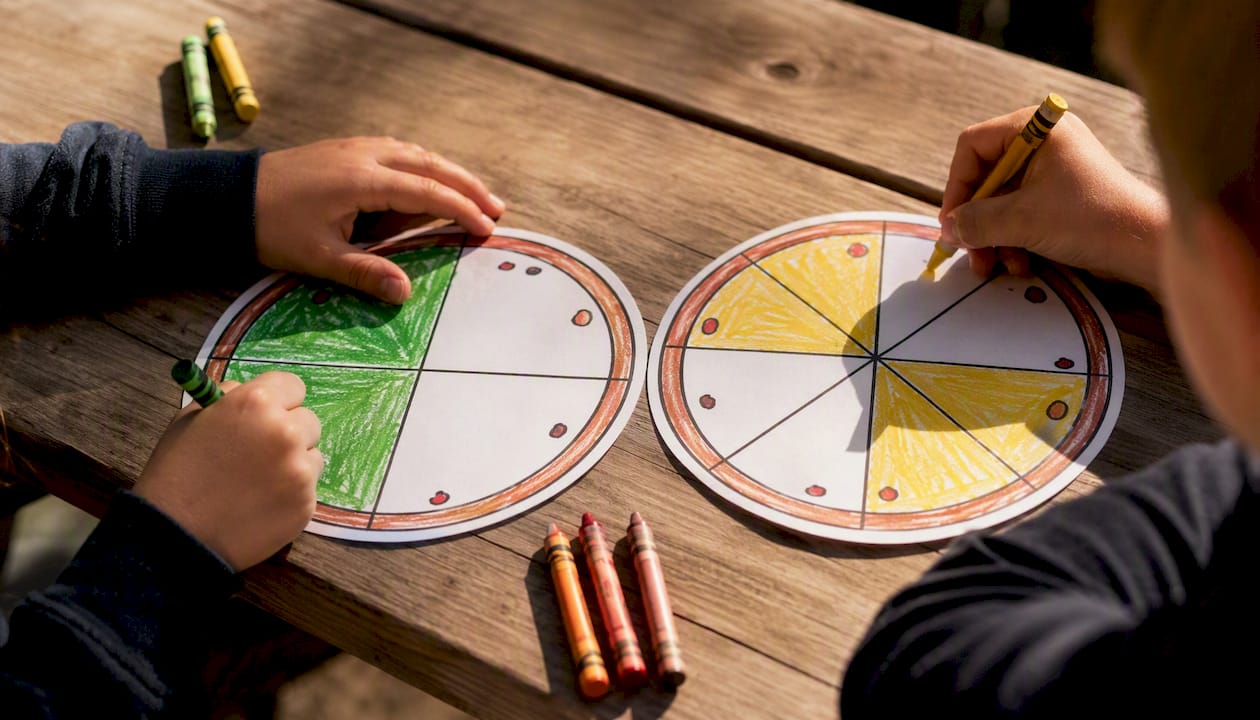
Area models use shapes, usually rectangles or circles, split into equal sections with some sections shaded. Show a rectangle split into quarters with two shaded next to a rectangle split into eighths with four shaded. The shaded area is identical even though the shapes are cut differently. This directly answers the question a lot of children silently ask: "How can 2/4 and 4/8 possibly be the same if the numbers are different?"
Number lines place several fractions with different denominators on one shared line and show that equivalent fractions land on the exact same point. This model does something the others don't: it proves equivalence isn't just about shapes matching up, it's about value and position matching up, which helps children generalize the idea beyond food and pizza slices.
Pro Tip: Sequence your visuals. Start with area models because they're concrete and food-related, move to fraction walls to compare several fractions at once, then finish with number lines once your child is comfortable, since number lines demand a bit more abstract thinking.
How Do You Find Equivalent Fractions by Scaling or Simplifying?
There are two routes to equivalent fractions, and KS2 children need both.
Creating equivalent fractions by scaling up:
- Pick a whole number scale factor (try 2, 3, 4, or 5, not just 2 every time).
- Multiply the numerator by that number.
- Multiply the denominator by the exact same number.
- Write the new fraction and check it against a fraction wall or number line if you want a visual confirmation.
Simplifying fractions to find lowest terms:
- Look for a common factor that divides evenly into both the numerator and denominator.
- Divide the numerator by that common factor.
- Divide the denominator by the same common factor.
- Repeat until no common factor remains other than 1, which means you've reached the simplest form according to Math is Fun.
Quick error-check before moving on:
- Did you multiply or divide both numbers, never just one?
- Did you use the same number on top and bottom?
- Can the new fraction be simplified further, or is it already in lowest terms?
This is where a lot of home practice quietly goes wrong. A child multiplies the numerator by 3 but the denominator by 2 because they were rushing, and the fraction that comes out isn't equivalent at all. Slowing down for that final checklist catches the mistake before it becomes a habit.
Can You Try Some Worked Equivalent Fractions Examples?
Practicing with full worked answers beats abstract explanation every time, especially for children who need to see the method applied before they trust it. Try these five, then check the answers.
- Find an equivalent fraction for 1/4 using a scale factor.
- Find an equivalent fraction for 3/5 using a scale factor.
- Simplify 8/12 to its lowest terms.
- Simplify 10/15 to its lowest terms.
- Is 2/3 equivalent to 6/9? Prove it.
A few notes on these questions worth flagging:
- Question 2 deliberately uses a factor of 4 instead of doubling, so children can't fall back on the doubling shortcut alone.
- Questions 3 and 4 both simplify to 2/3, which is a useful moment to point out that different starting fractions can share the same simplest form.
- Print these five as a quick exit ticket at the end of a lesson, or run them as a two-minute check before starting homework.
Which UK Resources and Activities Actually Help With Equivalent Fractions?
You don't need to build teaching materials from scratch. Several UK organizations already offer strong, curriculum-aligned resources for this exact topic.
- BBC Bitesize offers a clear Year 4 explainer on equivalent fractions with diagrams and short practice questions, ideal for a quick refresher before homework, according to BBC Bitesize's KS2 maths resources.
- Twinkl provides differentiated worksheets, posters, and interactive games for equivalent fractions across KS2, useful when you need practice pitched at slightly different ability levels within one class or family, per Twinkl's equivalent fractions resources.
- Oak National Academy publishes free video lessons and worksheets that specifically address the doubling habit many children fall into.
- Third Space Learning runs one-to-one online tutoring focused on KS2 maths gaps, a good option if a child needs more sustained, personalized support than a worksheet can give.
- NCETM offers teacher-facing guidance on how to sequence fraction teaching around proportional reasoning rather than rote steps.
At home, three low-effort activities build real fluency without feeling like extra homework:
- Packet or pizza sharing: cut a sandwich or a pizza into different numbers of equal pieces and ask how many pieces of the smaller cut equal one piece of the larger cut.
- Fraction cards: write ten fractions on cards, some equivalent pairs, some not, and have your child sort them into matching groups.
- Number-line challenges: draw a blank line from 0 to 1 and race to place five different fractions correctly, checking which ones land on the same spot.
Pro Tip: Keep daily practice under ten minutes and tie it to something your child already enjoys, whether that's a snack, a game, or a small reward. Short, frequent sessions beat one long weekly session almost every time, because fraction fluency comes from repetition, not intensity.
What Misconceptions Trip Kids Up With Equivalent Fractions?
The single biggest misconception in KS2 classrooms is what researchers call fixed-pattern bias, and it's worth understanding because it explains a lot of "they got it, then suddenly didn't" moments.
Fixed-pattern bias happens when pupils rely almost entirely on doubling to generate equivalent fractions. They can confidently turn 1/2 into 2/4 and 4/8, but freeze completely when asked to find an equivalent fraction using a scale factor of 3 or 5.
Oak National Academy recommends deliberately mixing in non-doubling scale factors from the start rather than introducing them later as an afterthought. A child who only ever practices with ×2 and ÷2 has learned a pattern, not the underlying relationship.
NCETM frames the fix clearly: teach equivalent fractions as a proportional relationship, where the ratio between numerator and denominator stays constant, rather than as a set of multiplication steps to memorize. That shift in framing, from "here's a trick" to "here's why the trick works," is what actually prevents the bias from forming.
Try these diagnostic questions to spot the problem early:
- "Can you find an equivalent fraction for 2/5 using 3 instead of 2?"
- "Is 3/4 the same as 9/12? How do you know, without just checking if it feels right?"
- "Can you show me 1/3 and an equivalent fraction on the same number line?"
If a child hesitates badly on the first question but breezes through doubling tasks, that's your signal to bring in more ×3, ×4, and ×5 examples before moving on.
When Do KS2 Children Cover Equivalent Fractions, Year by Year?
Equivalent fractions don't arrive in one lesson and disappear. They build steadily across KS2, with each year adding a new layer, as set out in the national curriculum programmes of study.
| Year | Typical focus | Example classroom activity |
|---|---|---|
| Year 3 | Recognizing and showing simple equivalent fractions using diagrams | Shading fraction walls to spot matching amounts |
| Year 4 | Recognizing and generating families of equivalent fractions | Number-line placement tasks with multiple denominators |
| Year 5 | Identifying, naming, and writing equivalent fractions of a given fraction, including simplifying | Simplifying fractions to lowest terms using common factors |
| Year 6 | Using equivalent fractions to add, subtract, and compare fractions with different denominators | Applying equivalence within multi-step word problems |
A child is generally on track when they can explain why two fractions are equivalent using the ratio, rather than just reciting "you multiply top and bottom." Other solid mastery indicators include placing equivalent fractions accurately on a shared number line and simplifying a fraction to lowest terms without prompting.
How Do You Know When a Child Is Ready to Move On?
A short readiness check tells you far more than a full test paper. Run through these before assuming a child has mastered equivalent fractions:
- Can they generate an equivalent fraction using a scale factor other than 2?
- Can they simplify a fraction like 9/12 to lowest terms independently?
- Can they correctly place two equivalent fractions on the same point of a number line?
- Can they explain, in their own words, why the value doesn't change when you scale top and bottom together?
If the answer to all four is yes, it's time to move forward. Natural next steps include simplifying fractions ks2 style with larger numbers, comparing fractions with unlike denominators, adding and subtracting fractions once a common denominator is found, and finding fractions of amounts ks2, such as working out 3/4 of 24.
One piece of practical advice: don't abandon visual models too early. If a child answers correctly but hesitates or seems to be guessing, drop back to a fraction wall or number line for another week rather than pushing straight into symbolic-only practice. Confidence with the reasoning matters more than speed at this stage.
What Actually Works at Home Without Turning Into a Battle?
The routines that stick aren't the elaborate ones. They're the boring, repeatable ones that fit into five minutes you already have, like the walk to school or the last few bites of dinner.
Try tying fraction talk to something already happening in your kitchen. If you're splitting a chocolate bar into pieces, ask which fraction each person gets, then ask if there's a different way to cut it that gives the same amount. That's equivalent fractions without a worksheet in sight, and it costs you nothing extra.
A workable daily routine looks like this: pick one quick question each evening, alternate between a visual model question and a straight calculation, and don't correct wrong answers immediately. Ask "how did you get that?" first. Often the reasoning reveals a fixed-pattern habit you can address gently rather than a genuine gap in understanding. Track progress loosely, maybe a simple tally of correct answers over a week, rather than turning it into a formal test that adds pressure.
Mixing visuals with quick game-style questioning is what actually prevents the doubling trap from forming in the first place. Ask "what if we used 3 instead of 2?" often enough, early enough, and it stops feeling like a special case and starts feeling normal.
How Can an Adaptive Practice App Support This at Home?
Worksheets and kitchen-table fraction talk get you most of the way there, but children often need more repetition than a busy household can realistically supply on paper alone. That's where Thepocketmoneygame fits in, sitting alongside the visual work in this guide rather than replacing it.
Thepocketmoneygame is built around adaptive maths practice that adjusts difficulty automatically as a child answers, so equivalent fractions questions get harder (or easier) based on real performance rather than a fixed worksheet level. Every answer gets immediate feedback, with voice support built in for children who find reading instructions harder than solving the maths itself. Parents keep full control over difficulty settings and how much pocket money is earned per correct answer, so the reward stays motivating without becoming unlimited.
Used alongside the routines in this guide, the app works best as the short, repeatable practice slot: five to ten minutes after the visual modeling and kitchen-table talk, reinforcing the same scale factors and simplifying skills without needing you to mark anything. If you want to see how it works for KS2 fraction practice specifically, take a look at the safe, browser-based learning games available with no download required, and start a free trial to see how your child responds to adaptive fraction questions this week.

Where Can You Find More Trusted UK Resources on This Topic?
For lesson plans, worksheets, and official guidance beyond this guide, these UK sources are worth bookmarking:
- BBC Bitesize for a clear, student-facing explainer with diagrams, suited to Year 4 revision.
- Oak National Academy for free video lessons that directly target fixed-pattern bias with varied scale-factor practice.
- NCETM for teacher-focused guidance on framing equivalence as a proportional relationship.
- Twinkl for differentiated worksheets and games across KS2 ability levels.
- Third Space Learning for one-to-one online tutoring when a child needs more sustained support than home practice alone can provide.
For the official word on what should be taught and when, the national curriculum's mathematics programmes of study remains the primary reference for year-by-year expectations.
If you're looking to keep fraction practice going at home between formal lessons, Thepocketmoneygame's KS2 maths games cover fractions alongside times tables and arithmetic, and the guide on Year 4 multiplication facts pairs well with the non-doubling scale factor practice covered above.
Sources
- Equivalent fractions - KS2 Maths resources for Year 4 - BBC Bitesize
- Use understanding of equivalent fractions to solve problems | Oak National Academy
- Finding equivalent fractions and simplifying fractions | NCETM
- National curriculum in England: mathematics programmes of study
- Equivalent Fractions | Math is Fun