
What are KS2 maths word problems and how do you solve them?
KS2 maths word problems are multi-step mathematical questions written in everyday language, asking children to apply number skills within real-life contexts. Think of a question like: "Six adults and five children go to the cinema. Each adult's ticket costs £7 and each child's ticket costs £4. How much do the tickets cost altogether?" Your child needs to read carefully, identify what is being asked, and work through the calculation in stages before arriving at a final answer.
BBC Bitesize recommends a clear five-step process that works well for children at every KS2 year group:
- Step 1: Read the whole problem carefully before touching a pencil.
- Step 2: Identify exactly what the question is asking for.
- Step 3: Work out the first calculation.
- Step 4: Work out the second (or further) calculation using the result from Step 3.
- Step 5: Check that the final answer makes sense in the context of the problem.
This method, also supported by Third Space Learning, builds accuracy and prevents the most common mistake: rushing straight to arithmetic before fully understanding what is being asked. Following these steps consistently gives children a reliable framework they can use independently, even when a problem looks unfamiliar.
Table of Contents
- Common types of word problems your child will encounter
- How word problems fit into the KS2 national curriculum
- Practical strategies for teaching and supporting children
- Supporting varied learners with adaptive tools and rewards
- Thepocketmoneygame makes maths practice feel worth it
- Key Takeaways
Common types of word problems your child will encounter
Word problems span every topic in KS2 maths, and recognizing the type of problem is half the battle. Children learn best when problems are embedded in real-world contexts rather than presented as abstract numbers alone.
Here are the main categories your child will meet:
- Addition and subtraction: "A school raises £345 on Monday and £278 on Tuesday. How much more do they need to reach their £700 target?"
- Multiplication and division: "A baker makes 9 trays of cookies with 12 cookies per tray. She sells 47. How many are left?"
- Fractions: "Three-fifths of a class of 30 children walk to school. How many travel by other means?"
- Decimals: "A bottle holds 1.75 litres. After pouring out 0.6 litres, how much remains?"
- Percentages: "A jacket costs £60. It is reduced by 15%. What is the sale price?"
- Measurement and time: "A train leaves at 09:45 and arrives 2 hours and 35 minutes later. What time does it arrive?"
- Ratio and proportion (Year 6): "For every 3 red beads there are 5 blue beads. If there are 24 red beads, how many blue beads are there?"
Problems grow in complexity as children move through the year groups. Year 3 typically involves one or two steps with familiar operations. By Year 6, questions layer fractions, decimals, percentages, and algebra together in a single problem, which is why the step-by-step approach matters so much by that stage.
How word problems fit into the KS2 national curriculum
Word problems are not an add-on to the KS2 maths curriculum. They sit at its core. The national curriculum defines mastery in maths as the combination of fluency, reasoning, and problem-solving, and word problems are the primary vehicle for testing all three together.
The KS2 curriculum is organized into nine strands. Two of them carry the heaviest load of word-problem content: Calculations and Fractions, Decimals and Percentages span numerous sub-strands across Years 3–6, indicating a significant focus on these areas. Together, those two strands account for a large proportion of the reasoning questions children face in SATs.
Word problems appear across both KS2 reasoning papers in the SATs, making regular practice with them genuinely important for assessment readiness. The problems are intentionally set in messy, real-life contexts precisely because that is where mathematical thinking is actually used. A child who can only perform a calculation in isolation, but freezes when the same calculation is wrapped in a story, has not yet reached mastery.
Practical strategies for teaching and supporting children
The good news is that word-problem confidence is very teachable. A few consistent strategies make a real difference, whether you are a parent supporting homework or a teacher planning lessons.
Draw it out. Bar models and diagrams externalize the structure of a problem, making each step visible before any arithmetic begins. Children who sketch a bar model rarely skip a step by accident.
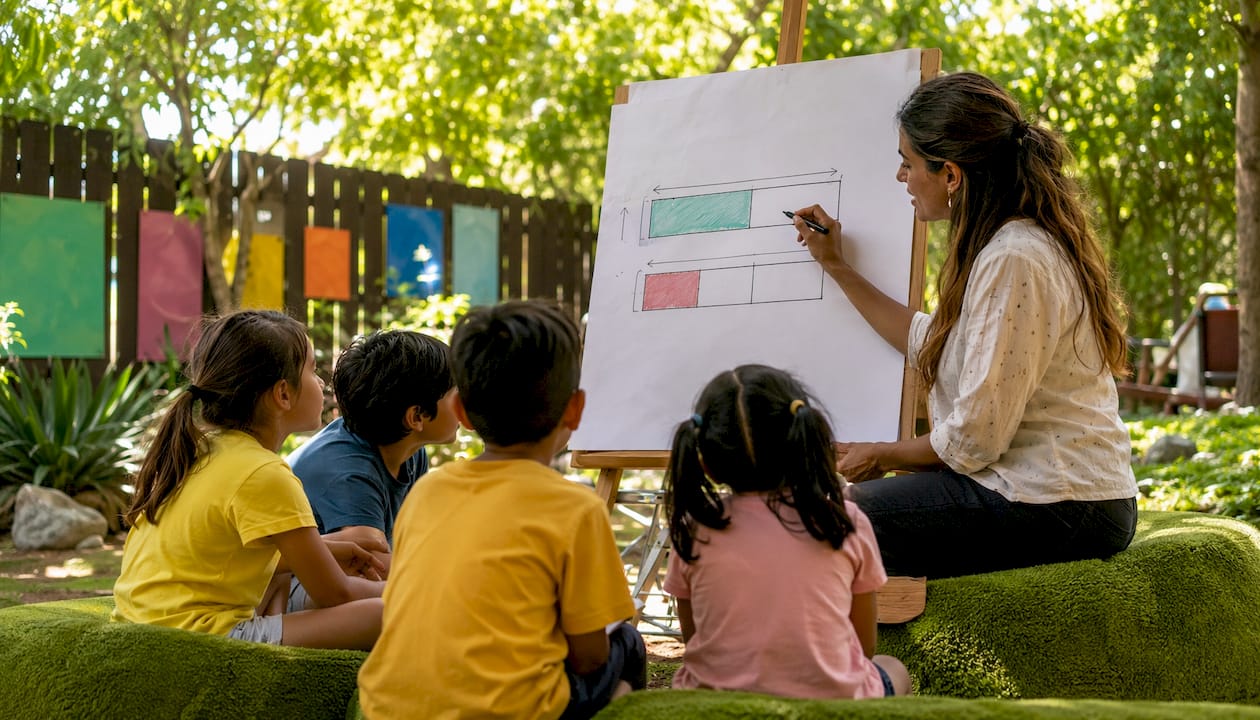
Use a problem-solving model. George Polya's four-stage approach, widely used in UK primary schools, asks children to understand the problem, devise a strategy, carry it out, and check the result. Acronyms like RUCSAC (Read, Understand, Choose, Solve, Answer, Check) make this memorable for younger learners.
Here are the core strategies worth building into regular practice:
- Drawing a diagram or bar model
- Working backwards from the answer
- Creating an organized list of possibilities
- Looking for a pattern across similar problems
- Acting out the scenario physically
- Guessing, checking, and adjusting
- Using logical reasoning to eliminate wrong approaches
Build vocabulary alongside maths. Words like "altogether," "remaining," "product," and "share equally" are language cues that signal which operation to use. Children who stumble on word problems often struggle with the language, not the arithmetic. Pairing vocabulary building with maths practice closes that gap faster than extra calculation drills alone.
Resist giving the answer too quickly. Ofsted guidance, reflected in the Primary Mathematics Series, advises teachers and parents to hold back and ask open questions instead: "What do you already know?" or "What could you try first?" That small shift builds the mathematical resilience children need to tackle unfamiliar problems independently.

Pro Tip: When your child gets an answer wrong, ask them to talk you through every step they took. Wrong answers explained out loud reveal exactly where the thinking went off track, and that conversation is often more useful than simply showing the correct method.
NRICH reinforces this: validating errors as part of the learning process reduces maths anxiety and helps children stay willing to attempt problems they find hard. A child who fears being wrong will avoid the very practice they need most.
For high-attaining pupils, the challenge should come from deeper reasoning across multiple maths strands, not just from harder numbers. Open-ended investigations and cross-topic problems that require children to justify their logic stretch capable learners far more effectively than simply increasing numeric difficulty.
You can also think about how you approach difficult problem-solving questions strategically as a model for your child. Showing them that adults also pause, re-read, and think before acting normalizes that process.
Supporting varied learners with adaptive tools and rewards
Not every child responds to the same approach, and that is completely normal. Children with ADHD, dyslexia, or other learning differences often find word problems particularly demanding because they combine reading comprehension, working memory, and multi-step calculation all at once.
Reward-based learning systems that link motivation to achievable, tangible rewards help sustain practice and improve outcomes for KS2 learners, particularly those who disengage quickly with traditional methods. The key is keeping the reward immediate and tied directly to effort, not just to correct answers.
Adaptive platforms that adjust difficulty in real time, provide voice support for children who struggle to read problem text independently, and offer immediate feedback remove several of the barriers that make word problems feel impossible. Benefits for parents and educators include:
- Difficulty that adjusts automatically so children are always working at the right level
- Voice support that reads problems aloud, reducing the reading barrier
- Immediate feedback that prevents misconceptions from embedding
- Multi-child profiles so siblings at different year groups can each practice at their own level
- Parent dashboards that show progress at a glance, making it easy to spot where extra support is needed
- Neurodiversity-friendly design that reduces cognitive overload
Strong times tables fluency also underpins word-problem success, since children who hesitate on multiplication facts spend their working memory on arithmetic rather than on understanding the problem itself.
Thepocketmoneygame makes maths practice feel worth it
If your child needs more practice with KS2 numeracy challenges but switches off the moment a worksheet appears, Thepocketmoneygame offers something genuinely different. Children earn real pocket money for every correct answer, which means the motivation to keep going comes from them, not from you.
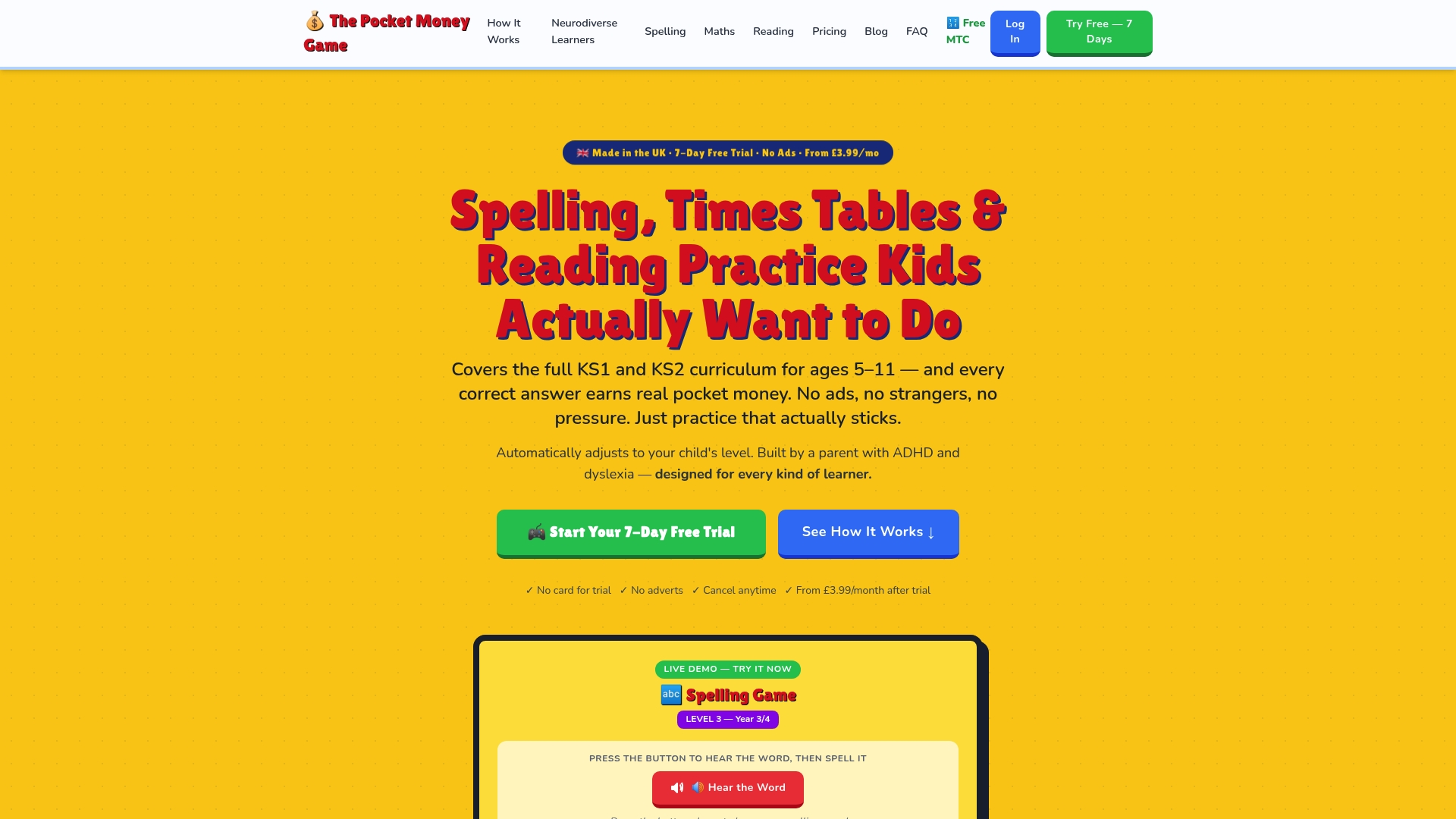
Built by a parent with ADHD and dyslexia, the platform was designed from the start for children who find traditional learning methods frustrating. It covers KS1 and KS2 maths, spelling, and reading, with adaptive difficulty, voice support, and a parent dashboard that keeps you in control of both the content and the rewards. Every session is short, focused, and curriculum-aligned, so practice fits around family life rather than taking it over. You can start a free trial today and see whether it clicks for your child, with no pressure and no long commitment required. For children who need extra neurodiversity support, the ADHD and dyslexia learning app page explains exactly how the platform adapts to different learners.
Key Takeaways
Mastering KS2 maths word problems requires a consistent five-step reading and calculation process, regular exposure to varied problem types, and a learning environment that treats mistakes as progress.
| Point | Details |
|---|---|
| Use the five-step method | Read, identify the question, calculate stepwise, and verify the answer every time. |
| Curriculum weight matters | Calculations and Fractions, Decimals and Percentages carry the heaviest word-problem load in KS2. |
| Vocabulary is half the battle | Language cues like "altogether" and "remaining" signal which operation to use; build word knowledge alongside maths. |
| Resist giving answers too quickly | Open questions build the mathematical resilience children need for independent problem-solving in SATs. |
| Thepocketmoneygame | Offers adaptive, curriculum-aligned maths practice with real pocket money rewards, voice support, and a parent dashboard for KS2 learners. |