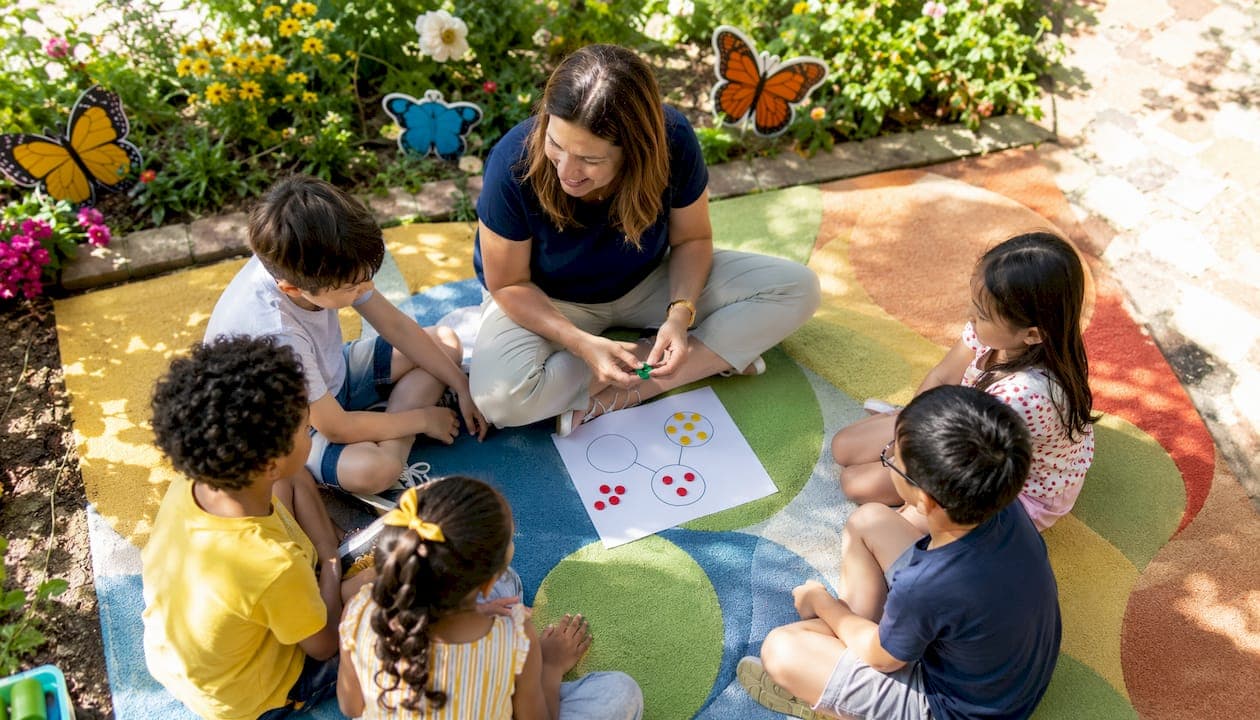
What is the part-whole model in primary maths?
The part-whole model is a visual tool that shows how a whole number is made up of smaller parts. Think of it like a pizza: the whole pizza can be split into slices, and those slices, when put back together, make the whole again. That simple idea sits at the heart of how young children learn addition and subtraction in UK primary schools.
The most common way you'll see it drawn is as a cherry diagram: a large circle at the top representing the whole, connected by lines to two or more smaller circles below representing the parts. If your child knows the parts, they add them to find the whole. If they know the whole and one part, they subtract to find the missing piece.
Here's what makes this model so useful in early maths:
- It gives children a concrete picture of how numbers relate to each other
- It connects addition and subtraction as two sides of the same idea
- It builds the foundation for number bonds, mental arithmetic, and place value
- It's introduced in Reception (age 4–5) and used throughout KS1 in the UK curriculum
Table of Contents
- How the part-whole model looks in practice
- When do children learn this in UK primary schools?
- Practical teaching tips for parents and educators
- How the part-whole concept connects to everyday life and wider maths
- How Thepocketmoneygame reinforces part-whole skills
- How to assess whether your child understands the part-whole model
- Key Takeaways
- Thepocketmoneygame makes maths practice feel worth it
How the part-whole model looks in practice
The cherry diagram is the go-to visual for early learners. The whole sits at the top, and the parts branch off below. Knowing any two values lets you work out the third.
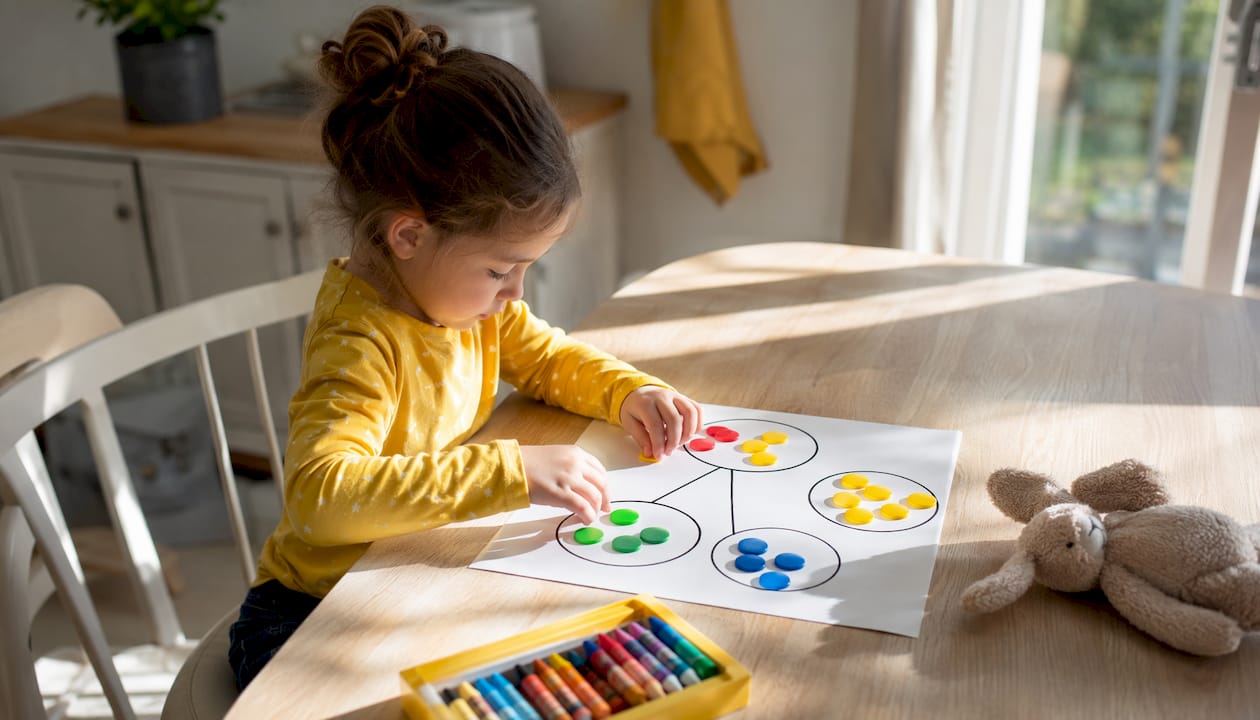
Here's how different number bonds look using this approach:
| Whole | Part 1 | Part 2 | Number sentence |
|---|---|---|---|
| 5 | 2 | 3 | 2 + 3 = 5 |
| 8 | 5 | 3 | 5 + 3 = 8 |
| 10 | 6 | 4 | 6 + 4 = 10 |
| 12 | 7 | 5 | 7 + 5 = 12 |
The model works in both directions, and that's the point. A child who sees that 5 and 3 make 8 also learns that 8 minus 3 equals 5, without needing to treat those as separate facts. They're the same relationship, just viewed from a different angle.
A few things worth knowing about how the examples work:
- A whole can be split into more than two parts (for example, 6 can become 3, 2, and 1)
- The parts always add up to the whole, never more or less
- Changing which part is "missing" gives you a new problem to solve, using the same diagram
- Bar models can also represent part-whole relationships as children progress
When do children learn this in UK primary schools?
Children in England begin developing part-whole reasoning in the early years of primary school. The journey from there follows a clear path.
- Reception: Children handle physical objects, sorting them into groups to build an intuitive sense of parts and wholes. This stage also develops subitising, the ability to recognize small quantities at a glance without counting, which is an early foundation for part-whole reasoning.
- Year 1 (KS1): Children move to pictorial representations like the cherry diagram, connecting what they did with objects to a drawn model.
- Year 2 (KS1): The model supports fluency in number bonds to 20, a specific national curriculum goal. Children begin working with abstract numbers more confidently.
- KS2 and beyond: Most children partition numbers mentally by this stage, but the model remains a helpful scaffold for those who need it, particularly for place value and multi-step problems.
The progression follows a concrete → pictorial → abstract path, which is the same approach used across mastery-based maths teaching in UK schools. Rushing past the concrete stage often leads to gaps later, so don't worry if your child still wants to use objects or diagrams well into Year 2.
Practical teaching tips for parents and educators
Getting this right at home or in the classroom doesn't require a teaching degree. A few clear habits make a real difference.
- Use physical objects first. Counters, coins, grapes, or toy cars all work. Place them in the "whole" space, then physically move them into the parts. This movement is key.
- Encourage full sentences. Rather than just writing "3 + 5 = 8," ask your child to say: "The whole is 8. One part is 3 and the other part is 5." Verbalizing relationships like this builds mathematical language that pays off in problem-solving later.
- Go beyond two parts. Once your child is comfortable, try splitting a number into three or four parts. This prevents the idea that a whole can only ever be cut in two.
- Flip the problem. Give the whole and one part, then ask for the missing part. This is where subtraction clicks naturally.
- Connect it to number bonds. The part-whole model is one of the best tools for learning number bonds to 10 and 20, which are a core Year 2 target.
Pro Tip: The most common mistake children make is placing objects in both the whole circle and the parts at the same time. If you see this, move the objects from the whole into the parts slowly, then back again, so your child can see that the whole "becomes" the parts, rather than existing alongside them.
One more thing worth noting: the phrase "part-part-whole" is sometimes used interchangeably with "part-whole model," but using the broader term encourages children to think beyond just two parts, which is better for long-term number sense.
How the part-whole concept connects to everyday life and wider maths
This model isn't just a classroom exercise. Once children internalize it, they use it constantly without realizing.
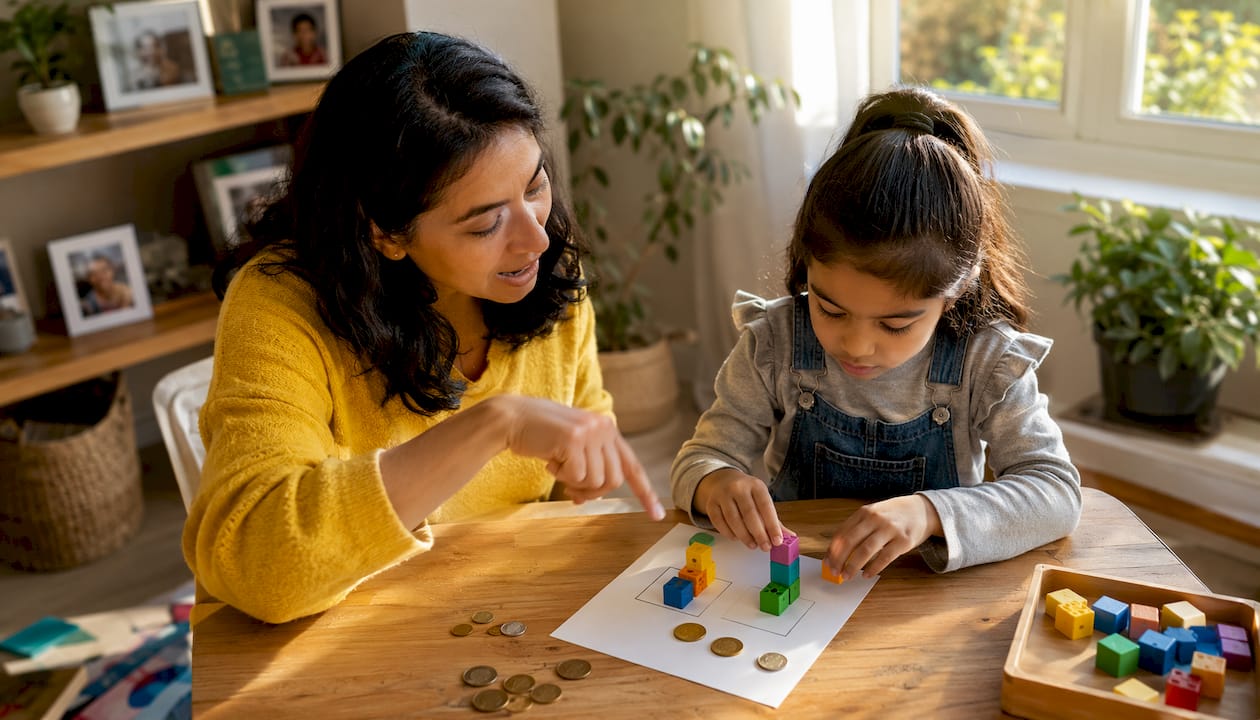
- Money: Calculating £5 + £7 becomes easier when you partition 7 into 5 and 2, add the two 5s to make 10, then add the remaining 2 to get £12. That's part-whole thinking in action, and it's a great way to connect learning money to real arithmetic.
- Number bonds: The model is the clearest visual for showing why 6 + 4 = 10 and 10 − 4 = 6 are the same fact.
- Fact families: One part-whole diagram generates four related number sentences, giving children four facts for the price of one.
- Place value: Partitioning 89 into 80 and 9 is a direct application of the model, and it underpins column addition and subtraction.
- Mental arithmetic strategies: Bridging to ten, using derived facts, and compensating all rely on flexible partitioning that the model builds.
- Inverse operations: Seeing addition and subtraction as two views of the same relationship, rather than two separate topics, is one of the biggest conceptual leaps in early maths. The part-whole model makes that visible.
How Thepocketmoneygame reinforces part-whole skills
Thepocketmoneygame is an online learning platform built for children aged 5–11, covering maths, spelling, and reading. For the part-whole model specifically, it offers something that worksheets alone can't: immediate feedback and adaptive difficulty that adjusts as your child's confidence grows.
- Children practice number bonds and partitioning through interactive questions that mirror the part-whole approach
- The platform's voice support means children can hear questions read aloud, which helps those who find reading a barrier to maths practice
- Every correct answer earns real pocket money, set and controlled by you as the parent. That reward system keeps motivation high, especially for children who find abstract maths frustrating
- The adaptive difficulty means the platform won't stay stuck on easy questions or jump too far ahead, it finds the right level and stays there until your child is ready to move on
- Parents get a dashboard showing progress, so you can see exactly where your child is building confidence and where they might need more support
Pro Tip: Use Thepocketmoneygame alongside physical part-whole activities at home. Let your child work through a concrete exercise with objects, then reinforce the same concept digitally. That concrete-to-digital loop mirrors the concrete-pictorial-abstract progression used in UK classrooms, and it sticks.
Thepocketmoneygame was developed by a parent who understands firsthand how hard it can be when traditional methods don't click. The platform is particularly well-suited to children with ADHD or dyslexia, where the combination of short sessions, real rewards, and voice support makes a genuine difference. You can explore maths games for KS1 and KS2 directly on the site.
How to assess whether your child understands the part-whole model
You don't need a formal test to know if the concept has landed. A few simple checks tell you a lot.
Watch what they do with objects. Ask your child to show you how 7 can be split into two parts using counters. If they move all 7 into the whole circle first, then physically transfer them into the parts, they understand the structure. If they place counters in all three circles at once, the concept of the whole "becoming" the parts hasn't clicked yet.
Ask them to explain it. A child who can say "the whole is 9, one part is 4, so the other part must be 5" has internalized the relationship. Struggling to put it into words usually means the pictorial stage needs more time.
Try a missing-part problem. Give the whole and one part, leave the other blank. This is the clearest test of whether subtraction is connected to the model or still treated as a separate skill.
Check flexibility. Can they split the same number in more than one way? If 10 can only ever be 5 and 5 in their mind, they need more practice with varied partitioning before moving to abstract number work.
Look for transfer. Do they use part-whole thinking when solving word problems or working with money? Transfer to new contexts is the strongest sign that understanding is genuine, not just memorized.
Key Takeaways
The part-whole model is the single most effective visual tool for building addition and subtraction understanding in children aged 4–7, and it underpins number bonds, fact families, and mental arithmetic strategies throughout primary school.
| Point | Details |
|---|---|
| Start with concrete objects | Physical movement from whole to parts builds the concept before diagrams or numbers are introduced. |
| Use the cherry diagram | A large circle for the whole, connected to smaller circles for parts, makes the relationship visible and memorable. |
| Go beyond two parts | Splitting a whole into three or more parts prevents rigid thinking and builds stronger number sense. |
| Connect to addition and subtraction | One part-whole diagram generates four related number sentences, linking both operations naturally. |
| Thepocketmoneygame supports practice | Its adaptive maths questions, real rewards, and voice support reinforce part-whole skills at home for children aged 5–11. |
Thepocketmoneygame makes maths practice feel worth it
If your child understands the part-whole model in class but loses interest the moment homework comes out, the problem usually isn't the maths. It's the motivation. Thepocketmoneygame solves that by turning practice into something children actually want to do: earn real pocket money for every correct answer.
Built by a parent who knows what it's like when standard approaches don't work, the platform covers KS1 and KS2 maths with adaptive difficulty, voice support, and a parent dashboard that keeps you in control. Whether your child needs to consolidate number bonds, practice partitioning, or build confidence with mental arithmetic, the questions adapt to meet them where they are. Children with ADHD or dyslexia get the same experience without the frustration, thanks to short sessions and immediate feedback. You set the reward amount, you track the progress, and your child does the learning.
Start your free 7-day trial today and see how quickly maths practice becomes the part of the day your child looks forward to.
Recommended
- Times Tables Year 4: MTC Curriculum Guide for Parents | The Pocket Money Game
- Teaching Children the Value of Money Through Learning | The Pocket Money Game
- My Child Still Can't Do Times Tables in Year 5 — Here's What Actually Helps | The Pocket Money Game
- How to Help Your Child Learn Times Tables at Home — The Pocket Money Game