
Bus stop division, formally called short division, is a written method where the dividend sits inside a bracket (the "bus stop"), the divisor sits outside to the left, and the quotient is written above. BBC Bitesize describes it as a structured left-to-right algorithm where you divide each digit and carry any remainder as a small digit to the next partial dividend. Teach it once your child knows their times tables confidently and understands place value. Start with single-digit divisors and two- or three-digit dividends before anything bigger.
Key Takeaways
Bus stop division is a left-to-right written algorithm that works best with single-digit divisors once a child knows their times tables and understands place value.
| Point | Details |
|---|---|
| Left-to-right always | Divide from the largest place value first; carrying remainders right is the core of the method. |
| Times tables come first | Short division depends on fast recall; build table fluency before introducing the bracket. |
| Three ways to show remainders | Express as r x, a fraction, or a decimal depending on the context the problem sets. |
| Daily five minutes beats weekly drills | Short, frequent sessions build procedural fluency faster than long, infrequent ones. |
| Thepocketmoneygame | Adaptive questions, voice support, and real pocket-money rewards make daily short-division practice sustainable. |
Table of Contents
- How to do bus stop division: a step-by-step walkthrough
- Common mistakes to watch for when your child practices
- Low-prep activities that make short division click
- Scaffolds for children who struggle, including neurodiverse learners
- Practice problems with worked answers
- When is your child ready to move on to long division?
- Quick ways to check whether an answer is right
- How Thepocketmoneygame supports short-division practice
- An honest word for parents who are finding this tricky
- Thepocketmoneygame makes short-division practice feel like a reward
- Sources
How to do bus stop division: a step-by-step walkthrough
The core sequence is: set up the bracket, divide the first digit, carry any remainder, move right, repeat. Here is how that looks in practice.
Worked example 1: 950 ÷ 4
Wikipedia's detailed worked example of this exact calculation shows the algorithm clearly.
- Write 4 outside the bracket and 950 inside.
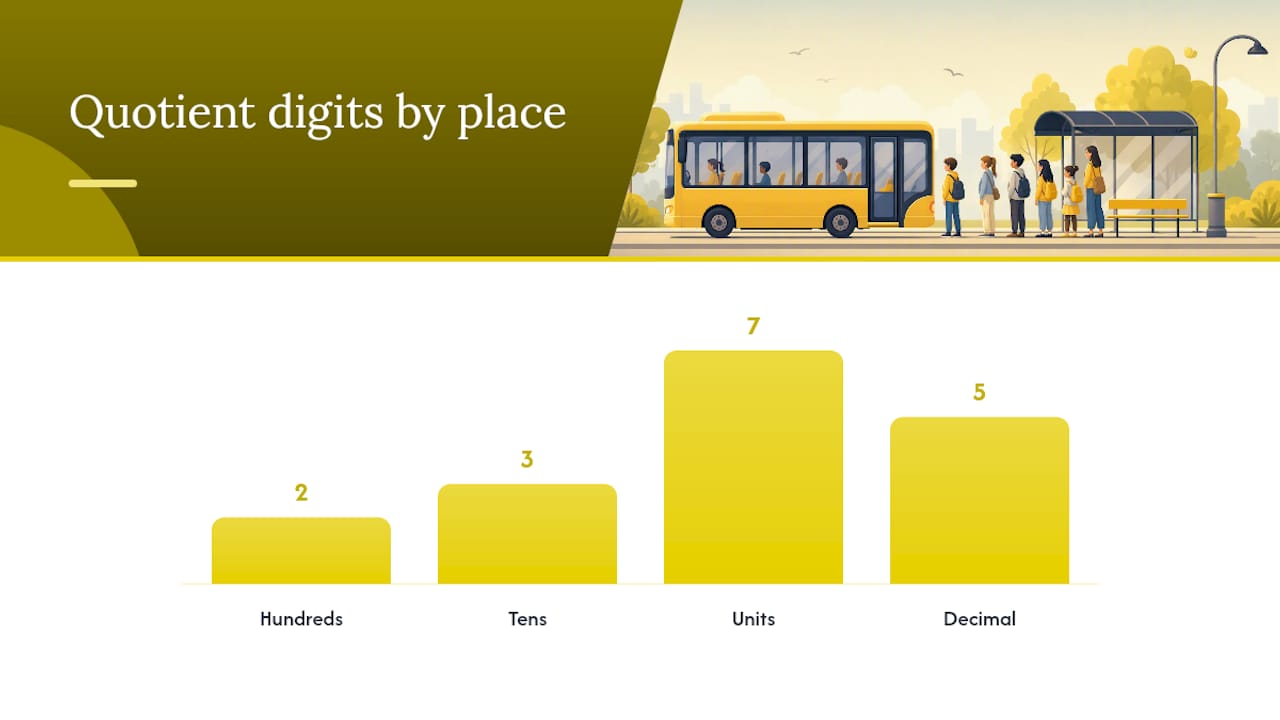
- Divide the hundreds: 9 ÷ 4 = 2, remainder 1. Write 2 above the 9. Carry the 1 as a small superscript before the 5, making the next partial dividend 15.
- Divide the tens: 15 ÷ 4 = 3, remainder 3. Write 3 above the 5. Carry the 3 before the 0, making the next partial dividend 30.
- Divide the units: 30 ÷ 4 = 7, remainder 2. Write 7 above the 0.
- Result: 237 remainder 2 (written 237 r 2).
To extend to a decimal, add a decimal point after 950 and a zero: 20 ÷ 4 = 5, giving 237.5.
Worked example 2: 500 ÷ 4
- 5 ÷ 4 = 1 r 1. Write 1, carry 1 to make 10.
- 10 ÷ 4 = 2 r 2. Write 2, carry 2 to make 20.
- 20 ÷ 4 = 5. Write 5.
- Result: 125 (no remainder).
| Step | Partial dividend | Quotient digit | Remainder carried |
|---|---|---|---|
| Hundreds | 9 | 2 | 1 |
| Tens | 15 | 3 | 3 |
| Units | 30 | 7 | 2 |
| Decimal (×10) | 20 | 5 | 0 |
Pro Tip: Write carried remainders as small superscript digits directly in front of the next digit, not above or below. Squared paper keeps columns straight and prevents place-value slippage, a tip PlanBee recommends for classroom use.
Common mistakes to watch for when your child practices
The single most common error is starting from the right instead of the left. Unlike column addition or subtraction, short division works left-to-right, and children who have just learned those methods often default to the wrong direction.
The four errors that trip children up most often:
- Starting from the right. Correct it with: "We always start with the biggest number first, the one on the left."
- Carrying the wrong remainder. If 13 ÷ 4 = 3 r 1, the carried digit is 1, not 3. Ask: "What's left over after you share it out?"
- Forgetting a placeholder zero. If a digit divides exactly, a 0 must go in the quotient. Skipping it shifts every digit that follows.
- Misaligning digits. One digit written slightly off-column causes cascading errors. Squared paper fixes this immediately.
Pro Tip: When your child carries a remainder, have them say it aloud: "9 divided by 4 is 2, with 1 left over." Verbalizing the step slows the process just enough to catch errors before they compound.
Low-prep activities that make short division click
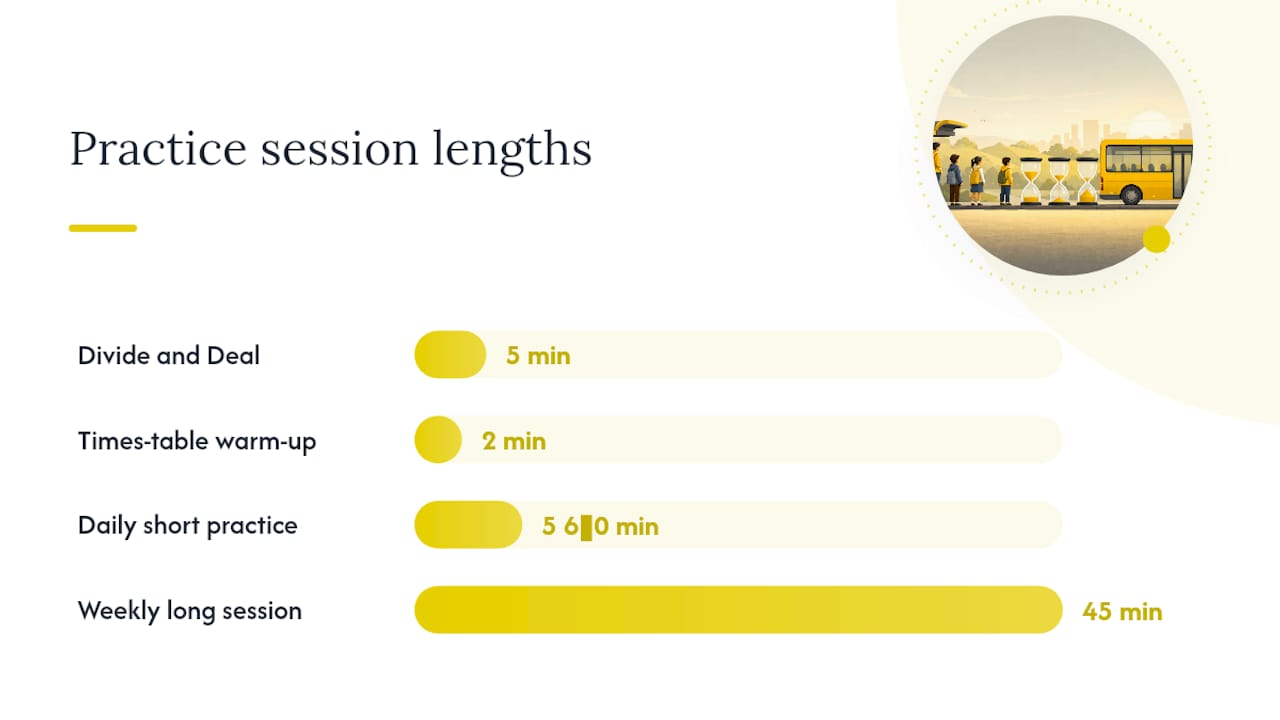
The quickest activity to start with is "Divide and Deal": write a three-digit number on a card, ask your child to deal it into equal groups using counters, then record the working using the bus stop bracket. It takes five minutes and makes the abstract algorithm concrete.
- Divide and Deal (counters). Use physical counters to share a two-digit number into equal groups. Connect the physical sharing to the written bracket notation. Works well for Year 3–4.
- Squared-paper relay. Write the bracket together, then take turns completing one step each. Keeps both of you engaged and slows the pace enough to spot errors.
- Card-draw problems. Draw two number cards for the dividend and one for the divisor. Solve, then check with multiplication. Adds a game element without any prep.
- Word-problem cards. Write short real-life scenarios: "84 sweets shared between 6 friends." KS2 word problems help children see division as a practical tool, not just a written exercise.
- Remainder hunt. Give a set of ten problems and challenge your child to find which ones produce a remainder. Builds number sense alongside the algorithm.
- Decimal extension challenge. Once a child is confident with remainders, add the decimal continuation step to one problem per session. Gradual exposure prevents overwhelm.
- Times-table warm-up. Spend two minutes on times-tables recall before every division session. Short division depends on fast recall; the warm-up pays off immediately.
Pro Tip: Five to ten minutes of daily practice beats a single 45-minute session every weekend. Short, frequent repetition is how procedural fluency actually builds.
Scaffolds for children who struggle, including neurodiverse learners
Start with fewer digits and use counters or voice support alongside the written method. That single adjustment reduces cognitive load more than any other change.
- Chunk the problem. Cover all but the first digit with a piece of card. Reveal one digit at a time so the child focuses on one step, not the whole number.
- Color-code place values. Hundreds in blue, tens in green, units in red. Visual separation helps children with dyslexia track which column they are working in.
- Read instructions aloud. Narrate each step: "Now look at the tens digit. What does 4 go into 15?" Voice prompts reduce working-memory load for children with ADHD.
- Allow oral answers first. Let your child say the answer before writing it. Recording comes second; accuracy comes first.
- Use adaptive timing. Remove time pressure entirely during the learning phase. Speed comes with fluency, not the other way around.
- Reward small wins. A sticker, a point, or a small coin for each correctly completed step keeps motivation alive through the tricky middle stage.
Thepocketmoneygame was built by a parent with ADHD and dyslexia, so its voice support, adaptive difficulty, and reward-based learning for ADHD features map directly onto these scaffolds. The platform adjusts question difficulty automatically and reads questions aloud, which removes two of the biggest friction points for neurodiverse learners.
Pro Tip: If your child freezes at the bracket, try the part-whole model first. Visualizing how a number splits into parts often unlocks the "why" behind carrying remainders.
Practice problems with worked answers
Ten problems, ordered from straightforward to more demanding. BBC Bitesize's division practice uses a similar progression for primary pupils.
- 84 ÷ 4 = 21 (clean, no remainder)
- 96 ÷ 3 = 32 (clean)
- 75 ÷ 5 = 15 (clean)
- 91 ÷ 7 = 13 (clean)
- 85 ÷ 4 = 21 r 1 (remainder)
- 67 ÷ 3 = 22 r 1 (remainder)
- 143 ÷ 6 = 23 r 5 (three-digit, remainder)
- 256 ÷ 8 = 32 (three-digit, clean)
- 950 ÷ 4 = 237 r 2 (or 237.5 as a decimal)
- 375 ÷ 6 = 62 r 3 (or 62.5)
Marking tips: Check that the quotient digit sits directly above the digit it came from. Check that every carried remainder is written as a small digit, not circled or written separately. If the answer feels too large or too small, run the quick multiplication check in the next section.
Remainders can be expressed three ways: as r x, as a fraction (remainder over divisor), or as a decimal. BBC Bitesize explains when each representation is appropriate, and practicing all three with word problems builds the contextual judgment the curriculum requires.
When is your child ready to move on to long division?
The clearest signal: your child completes short division problems accurately and quickly, with no hesitation on times-table facts up to 10×. Third Space Learning notes that the method is typically introduced in Year 3, practiced in Year 4, and consolidated in Years 4–5 before long division appears.
Short division is the right tool when:
- The divisor is a single digit (2–9).
- The child can hold partial remainders in their head without losing track.
- Speed and compactness matter more than showing every partial product.
Long division becomes necessary when:
- The divisor has two or more digits.
- The mental arithmetic load of estimating partial products is too high.
- The curriculum explicitly requires written partial products (typically Year 5–6).
Bridge steps to prepare your child:
- Practice short division with divisors of 7, 8, and 9 until fluent (these require the strongest times-table recall).
- Introduce the idea of "how many times does 12 go into 36?" as a spoken question before writing anything.
- Work one problem showing both methods side by side so your child sees that long division is just short division with the working shown explicitly.
Quick ways to check whether an answer is right
The fastest check: multiply the quotient by the divisor, then add the remainder. The result must equal the original dividend.
- Multiplication reconstruction. For 950 ÷ 4 = 237 r 2: (237 × 4) + 2 = 948 + 2 = 950. Correct.
- Rounding estimate. Round 950 to 1,000 and divide by 4 mentally: roughly 250. An answer of 237 is close; an answer of 2,370 is not. This catches place-value errors immediately.
- Place-value sense check. Ask: "Does it make sense that sharing 950 into 4 groups gives about 237 each?" If the quotient is bigger than the dividend, something has gone wrong.
How Thepocketmoneygame supports short-division practice
The single most useful feature for division practice is adaptive questioning combined with real pocket-money rewards. The platform adjusts difficulty automatically, so a child who breezes through 84 ÷ 4 gets pushed toward 143 ÷ 6 without you having to select the next problem yourself.
- Adaptive difficulty matches question complexity to your child's current accuracy, keeping practice in the productive zone.
- Voice support reads questions aloud, reducing reading load so the focus stays on the maths.
- Parent dashboard shows which question types your child is getting right and where errors cluster.
- Reward controls let you set small real-money rewards per correct answer, turning a five-minute practice session into something your child actually asks for.
- Short-session design fits the five-to-ten-minute daily practice rhythm that builds fluency fastest.
For KS2 maths practice, pair platform sessions with the offline activities above: use the app for daily drilling and the counters or squared-paper exercises for the initial concept-building stage.
An honest word for parents who are finding this tricky
Short division looks simple on paper and feels harder in practice, especially when you are trying to explain it to a frustrated eight-year-old at the kitchen table. That is completely normal. Most children need several weeks of short, regular practice before the method feels automatic, and most parents need a session or two to remember the steps themselves.
The goal is not perfection in one sitting. It is five minutes today, five minutes tomorrow, and a little more confidence each time. Try one activity from the list above and one set of practice problems this week. That is enough.
Thepocketmoneygame makes short-division practice feel like a reward
Real pocket money for every correct answer changes the dynamic completely. Instead of sitting down to "do maths," your child sits down to earn. Thepocketmoneygame's adaptive learning app covers KS1 and KS2 maths with no download needed, voice support built in, and a parent dashboard that shows exactly where your child needs more practice.

Start a free 7-day trial, set the difficulty to short division, turn on voice support, and enable a small reward per correct answer. One seven-minute session is all it takes to see whether it clicks for your child.
Sources
- How to use the bus stop method in short division - BBC Bitesize
- Short division - Wikipedia
- What Is Short Division? Explained For Primary School
- Bus Stop Method Division | Short Division – PlanBee