
Three five-minute retrieval sessions a day, using timed mixed-table drills with immediate feedback, is the single most effective home routine for building fast times tables recall. Start today with two activities: run a timed online drill with a 3–4 second cutoff, then follow it with a quick offline flashcard round. That's it. Ten minutes, done.
Here's what to keep in mind from the start:
- Short and frequent beats long and occasional. Three 5-minute sessions daily outperform one 15-minute block for long-term retention.
- Timed retrieval is the goal. Speed reveals which facts your child has truly memorized versus which ones they're still working out.
- The MTC is the benchmark. England's Multiplication Tables Check (MTC), taken by Year 4 pupils, tests all tables from 2–12 in a timed online format.
- Low-stakes rewards keep kids going. Praise, sticker charts, or earned pocket money reduce anxiety and build the habit.
If you want a ready-made solution, Thepocketmoneygame offers KS1/KS2-aligned timed multiplication practice where children earn real pocket money for correct answers — a reward system that keeps motivation high without pressure.
Table of Contents
- What is the Multiplication Tables Check and why does it matter?
- How to build a simple daily times tables practice plan
- Which interactive resources actually build fluent recall?
- Printable worksheets and offline games that reinforce recall
- How to help your child move from counting to instant recall
- Signs your child needs extra support
- Key Takeaways
- The part most parents get wrong about times tables
- Thepocketmoneygame makes times tables practice feel worth it
- Useful sources and further reading
What is the Multiplication Tables Check and why does it matter?
The Multiplication Tables Check (MTC) is a statutory assessment for Year 4 pupils in England. It consists of 25 questions covering times tables from 2 to 12, delivered online, with pupils given 6 seconds to answer each question. The whole check takes around 5 minutes.
The MTC isn't just a box-ticking exercise. Fluent recall of multiplication facts underpins division, fractions, long multiplication, and almost every area of secondary maths. A child who has to count up to find 7×8 will struggle to keep up when problems get more complex.
Key facts about the MTC:
- Covers all times tables from the lower single digits through 12
- A series of questions, each with a short time limit for answering
- Taken by pupils at a primary school level annually, toward the end of the school year
- Results are shared with parents but are not used for school league tables
- KS1 pupils (Years 1–2) begin building the foundations; KS2 pupils (Years 3–6) consolidate and extend
For a full breakdown of what Year 4 pupils are expected to know, the MTC curriculum guide on Thepocketmoneygame is a helpful starting point.
How to build a simple daily times tables practice plan
You don't need a tutor or an expensive program. A consistent daily structure, built around short retrieval sessions, is what actually moves the needle.
The daily schedule
Aim for a short total daily practice time split across two or three short bursts if your child's attention drifts. A workable structure:
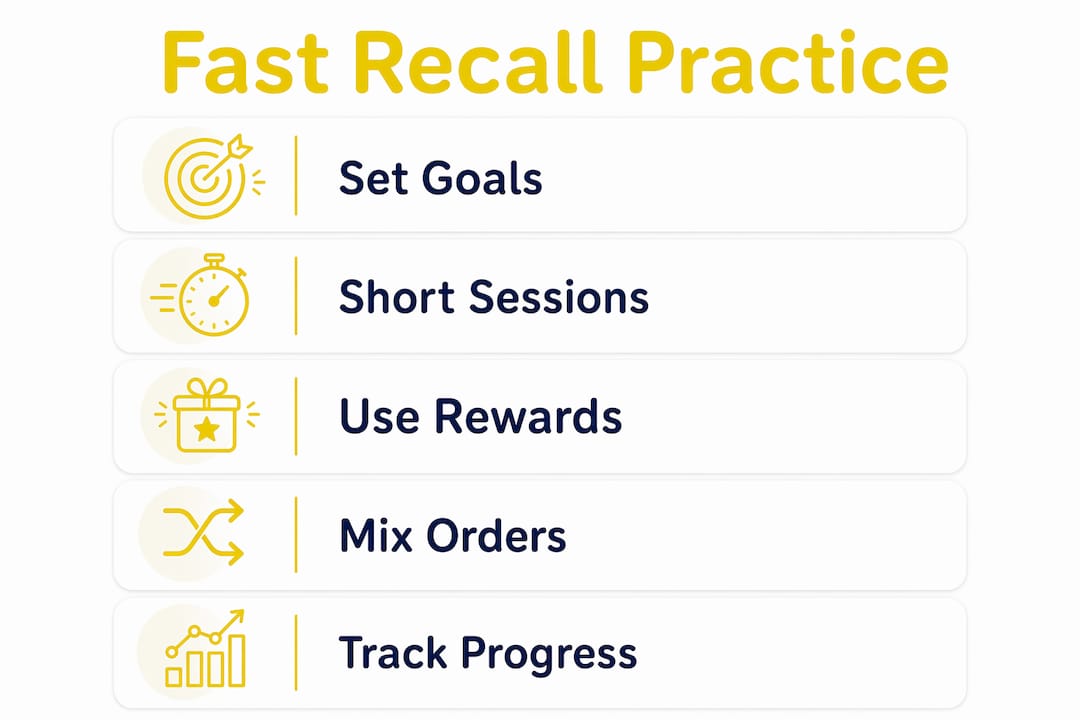
- Morning warm-up (5 minutes): Run a timed online drill. Set the cutoff to 3–4 seconds per answer. This forces retrieval rather than counting.
- After-school review (5 minutes): Flashcards or a whiteboard race focused on the current table set.
- Evening wind-down (optional, 5 minutes): A low-pressure mixed-table quiz or a multiplication game.
Weekly progression checklist
Learning tables in chunks reduces cognitive overload and builds early confidence. Follow this order:
- Week 1–2: 1s, 2s, 5s, 10s (pattern-based, confidence-building)
- Week 3–4: 3s and 4s (introduce alongside mixed practice of Week 1–2 tables)
- Week 5–6: 6s, 7s, 8s, 9s, 12s (harder sets; use known tables as scaffolding)
- Week 7+: Full mixed-table random drills across all 2–12
Parent readiness checklist
Before moving to random timed drills, confirm your child can:
- Answer the current table set in sequence without hesitation
- Answer questions in random order within that table
- Recall answers in under 4 seconds consistently
Pro Tip: Use small, immediate rewards after each session rather than saving praise for a "perfect" score. A sticker, a point toward pocket money, or simply saying "that was faster than yesterday" does more for consistency than waiting for a flawless run.
Which interactive resources actually build fluent recall?
Not all apps are equal. The features that genuinely improve recall are specific, and knowing what to look for saves you from wasting time on tools that feel educational but don't build speed.
Features that matter:
- Timed drills with an adjustable cutoff (ideally 3–4 seconds) so children retrieve rather than calculate
- Adaptive focus on slow facts: the app identifies which answers took longest and queues those for extra review
- Mixed-table randomization to prevent sequence memorization
- Instant feedback after every answer
- Parent-facing progress reports showing accuracy and response times
- Low-stakes reward mechanics that motivate without creating test anxiety
Reward-based systems are particularly effective for children preparing for timed assessments like the MTC, because they associate practice with a positive outcome rather than a pass/fail judgment.
How Thepocketmoneygame maps to these features
Thepocketmoneygame covers all of these bases for KS1 and KS2 learners. Its KS2 maths games include timed multiplication drills aligned to the Year 2–6 curriculum, with a parent dashboard that tracks progress across sessions. The reward system is genuinely different: children earn real pocket money for correct answers, controlled entirely by the parent. Voice support is built in, which helps children who struggle with reading-heavy interfaces.
When trialing any app, test these three things in the free period: voice support, multi-child profiles (useful for siblings), and whether the curriculum tags match your child's year group.
Printable worksheets and offline games that reinforce recall
Online drills are powerful, but offline practice has a place too, especially when screens need a break or you want a quick diagnostic comparison.
Quick offline activities:
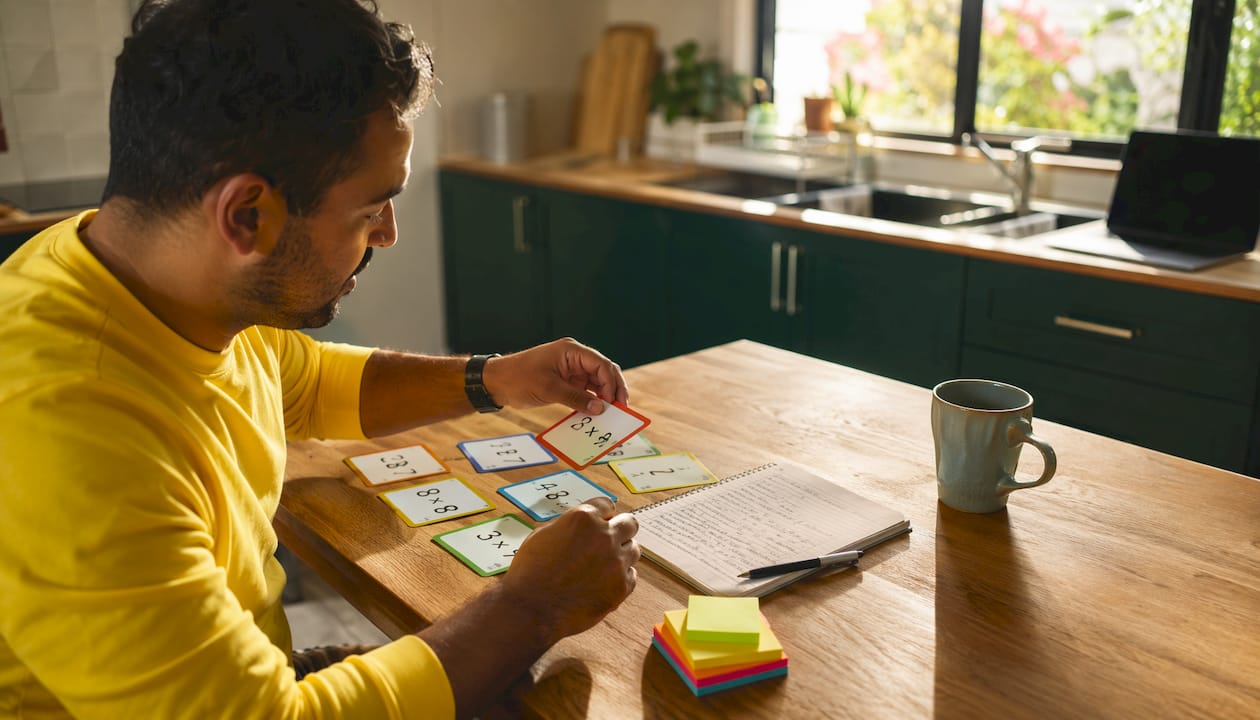
- One-minute flashcard sprints: Shuffle a set of cards for the current table, flip them one by one, and count how many your child answers in 60 seconds. Repeat the round and try to beat the score.
- Whiteboard mixed-table races: Write a random question on a whiteboard and time the response. Erase and repeat. Kids often find the physical act of writing the answer more engaging than typing.
- Build-a-fact puzzles: Give your child a multiplication answer (e.g., 24) and ask them to name every table fact that produces it. This reinforces inverse relationships naturally.
- Printable mixed-table grids and one-minute timed sheets are useful for a quick offline check and let you compare results to online scores over time.
When picking or designing times table worksheets, choose mixed-order over sequential. Sequential sheets let children use the pattern rather than recall the fact.
Pro Tip: Keep every offline task under five minutes and always finish with something positive, even if it's just "you got three more right than last time." Ending on a win is what makes a child want to come back tomorrow.

How to help your child move from counting to instant recall
Counting up in steps is a natural early strategy, but it has to be phased out. A child who counts to reach 6×7 will never pass the MTC comfortably, and the habit becomes a bottleneck in Year 5 and beyond.
Here's a simple 5-minute session that forces retrieval:
- Timed warm-up (90 seconds): Run 10 questions from a familiar table at a 4-second cutoff. This builds confidence before the harder work.
- Slow-fact focus (2 minutes): Identify the 2–3 facts that took longest in the warm-up. Drill only those, repeatedly, with a tighter cutoff (3 seconds).
- Mixed high-speed drill (90 seconds): Run 10 random questions across two or three tables. Don't correct mid-session; just keep the pace fast.
Two techniques that accelerate the shift from counting to recall:
- Reversal practice: Drill both 7×8 and 8×7 in the same session. Pairing reversed questions with their inverse division facts (56÷7=8) deepens understanding and prevents rote sequence memorization.
- Response time as a diagnostic: Any answer taking longer than 3 seconds is a "slow fact." Log it, and add it to the next session's focused review queue rather than drilling the whole table again.
Pro Tip: Don't tell your child they're "too slow." Instead, frame it as: "Let's make that one feel easy." The goal is to make fast recall feel like a superpower, not a test they're failing.
Signs your child needs extra support
Most children reach fluent recall with consistent daily practice. But some need more targeted help, and spotting the signs early makes a real difference.
Watch for these red flags:
- Persistent slow recall on most tables by Year 5, despite regular practice
- Frequent errors on inverse facts (e.g., knows 6×8 but can't do 48÷6)
- Anxiety or distress that prevents even short, low-stakes sessions
- No improvement in response times after 4–6 weeks of daily practice
If you're seeing these patterns, here's a practical action plan:
- Log two weeks of session data (which facts are slow, how long sessions last, how your child responds emotionally) before speaking to a teacher.
- Book a conversation with the class teacher or KS2 maths lead. Bring your log. Ask specifically about in-class support and whether a SENCO referral is appropriate.
- Try a neurodiversity-aware approach for 4–6 weeks. Short sessions (5 minutes maximum), voice support, and reward-based practice are particularly helpful for children with ADHD or dyslexia. Thepocketmoneygame was built by a parent with ADHD and dyslexia specifically with these needs in mind.
- Consider a specialist primary numeracy tutor if school support isn't sufficient.
For more specific guidance on children who are behind expected fluency, this resource for Year 5 covers what actually helps when standard practice isn't working.
Key Takeaways
Short, frequent, timed retrieval sessions are the most effective way to build fluent times tables recall and prepare for the MTC.
| Point | Details |
|---|---|
| Session length and frequency | Three 5-minute sessions daily outperform longer, infrequent blocks for long-term retention. |
| MTC readiness | The MTC tests 25 questions across tables 2–12 with 6 seconds per answer; timed practice at home mirrors this format directly. |
| Chunked progression | Start with 1s, 2s, 5s, 10s; add 3s and 4s; then tackle 6–9 and 12s before moving to full mixed drills. |
| Low-stakes rewards | Immediate small rewards after each session reduce anxiety and sustain the daily habit. |
| Thepocketmoneygame | Offers KS1/KS2-aligned timed drills, a parent dashboard, and a real pocket money reward system — try it free for one week. |
The part most parents get wrong about times tables
Most parents focus on whether their child gets the answer right. The more useful question is how fast they got there.
Accuracy without speed is not fluency. A child who works out 8×7 correctly in 8 seconds is still counting. The MTC gives 6 seconds per question, and real mathematical fluency, the kind that helps in Year 6 and beyond, needs answers to come in under 3. That's the threshold worth tracking at home.
The other thing worth saying plainly: setbacks are normal. A child who nails the 4 times table on Monday and blanks on it Thursday hasn't forgotten everything. Memory consolidates unevenly, especially in primary-aged children. The answer isn't a longer session or more pressure. It's showing up again the next day for another five minutes.
Consistency beats intensity every time. A child who practices for 10 minutes daily for a month will outperform one who does an hour on Sunday. That's not a motivational claim; it's how retrieval practice actually works. Keep sessions short, keep them regular, and keep the atmosphere calm. The recall will come.
Thepocketmoneygame makes times tables practice feel worth it
Most children don't resist learning times tables because they're lazy. They resist because practice feels like a test they keep failing. Thepocketmoneygame flips that: every correct answer earns real pocket money, controlled by you as the parent, so the reward is immediate and tangible.

The platform covers KS1 and KS2 multiplication, with timed drills aligned to the MTC format, a parent dashboard showing progress and response times, and adaptive difficulty that adjusts to your child's current level. Voice support is built in for children who find reading-heavy interfaces difficult, and you can set up multiple child profiles if you have more than one child practicing. The whole thing is designed to run in short daily sessions, which is exactly what the research supports.
Start with a free trial at Thepocketmoneygame and see how your child responds when practice comes with a real reward.
Useful sources and further reading
These are the resources cited throughout this article, plus a few extras worth bookmarking:
- Multiplication Tables Check — GOV.UK: The official assessment framework for the MTC, including format, timing, and statutory requirements.
- Education Hub — What is the MTC?: A plain-language government explainer on why the MTC was introduced and what it measures.
- Math Trainer — Multiplication (Maths Is Fun): Free timed online trainer with adjustable cutoff; excellent for daily retrieval sessions.
- Printable Times Table Grids (Maths Is Fun): Printable mixed-table grids and blank charts for offline practice.
- Timestables.co.uk: MTC-style practice with 25-question timed tests; useful for simulating the actual check.
- Times Tables Kids: Chunked learning sequences and games organized by table difficulty.
- BBC Bitesize — Times Tables Games and Songs: Songs, quizzes, and interactive activities for KS1 and KS2, covering all tables from 2 to 12.
- HeLovesMath — Times Table Practice: Interactive quizzes with reversal and division-fact pairing.
- Thepocketmoneygame — Times Tables & MTC Practice: Free MTC-style practice and games for Year 2–6, with the parent-controlled reward system.
Pick two or three of these and try them consistently for one week. Variety keeps practice fresh; consistency is what builds recall.
Recommended
- How to Help Your Child Learn Times Tables at Home — The Pocket Money Game
- Times Tables Year 4: MTC Curriculum Guide for Parents | The Pocket Money Game
- Times Tables Games & Free MTC Practice | Year 2–6 | The Pocket Money Game
- My Child Still Can't Do Times Tables in Year 5 — Here's What Actually Helps | The Pocket Money Game