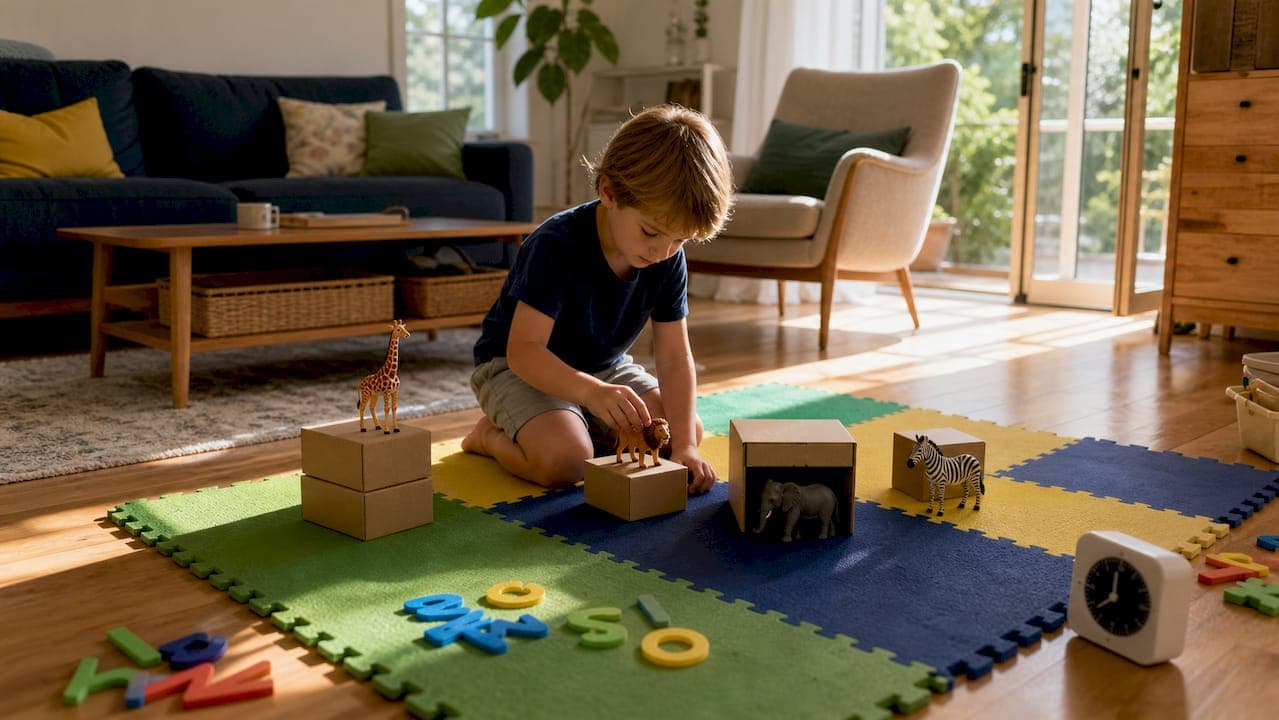
The fastest way to teach prepositions at KS1 is to start with place words, move children's bodies, and keep every session under 10 minutes. Three activities you can run right now:
1. Movement Game (Simon Says variant)
- Say "Simon says put your hands on your head" or "stand behind your chair."
- Children act out each instruction. No materials needed.
- Run for 3–5 minutes, swapping in a new preposition each round.
2. Matching/Pairs Game
- Print or draw six picture cards showing a toy in different positions (in a box, on a box, under a box).
- Lay them face-up and ask children to match each picture to a word card.
- Takes about 5 minutes; works 1:1 or in a small group.
3. Story-Sentence Swap
- Read one sentence from a picture book aloud: "The cat sat on the mat."
- Ask the child to swap the preposition: "What if the cat sat under the mat?"
- One minute per sentence; no prep required.
These three activities cover the core KS1 teaching target: place prepositions that show where something is. Once children are confident with position words, you add simple time prepositions like before, after, and during.
Key Takeaways
Teaching prepositions at KS1 works best when you start with concrete place words, use movement and matching activities daily, and keep every session short enough that children always want more.
| Point | Details |
|---|---|
| Start with place prepositions | Teach in, on, under, next to, behind before introducing time words like before or after. |
| Use movement every session | Simon Says variants and obstacle courses help children internalize position words faster than worksheets alone. |
| Keep sessions under 10 minutes | Short, frequent practice builds retention more reliably than a single longer lesson each week. |
| Adapt for every learner | Visual timers, gesture cues, voice support, and immediate micro-rewards keep neurodiverse learners engaged. |
| Thepocketmoneygame for daily practice | Short reward-based sessions with voice support and parent-controlled difficulty complement hands-on KS1 activities. |
Table of Contents
- What is a preposition? A KS1-friendly explanation with examples
- Which prepositions should you teach first at KS1?
- Ready-to-use preposition activities for KS1 (step-by-step)
- Where to find printables and digital resources for KS1
- A copy-and-paste 15-minute KS1 preposition lesson plan
- How to adapt preposition activities for every learner
- How to check understanding and plan what comes next
- Why short, multi-sensory practice works for KS1 learners
- The small habit that actually builds grammar confidence
- Thepocketmoneygame makes short preposition practice genuinely rewarding
- Useful resources for KS1 preposition teaching
- Sources
What is a preposition? A KS1-friendly explanation with examples
A preposition is a word that tells you where something is or when something happens. That is the whole definition, and it is enough for a 5–7-year-old.
The classic teaching image is a mouse and a box. Place a toy mouse in the box, on the box, under the box, and next to the box. Each position gets one word. Children see the relationship between the mouse and the box change with every move, which is exactly what a preposition does: it shows the relationship between two things.
Short example sentences to use with KS1 children:
- "The ball is in the bag."
- "The book is on the table."
- "The dog is under the chair."
- "Sam is standing next to the door."
Picture-prompt ideas: Use a small toy animal and a shoebox, a pencil case and a ruler, or classroom objects like a water bottle and a tray. The physical object matters more than any worksheet at this stage. Children who act out the sentence ("Put the bear behind the cup") remember the word far longer than children who only read it.
Which prepositions should you teach first at KS1?
Start with the nine place prepositions that appear most often in KS1 reading and writing. Teach them in this order, because each step builds on the last:
- in and on (the two most common; children already use them in speech)
- under (natural opposite pair with on)
- next to / beside (side-by-side position; introduce both words together)
- behind and in front of (opposite pair; great for movement games)
- between (requires understanding of two reference points)
- above and below (more abstract; use wall displays or ceiling/floor)
- near (relative distance; slightly more conceptual)
Once children can use all nine confidently in spoken sentences, introduce simple time prepositions: before, after, at (as in "at lunchtime"), and in (as in "in the morning"). The teaching sequence matters because concrete place words give children a mental model they can later transfer to time.
This list aligns with the Key Stage 1 English curriculum, which asks children to use words that describe position and to write sentences with correct grammar. Prepositions are not named explicitly in the KS1 programme of study, but they underpin the sentence-level work children are assessed on throughout Years 1 and 2.
Ready-to-use preposition activities for KS1 (step-by-step)
These activities work in a classroom or at home. Each one is low-prep, and most need nothing beyond everyday objects.
1. Simon Says preposition game
- Stand children in a space where they can move freely.
- Call out "Simon says put your pencil on your head" or "Simon says stand behind your chair."
- Anyone who moves without "Simon says" sits down for one round.
- Swap in a new preposition every 2–3 turns.
Movement games like this help children internalize positional vocabulary because the body becomes the learning tool. Whole-class; 5 minutes.
2. Obstacle course directions
- Set up a simple course using chairs, a hoop, and a table.
- Give directions using only prepositions: "Go through the hoop, walk around the chair, crawl under the table."
- Children take turns following the route while the class calls out the preposition they see.
- Swap the course layout to introduce new words.
Small group; 10 minutes.
3. Counting bear and cup matching
- Place a small toy (a counting bear, a LEGO figure, or any small object) and a cup on the table.
- Say a preposition and ask the child to position the toy: "Put the bear inside the cup."
- Then reverse it: the child positions the toy and you name the preposition.
- Extend by asking the child to say a full sentence: "The bear is inside the cup."
This hands-on approach works especially well for 1:1 and small-group sessions. 5–8 minutes.
4. Preposition song with gestures
- Choose a simple tune (the chorus of "Head, Shoulders, Knees and Toes" works well).
- Sing a line for each preposition while doing the matching gesture: arms up for above, crouch down for below, hands beside hips for next to.
- Repeat the song twice, getting faster each time.
- Ask children to freeze on a named preposition and hold the gesture.
Pairing rhythm with motion helps children retain the words by anchoring meaning to a physical memory. Whole-class; 5 minutes.
5. Preposition scavenger hunt with drawing
- Give each child a simple grid with six boxes.
- Call out a prompt: "Draw something that is on a shelf" or "Draw something that is under a table."
- Children sketch quickly (30 seconds per box), then share with a partner.
- Partners say the full sentence: "My picture shows a book on a shelf."
Drawing-and-movement prompts give children ownership and support EAL learners who can show understanding before they can say the word. Small group or whole-class; 10 minutes.
6. Class preposition book
- Each child contributes one page: they draw a scene and write (or dictate) one sentence using a preposition.
- Compile the pages into a class book: "Our Preposition Book."
- Read it together as a shared text in a later session.
- Ask children to spot prepositions in the wild in other books you read that week.
Whole-class project; 15 minutes to create, ongoing use.
Timings and group sizes at a glance:
| Activity | Time | Group size |
|---|---|---|
| Simon Says game | 5 minutes | Whole class |
| Obstacle course | 10 minutes | Small group (4–6) |
| Counting bear and cup | 5–8 minutes | 1:1 or pairs |
| Preposition song | 5 minutes | Whole class |
| Scavenger hunt drawing | 10 minutes | Small group or whole class |
| Class preposition book | 15 minutes | Whole class |
Where to find printables and digital resources for KS1
Good printables save you 20 minutes of prep. Here is where to look and how to use what you find.
Printable resource types to look for:
- Picture-and-word matching cards (a picture of a cat on a box paired with the word card "on")
- Preposition sorting mats (children place word cards into columns: place words vs. time words)
- Fill-in-the-gap sentence strips ("The ball is ___ the bag")
- Simple scene images with a blank sentence frame underneath
Where to find them:
- Twinkl is the most widely used UK teacher resource platform and carries a large range of KS1 preposition printables, including matching cards, display posters, and differentiated worksheets aligned to the National Curriculum.
- Teach Starter offers image-and-word matching card sets that work directly with the matching activities above.
- For screen-free, 5-minute activity ideas that adapt well to home settings, Mooshie Moments has practical inspiration for early-years and KS1 families.
How to use downloaded cards in your activities:
- Use matching cards as the pairs game from Section 1.
- Lay picture cards face-down for a memory/snap variant.
- Use scene images as charades prompts: one child acts out the position, others hold up the matching word card.
Short digital practice: A 5–10 minute screen session works well after a hands-on activity, not instead of one. Thepocketmoneygame provides short, reward-based practice with voice support, which means children hear the word read aloud as they answer, reinforcing the connection between the written word and its sound. That is particularly useful for early readers who are not yet confident decoding independently.
A copy-and-paste 15-minute KS1 preposition lesson plan
Learning objective: Children can identify and use at least three place prepositions in spoken sentences.
Success criteria:
- I can say what a preposition does (it tells us where something is).
- I can use in, on, and under correctly in a spoken sentence.
- I can follow a direction that uses a preposition.
Materials: One small toy, one box or cup, six picture cards (printable or hand-drawn), word cards for in, on, under, next to, behind.
| Time | Activity | Teacher prompt |
|---|---|---|
| 3–5 min | Starter: toy and box demo | "Watch where I put the bear. What word tells us where it is?" |
| 3–8 min | Simon Says movement game | "Simon says stand behind your chair." Swap preposition every 2 turns. |
| 5–10 min | Matching cards activity | "Match the picture to the word. Say the sentence out loud." |
| 15 min | Plenary: quick check | See assessment checks below. |
Quick assessment checks (plenary, 2 minutes):
- Hold up a picture card and ask: "Tell me where the toy is. Use the word." Listen for correct preposition use in a full sentence.
- Give a direction: "Put your pencil under your book." Watch whether children follow it correctly without hesitation.
How to adapt preposition activities for every learner
Not every child will be ready to say a full sentence on day one, and that is completely fine. Small adjustments make a big difference.
Visual supports:
- Keep a preposition word wall or mat on the table throughout every activity.
- Use color-coded cards (one color per preposition) so children can point before they speak.
- Pair every word with a consistent gesture (thumbs up for above, thumbs down for below).
For children with ADHD:
- Cap each activity at 5 minutes and use a visual timer.
- Give one instruction at a time, not a sequence.
- Immediate micro-rewards (a sticker, a point on a tally chart, or a small digital reward) after each correct response sustain attention far better than end-of-lesson praise. Reward-based learning is particularly effective for attention-challenged learners.
For children with dyslexia:
- Use voice support: read the word card aloud before asking the child to match it.
- Avoid asking children to write prepositions until they are secure in spoken use.
- The gesture-plus-voice approach pairs movement with sound, which supports phonological memory.
For EAL learners:
- Use physical objects and real actions before any written or printed material.
- The scavenger-hunt drawing activity (Section 4, Activity 5) lets EAL children show understanding through pictures before words.
For sensory-sensitive children:
- Offer a fidget toy during seated activities.
- Allow children to whisper their answer rather than call it out.
- Keep the physical space clear and predictable; move furniture before the lesson, not during.
Pro Tip: For high-energy KS1 learners, attach a physical action to every new preposition the moment you introduce it. "Above" gets arms stretched overhead; "under" gets a crouch. Once the gesture is set, you can cue the word silently by doing the action, which keeps the pace fast and the noise manageable.
How to check understanding and plan what comes next
Assessment at KS1 does not need to be formal. The most reliable checks happen during the activity itself.
Observational checks to run during any activity:
- Can the child follow a preposition direction without looking at a peer first?
- Does the child use the preposition spontaneously in speech, not just when prompted?
- Can the child correct a deliberate mistake ("The bear is on the box" when it is clearly under)?
Quick formative checks (1–2 minutes):
- Show a picture card and ask for the sentence. Listen for the preposition.
- Give a matching strip with three options and ask the child to circle the right word.
- Ask the child to give you a direction using a preposition: "Tell me where to put the pencil."
Progression steps — when to move on:
- Secure with single place prepositions in speech → introduce opposite pairs (above/below, in front of/behind).
- Secure with opposite pairs → introduce two-word prepositional phrases: "in the box," "on the shelf."
- Secure with phrases → teach children to move the phrase in a sentence: "The cat sat on the mat" becomes "On the mat, the cat sat." This phrase-as-a-chunk approach is the bridge to KS2 sentence variety.
- Secure with place phrases → introduce time prepositions: before, after, during, at.
- Secure with time prepositions → children are ready for KS2 expectations around prepositional phrases and sentence-level variation.
Why short, multi-sensory practice works for KS1 learners
The evidence behind the activities in this guide points in one direction: young children learn position words faster when they move, see, and hear them together, rather than reading a definition.
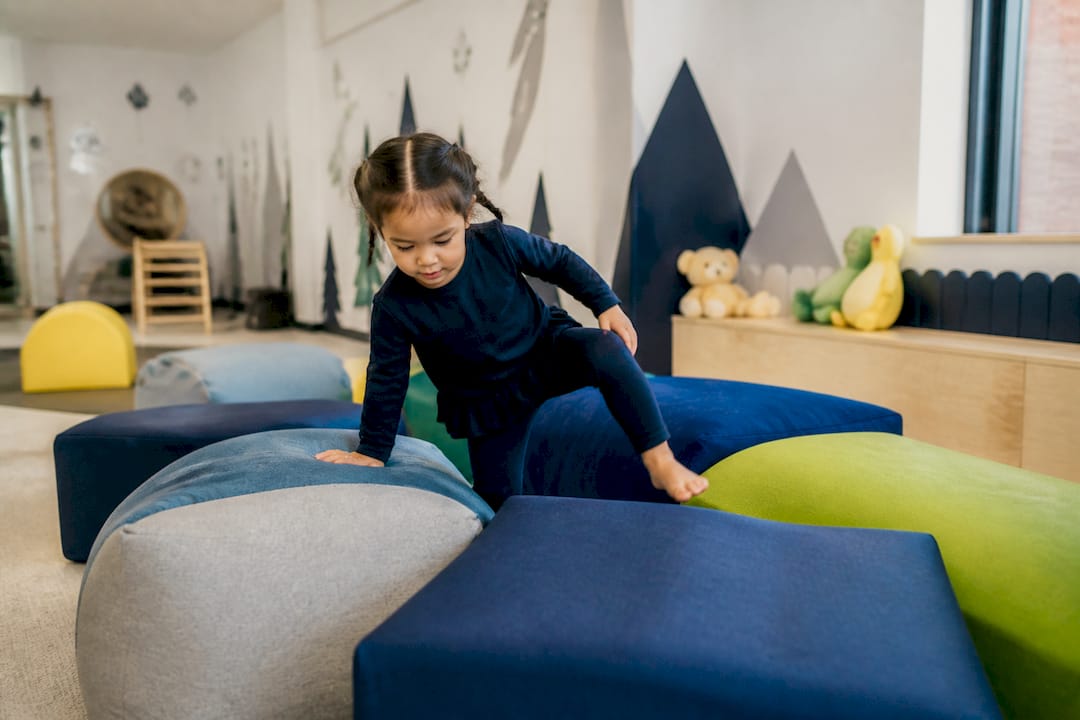
Teaching prepositions through physical demonstration, image-word matching, and spoken sentence use, rotated across short daily sessions, builds retention more reliably than a single longer lesson. The mouse-and-box visual combined with acting out is one of the most cited practical techniques precisely because it gives children a concrete reference point they can return to mentally.
Music and gesture add another layer: rhythm helps children recall the word sequence, and the physical gesture anchors meaning in muscle memory. This is why the preposition song activity works even for children who struggle with reading.
Short digital micro-practice, 5–10 minutes at most, complements hands-on work rather than replacing it. The key is immediacy: a child who gets instant feedback on a correct answer builds confidence faster than one who waits for a marked worksheet to come back.
Gestures anchor meaning, voice support helps decoding for children with dyslexia, and short rewards sustain attention for children with ADHD. When all three work together in a session, even reluctant learners stay engaged long enough to make real progress.
UK guidance on screen time for primary-age children recommends that digital practice is purposeful, time-limited, and supervised. A parent-controlled platform with a daily question cap fits that framework naturally. Thepocketmoneygame's reward-based learning approach is built around exactly these principles: short sessions, immediate feedback, and parent oversight.
The small habit that actually builds grammar confidence
Most parents and teachers I speak with want a single, reliable routine, not a 30-page scheme of work. The truth about teaching prepositions is that five minutes of consistent daily practice beats a 45-minute lesson once a week. Children at KS1 are still building their working vocabulary, and position words need repetition in different contexts before they stick.
One short movement game before lunch. One matching activity at the kitchen table. One sentence swap from a bedtime story. That is enough. Over two weeks, a child who does those three things daily will use prepositions correctly in their own writing without being reminded.
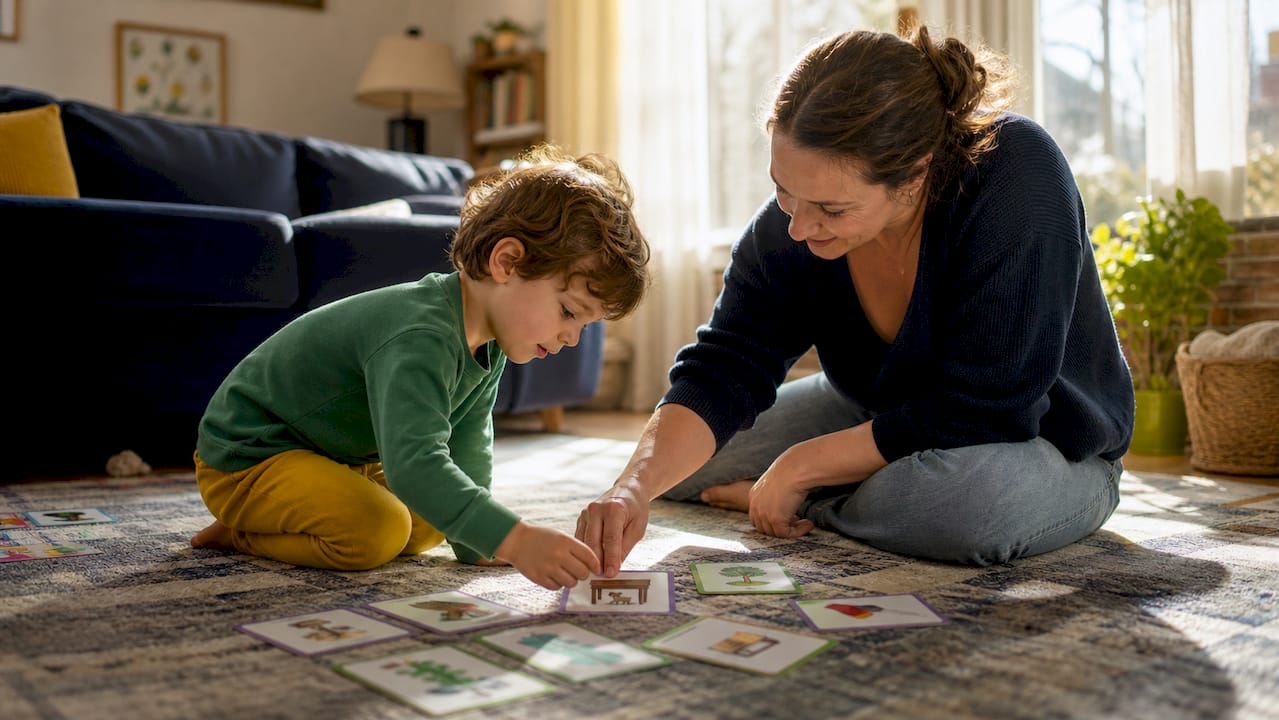
The other thing worth saying: do not wait until a child is "ready." The physical activities in this guide work for children who cannot yet read a single word. Start with the body, then move to pictures, then to print. That sequence is not just good pedagogy; it is how language acquisition actually works.
Thepocketmoneygame makes short preposition practice genuinely rewarding
Hands-on activities are the foundation, and a short daily digital session is the habit that keeps the learning alive between lessons. Thepocketmoneygame is built for exactly that gap.
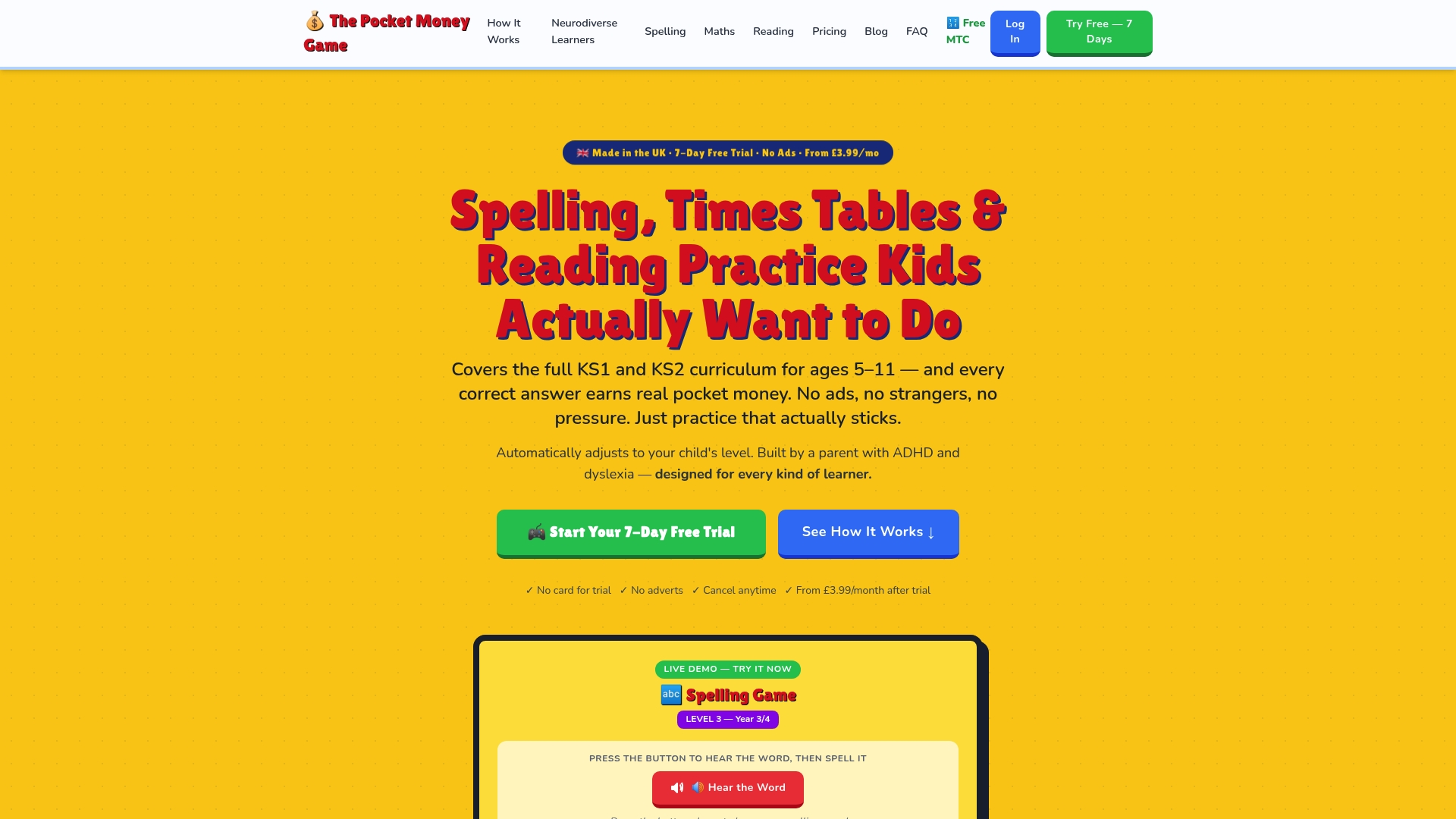
Children aged 5–11 practice spelling, reading, and language skills in sessions that take 5–10 minutes, with voice support reading every question aloud so early readers are never stuck on a word. Every correct answer earns real pocket money, set and controlled entirely by you as the parent. You choose the difficulty, the daily question cap, and the reward amount. For children with ADHD or dyslexia, the adaptive difficulty and voice support mean the platform adjusts to where your child actually is, not where the curriculum says they should be.
The routine is simple: hands-on activity first, then a 5-minute session on Thepocketmoneygame to reinforce what was just practiced. No hidden costs, no long-term lock-in. Start a free 7-day trial at Thepocketmoneygame and see whether your child asks to do it again tomorrow.
Useful resources for KS1 preposition teaching
- Twinkl — The most widely used UK teacher resource platform; search "KS1 prepositions" for matching cards, display posters, and differentiated worksheets aligned to the National Curriculum.
- Teach Starter — Preposition Matching Game — Downloadable picture-and-word matching cards that slot directly into the activities in this guide.
- InstructorWeb — How to Teach Prepositions — Clear, practical teaching sequence including the mouse-and-box visual and the phrase-as-a-chunk approach.
- Learning at the Primary Pond — Five Fun Activities — Hands-on activity templates including the counting bear, hide-and-seek clues, and class book ideas.
- Mooshie Moments — Short, screen-free activity ideas for young children that adapt well to KS1 home practice.
- Thepocketmoneygame — Short, reward-based digital practice for children aged 5–11, with voice support, adaptive difficulty, and full parent control; pairs well with the hands-on activities in this guide.
Sources
- How to Teach Prepositions - InstructorWeb
- Fun Activities for Teaching Prepositions - Andrea Knight
- Five Fun Activities for Teaching Prepositions in the Primary Grades - Learning at the Primary Pond
- Preposition Song: How to Teach Prepositions With Music (Plus Classroom Activities) — Teachertainment
- Preposition Images Matching Game | Teach Starter