Homophones are words that sound identical when spoken but have different meanings and, usually, different spellings. Think there, their, and they're, or to, too, and two, or hear and here. These are the pairs and triples that trip up KS2 children every single day. The best first move, whether you're a teacher planning a lesson or a parent helping at home, is simple: pick one small set, show it in a sentence, and practice it in context before moving on.
Key Takeaways
Homophones have no spelling rules, so repeated sentence-level practice and sight-learning are the most reliable ways to help KS2 children choose the correct spelling every time.
| Point | Details |
|---|---|
| Definition to share with children | Homophones sound the same but have different meanings and spellings; always show them in sentences, not in isolation. |
| Curriculum fit | The National Curriculum expects pupils to distinguish homophones from Y3 through Y6, with complexity increasing each year. |
| Teach by context | Sentence-level gap-fill and correction tasks outperform isolated spelling lists because meaning drives the correct spelling choice. |
| Daily practice matters | A five-day micro-plan of 3–10 minutes per day builds the repeated exposure children need to learn homophones by sight. |
| Thepocketmoneygame for home | Adaptive KS2 spelling practice with immediate rewards and voice support makes short daily sessions easy to run without parent-led instruction. |
Table of Contents
- What are homophones, and how do you explain them to KS2 children?
- How homophones fit into the KS2 curriculum by year group
- A ready-to-use KS2 homophones list, grouped by year
- Strategies that actually work for teaching homophones in KS2
- Fast KS2 activities you can use this week
- How to check whether children have actually understood homophones
- Why short, reward-backed practice helps children remember homophones
- Where to find lesson packs, worksheets, and games
- How parents can reinforce homophone learning at home
- What teachers and parents often get wrong about homophones
- Thepocketmoneygame makes homophone practice something children actually want to do
- Sources
What are homophones, and how do you explain them to KS2 children?
Homophones are words that sound the same but mean something different and are usually spelled differently. A child-friendly way to put it: "Your ears hear the same sound, but your eyes see different words."
BBC Bitesize explains it well: homophones sound the same but carry different meanings and spellings, and children learn them best by connecting the sound to the sentence meaning first, then to the spelling.
Here are a few high-frequency pairs with simple child-facing sentences you can copy straight onto a worksheet:
- Here / hear — "Put your bag down here" vs. "I can't hear you over the noise."
- There / their / they're — "The book is over there" vs. "It's their dog" vs. "They're going to the park."
- To / too / two — "I want to go" vs. "Me too!" vs. "I have two cats."
- See / sea — "Can you see the board?" vs. "We swam in the sea."
- Right / write — "Turn right at the corner" vs. "Write your name at the top."
- One / won — "I have one brother" vs. "She won the race."
- Mail / male — "The mail arrived late" vs. "The male lion roared."
A quick note on terminology: a homophone specifically sounds the same as another word. A homonym can sound the same AND be spelled the same (like bat the animal and bat the cricket bat). KS2 lessons typically focus on homophones because the spelling difference is where children make mistakes in writing.
How homophones fit into the KS2 curriculum by year group
KS2 pupils are expected to distinguish between common homophones and choose the correct spelling based on sentence context. This sits inside the statutory spelling requirements of the National Curriculum, and English Appendix 1 lists homophones and near-homophones as non-statutory example words, noting that "it is important to know the difference in meaning between homophones."
| Year group | Key learning outcomes |
|---|---|
| Year 3 | Introduce common homophone sets (there/their/they're, here/hear, see/sea); practice choosing the correct spelling in short sentences |
| Year 4 | Consolidate known pairs; extend to new sets (mail/male, one/won, right/write); use homophones correctly in independent writing |
| Year 5 | Learn that there are no spelling rules for homophones — pupils must learn them by sight and use sentence context to identify the correct form |
| Year 6 | Apply context-based selection to tricky pairs including licence/license, practice/practise, and prophecy/prophesy; understand how word class affects spelling |
The progression is deliberate. You introduce, consolidate, then extend. Rushing children to Y6-level pairs before they've secured the basics tends to create confusion rather than confidence.
A ready-to-use KS2 homophones list, grouped by year
These lists pull from the National Curriculum Appendix and classroom-tested resources. Copy them directly into flashcards, sorting cards, or a printed cheat-sheet.
Year 3 starter set (high-frequency, easy to illustrate):
- there / their / they're
- here / hear
- to / too / two
- see / sea
- one / won
- right / write
- be / bee
- blue / blew
- bare / bear
Year 4 intermediate set:
- mail / male
- rain / reign / rein
- fair / fare
- knot / not
- night / knight
- peace / piece
- plain / plane
- weather / whether
- flour / flower
Year 5–6 extended and tricky pairs:
- accept / except
- affect / effect
- aisle / isle
- aloud / allowed
- altar / alter
- principal / principle
- stationary / stationery
- licence / license
- practice / practise
- prophecy / prophesy
The Y5–6 pairs often involve a noun/verb distinction (e.g., practice is the noun, practise is the verb), which is why the Oak National Academy Y6 lesson links homophone teaching to word class. Pairing these with the prefixes and suffixes KS2 guide helps children see the pattern rather than just memorizing two separate words.
For a printable reference, EnglishClub's common homophones list covers around 70 pairs based on Standard British English and is free to use.
Strategies that actually work for teaching homophones in KS2
The single most effective approach is context-first teaching. Show the homophone in a sentence before you ask children to spell it in isolation. Oak National Academy's Y3 lesson makes this explicit: pupils use the context of a sentence to decide which spelling is correct, and sentence-level tasks reduce errors because meaning drives the spelling choice.
Here's a practical four-step sequence:
- Introduce a tiny set. Start with two or three pairs maximum. Overloading children with a long list at once rarely sticks.
- Model in context. Write both words in separate sentences on the board. Read them aloud together. Ask: "What's different about what these words mean?"
- Guided practice. Give pupils a gap-fill sentence and ask them to choose the correct homophone. Discuss wrong choices without embarrassment.
- Independent application. Ask children to write their own sentences using each word correctly, or spot the homophones in a short passage.
Differentiation for dyslexia and ADHD learners:
The "naughty letters" strategy, highlighted by Oak National Academy, directs pupils' attention to the specific letters that distinguish one homophone from another. For example, in hear vs. here, the "ear" inside hear is the clue: "You hear with your ear." This reduces cognitive load by giving children one memorable hook rather than two whole words to memorize separately.
Pro Tip: For children with ADHD or dyslexia, keep practice sessions to five minutes maximum, use color-coded cards for each homophone, and always return to the sentence context rather than asking for isolated spelling. Multisensory prompts (say it, write it, use it in a sentence) build stronger memory traces than repetition alone.
A quick teacher script for modeling: "Both words sound exactly the same when I say them. Watch how the sentence tells me which one to write. 'I can hear the bell.' I know it's h-e-a-r because I'm talking about listening, and 'ear' is hiding inside the word."
Fast KS2 activities you can use this week
These activities work as starters, main tasks, or homework. Most need nothing more than paper or a whiteboard.
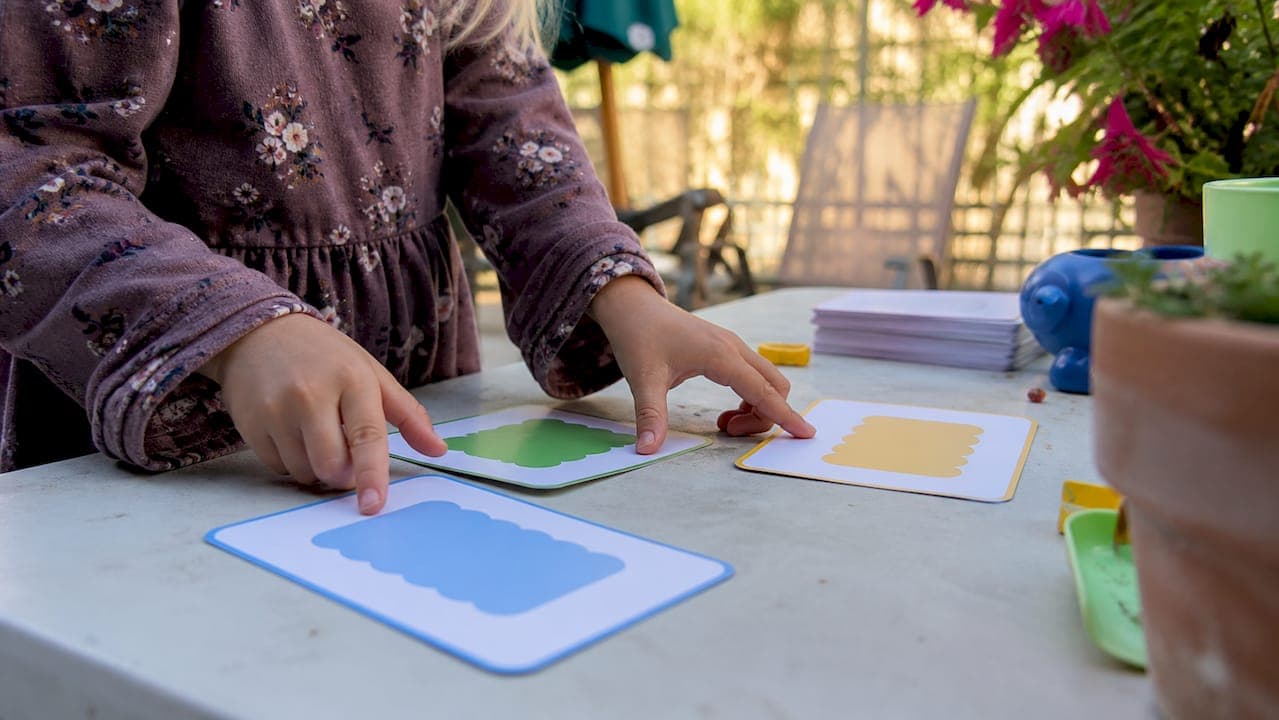
- Sorting cards (10 minutes). Write each homophone on a separate card. Children sort them into pairs or triples, then write one sentence per word. Works well in pairs or small groups.
- Homophone hunt (15 minutes). Children skim a page of a book they're reading and list every homophone they spot. BBC Bitesize suggests this as a way to link listening to meaning in a real reading context.
- Dictation sentences (5–10 minutes). Read aloud sentences containing target homophones. Children write them down and underline the homophone. Immediate class correction keeps it low-stakes.
- Short story challenge (15–20 minutes). BBC Teach recommends showing a short film to introduce their/there/they're, then asking pupils to write a short story using as many homophones as possible. It's creative, memorable, and shows children that homophones appear naturally in real writing.
- Whiteboard quick-fire (5 minutes). Call out a sentence with a gap. Children write the correct homophone on mini whiteboards and hold them up. Instant formative check, zero marking.
- Homophone pairs game (10 minutes). A memory-style matching game where children flip cards to find the homophone partner. Good for early finishers or a Friday plenary.
For ready-made interactive activities, Oak National Academy's lessons include built-in quizzes and exit tasks at no cost. BBC Bitesize offers free interactive games where children spot homophones in videos. Both are curriculum-aligned and need no preparation. You can also use spelling games for KS2 for short, repeated digital practice sessions that reinforce the same pairs at home.
How to check whether children have actually understood homophones
Sentence-level selection tasks are more reliable than asking children to spell a homophone in isolation. A child can memorize t-h-e-r-e and still write it in the wrong place. The real test is whether they can choose the right spelling when meaning is in play.
Here's a six-item mini-quiz you can drop into any lesson or send as homework:
- Choose the correct word: "The children forgot ____ coats." (their / there / they're)
- Choose the correct word: "We walked ____ the park." (to / too / two)
- Correct the mistake: "I can here the music from upstairs."
- Choose the correct word: "She ____ the spelling competition." (one / won)
- Correct the mistake: "The whether was cold and wet."
- Choose the correct word: "He used the wrong ____ in his letter." (stationary / stationery)
Marking guidance:
- Full marks: correct spelling AND the child can explain why (even briefly).
- Partial credit: correct spelling but no explanation — note for follow-up.
- Incorrect: check whether the error is a random guess or a consistent swap (e.g., always writing their for there). A consistent swap tells you the child knows the word exists but hasn't connected it to meaning yet.
Feedback script for class correction: "Let's look at question three together. 'I can here the music' — does that sound right? What does 'here' mean? And what does 'hear' mean? Which one fits the sentence?" Framing it as a puzzle rather than a mistake keeps the atmosphere safe.
Why short, reward-backed practice helps children remember homophones
Repeated exposure in sentence context is the most reliable route to retention. Oak's Y5 lesson states it plainly: since there are no spelling rules for homophones, children must learn them by sight, and the only way sight-learning sticks is through repeated, meaningful encounters. BBC Bitesize frames this as linking listening to meaning: when children connect the sound to the sentence context and then to the spelling, the memory is stronger than rote repetition.
A five-day micro-plan for school or home (3–10 minutes daily):
- Day 1: Introduce two pairs with model sentences. Read aloud together.
- Day 2: Gap-fill sentences using the same pairs. Discuss any errors.
- Day 3: Dictation of three sentences containing the target homophones.
- Day 4: Children write their own sentences for each word. Peer-check.
- Day 5: Quick-fire quiz or sorting game. Celebrate correct answers.
Pro Tip: Small, immediate rewards after correct answers, like a sticker, a point on a chart, or a verbal "yes, that's exactly right," work as fuel for motivation. Children with ADHD especially benefit from instant feedback rather than end-of-week praise. The reward doesn't need to be big; it needs to be immediate.
Where to find lesson packs, worksheets, and games
Free curriculum-aligned resources cover most classroom needs. Paid packs are worth it when you need a full lesson sequence with differentiation already built in.
- BBC Teach: KS2 Homophones — Free. Short film plus teacher notes for their/there/they're. Best for introducing a new set with a visual hook.
- BBC Bitesize: What are homophones? — Free. Interactive activities, video clips, and example lists. Good for independent pupil practice or homework.
- Oak National Academy — Free. Full lesson sequences for Y3, Y5, and Y6 with slides, worksheets, and exit quizzes. The most complete free option for teachers who want a ready-to-teach lesson.
- Planbee — Paid subscription. Offers downloadable KS2 homophone lesson packs with differentiated worksheets, starter activities, and assessment tasks. Useful when you want a full unit rather than individual lessons.
- EnglishClub homophones list — Free. Printable list of around 70 pairs in Standard British English. Good for a classroom display or take-home reference sheet.
- Thepocketmoneygame spelling practice — Subscription with free trial. Adaptive KS2 spelling games with immediate feedback, voice support, and parent-controlled rewards. Best for home practice and homework reinforcement, particularly for children who need short, motivating sessions.
For Y5–6 stretch work, the Year 5 and 6 spellings guide pairs well with the trickier homophone pairs listed above.
How parents can reinforce homophone learning at home
Parents don't need to run formal lessons. The most effective home support is short, low-pressure, and woven into everyday life.
Practical ideas:
- Spot-it during reading. When you read together, pause if you come across a homophone and ask: "Why did the author use that spelling?" It takes ten seconds and builds the habit of noticing.
- Fridge flashcards. Write one homophone pair on a sticky note and put it somewhere visible. Change it each week. Children absorb more than you'd expect from passive exposure.
- Sentence challenge at dinner. Ask your child to use both words in a homophone pair in separate sentences. Keep it light, like a game rather than a test.
- Homework reinforcement with an app. Short digital practice sessions work well for children who resist sitting down with a worksheet. Thepocketmoneygame's adaptive spelling practice covers KS2 homophones with immediate feedback and voice support, so children get the repetition they need without a parent having to run the session.
- Share the class list. Ask the teacher which homophone sets the class is currently working on, then focus home practice on the same pairs. Consistency between school and home accelerates progress.
The KS2 statutory spelling list is a useful reference for parents who want to see the full picture of what their child is expected to learn across Years 3–6.
What teachers and parents often get wrong about homophones
Most people assume homophones are a spelling problem. They're actually a meaning problem. A child who writes their instead of there usually knows how to spell both words. What they haven't done is slow down long enough to ask what the word needs to mean in that sentence.
This is why drilling isolated spelling lists rarely fixes the issue. You can test a child on there/their/they're as a standalone exercise and watch them get full marks, then see the same errors appear in their next piece of free writing. The gap between knowing a word and using it correctly under the pressure of composition is real, and it closes through sentence-level practice, not list memorization.
The other thing worth saying: some children, particularly those with dyslexia or ADHD, will take longer with homophones than their peers, and that's not a sign of low ability. It reflects the fact that homophones genuinely have no spelling rules to lean on. As Oak's Y5 lesson states directly, there are no rules here. Everyone, at every ability level, is learning these by sight and by meaning. Framing it that way to children removes a lot of unnecessary shame.
Thepocketmoneygame makes homophone practice something children actually want to do
Homophone practice works best when it's short, repeated, and immediately rewarding. That's exactly what Thepocketmoneygame is built for.
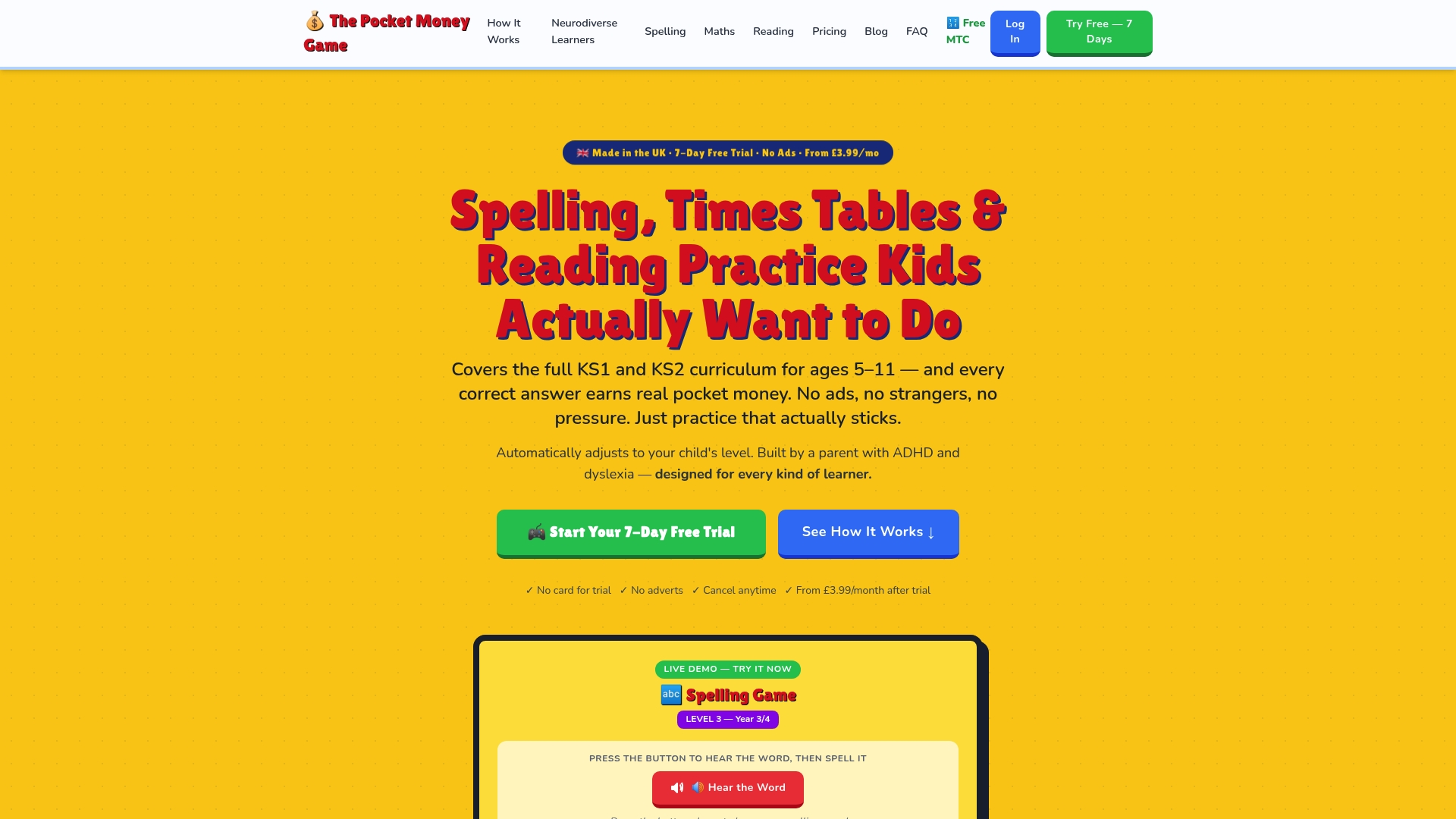
The platform covers KS2 spelling, including homophones, with adaptive questions that adjust to your child's level. Every correct answer earns real pocket money, controlled entirely by you as the parent. There's no guessing at whether your child is engaged: the reward is built in. Voice support means children who struggle to read instructions independently can still access the practice, and the parent dashboard shows you exactly which words they're getting right and where they're still slipping.
It's a practical fit for homework reinforcement or a five-minute daily session alongside whatever the class is working on at school. Start with a free trial at Thepocketmoneygame and see whether your child takes to it.
Sources
- KS2 English: Homophones - BBC Teach
- Practise and apply spelling homophones KS2 | Y3 English | Lesson Resources | Oak National Academy
- What are homophones? - BBC Bitesize
- Spelling a selection of homophones KS2 | Y5 English Lesson Resources | Oak National Academy
- English Appendix 1 - Spelling (National Curriculum)