
Reading aloud measurably improves vocabulary, reading fluency, comprehension, executive function, and the emotional bond between caregiver and child. The research is clear: this one daily habit does more for a child's literacy development than almost anything else you can add to your routine.
Here is what the evidence shows at a glance:
- Vocabulary growth: Children hear words in read-alouds they rarely encounter in everyday conversation, building both receptive and expressive language faster than independent reading alone.
- Reading fluency: Fluency means reading at the right rate, with accuracy, and with natural expression (prosody). Hearing fluent reading modeled regularly is one of the fastest ways to build it.
- Comprehension: Read-alouds expose children to complex texts and model the thinking strategies good readers use, like predicting, inferring, and connecting.
- Executive function: Shared reading activates attention networks and working memory, with neural benefits that show up years later in reading scores.
- Social-emotional bonding: Consistent read-aloud sessions build attachment, joint attention, and a positive association with books.
- Long-term academic gains: Children with rich read-aloud histories enter school with larger vocabularies, stronger narrative skills, and better reading outcomes across subjects.
A typical reader grows from roughly 30 words correct per minute (WCPM) at mid-grade 1 to about 100 WCPM by the end of grade 2. Regular read-alouds, especially interactive ones, accelerate that trajectory. Start with 10–20 minutes a day. You do not need to be a trained teacher. You just need to show up and read.
Table of Contents
- What reading aloud actually does for your child's development
- How read-aloud benefits change at every age
- How to make every read-aloud session count
- Key Takeaways
- The part most guides skip over
- Thepocketmoneygame: practice that keeps going between sessions
- Useful sources for further reading
What reading aloud actually does for your child's development
The advantages of reading aloud span six distinct areas of development. Each one builds on the others, which is why the habit compounds so quickly.
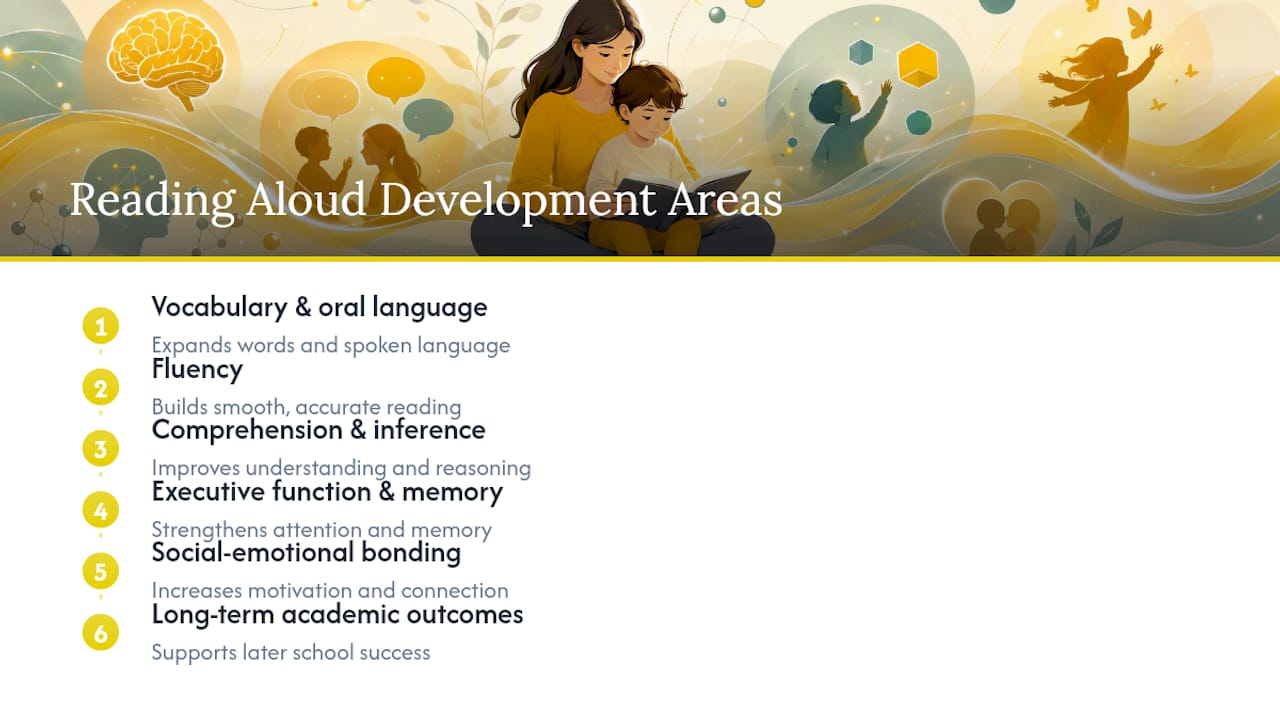
Vocabulary and oral language
Children's books contain words that almost never appear in everyday speech. When you read aloud, your child hears those words in context, with your tone and expression giving them meaning. Over time, receptive vocabulary (words they understand) converts into expressive vocabulary (words they use). Reading Rockets notes that read-alouds introduce higher-level vocabulary and model comprehension strategies that caregivers can use to scaffold learning. Dialogic reading, where you pause to ask questions and invite responses, turns that exposure into active language practice.
Fluency: rate, accuracy, and prosody
Fluency is the bridge between decoding words and actually understanding them. The National Institute for Literacy defines fluency as reading with appropriate rate, accuracy, and prosody (natural phrasing and expression). When a child is stuck sounding out every word, there is no mental energy left for meaning. Hearing a fluent reader models what that bridge sounds like. Repeated oral reading, choral reading, and modeling fluent reading reliably improve rate, accuracy, and prosody, and that improvement directly reduces the decoding load so comprehension can happen.
Comprehension and inference
Read-alouds let children access texts that are above their independent reading level. A second grader who can only decode simple sentences can follow a rich chapter book when you read it to them. That exposure builds background knowledge, narrative understanding, and the ability to make inferences, all before they can read those texts themselves. ASCD guidance recommends read-alouds specifically to expose students to complex texts and model deeper thinking and discussion skills.
Executive function and memory
Shared reading is not passive for a child's brain. Peer-reviewed research links narrative exposure and reading activity to cognitive resilience across the lifespan, including benefits to attention and working memory. The child who sits with you for a story is practicing sustained attention, holding plot details in working memory, and predicting what comes next. Those are executive function skills, and they transfer to the classroom.
Social-emotional bonding and motivation
Sitting together with a book creates joint attention, a shared focus that is one of the foundations of secure attachment. Children who associate reading with warmth and safety are far more likely to become motivated readers. That motivation is not a soft outcome. It predicts how much a child reads independently, and reading volume is one of the strongest predictors of long-term literacy.

Long-term academic outcomes
The home literacy environment, specifically how many books a child is exposed to and how often caregivers read aloud, consistently predicts later reading achievement. Intensive narrative-listening training improves comprehension and basic cognitive processes across age groups compared with controls. Children who arrive at kindergarten with strong oral language and narrative skills learn to decode faster, comprehend more deeply, and sustain reading habits longer.
How read-aloud benefits change at every age
Read-alouds look different at six months than they do at twelve years. Matching your approach to your child's developmental stage makes every session more effective.
Infants (0–12 months)
At this stage, the goal is not comprehension. It is exposure to language rhythm, your voice, and the physical routine of shared attention. Board books with high contrast and simple images work well. Point to pictures, name objects, and let your baby track your finger. Even two or three minutes counts.
Pro Tip: Narrate your day in full sentences. "Now we are putting on your socks. One sock, two socks." This builds oral language exposure between formal reading sessions.
Toddlers (1–3 years)
Vocabulary is exploding at this stage, and read-alouds fuel it. Label objects on the page, then expand: "That's a dog. The dog is running fast." Choral reading, where you say a repeated phrase together, builds early phonological awareness. Expect interruptions and questions. Those are signs of engagement, not distraction.
Preschool (3–5 years)
Narrative skills develop rapidly here. Ask prediction questions before turning the page. Use repeated readings of favorite books: children who hear the same story multiple times build fluency and comprehension simultaneously. Dialogic reading is especially powerful at this age. The reading fluency at home milestones for this stage center on print awareness and story structure.
Early elementary (K–2)
This is where fluency practice becomes central. Echo reading (you read a line, they repeat it) and choral reading (reading together simultaneously) are both evidence-based. The pause–prompt–praise method works well here: pause three to five seconds when a child is stuck, offer a prompt if needed, then praise the attempt. KS1 comprehension strategies at this stage focus on decoding support and simple inference.
Pro Tip: Choose books one level above your child's independent reading level for read-alouds. The slight stretch builds vocabulary and comprehension without the frustration of decoding.
Later elementary (grades 3–5)
Read-alouds remain powerful here, even though many children can read independently. Reading a complex text aloud models how a skilled reader navigates difficult vocabulary, long sentences, and layered ideas. Use post-reading discussion to build inference skills. KS2 comprehension practice at this stage emphasizes text analysis and author intent.
Teens and adult learners
Secondary teachers who read aloud model comprehension strategies and close background-knowledge gaps for older students who may have missed foundational content. For adult learners, narrative listening activates brain networks beyond language areas and is linked to cognitive benefits across the lifespan. Discussion prompts after a read-aloud session build critical thinking in ways that silent reading alone does not.
How to make every read-aloud session count
The difference between a good read-aloud and a great one is interaction. Passive listening helps. Active engagement transforms.
Before you open the book (30–60 seconds)
Activate background knowledge. Show the cover and ask: "What do you think this book is about?" or "Have you ever seen something like this?" That brief warm-up primes comprehension and gives you a window into what your child already knows.
After the reading
- Ask one connection question: "Has anything like this ever happened to you?"
- Ask one inference question: "Why do you think the author ended it that way?"
- Celebrate what went well. Specific praise ("You remembered exactly what happened in chapter two") builds confidence and motivation.
When things go sideways
If a child resists reading, reduce the pressure. Let them choose the book. Try a shorter session. For children with reading anxiety or ADHD, practical strategies for neurodivergent readers include shorter bursts, more frequent praise, and pairing audio with visual tracking. If progress stalls, check whether the text level is appropriate. A book that is too hard discourages; one that is slightly above their level with your support builds skill.
Pro Tip: Avoid the perfection trap. Celebrate incremental wins: a faster second read, better intonation on a repeated passage, or simply staying engaged for five more minutes than last week. Small wins sustain motivation.
Key Takeaways
Reading aloud daily with interaction, not just passive listening, produces measurable gains in vocabulary, fluency, comprehension, and executive function at every age from infancy through adolescence.
| Point | Details |
|---|---|
| Interaction beats passive listening | Dialogic prompts and echo reading convert a story session into active comprehension practice. |
| Fluency benchmarks matter | Typical growth runs from ~30 WCPM at mid-grade 1 to ~100 WCPM by end of grade 2; read-alouds accelerate this. |
| Short regular reading practice is enough | Short, consistent sessions several times a week produce measurable fluency and comprehension gains. |
| Your voice has a neural advantage | fMRI research shows parental storytelling strengthens attention and executive function networks more than a stranger's voice. |
| Thepocketmoneygame complements read-alouds | The platform's voice support, adaptive reading comprehension, and reward system reinforce skills between caregiver-led sessions. |
The part most guides skip over
There is a version of read-aloud advice that makes it sound effortless: sit down, open a book, watch your child flourish. The reality is messier and more interesting.
The research on parental narration and neural connectivity is genuinely striking. The fMRI finding that a parent's voice specifically strengthens attention and executive function networks is not a minor footnote. It suggests that the relationship itself is part of the mechanism. A recording of a fluent reader helps. A caregiver who pauses, asks questions, and responds to a child's confusion does something categorically different.
What most guides also underplay is the compounding effect of consistency over novelty. Parents often worry about choosing the "right" book or using the "correct" technique. The evidence points elsewhere. A child who hears 15 minutes of interactive reading five days a week, from a caregiver who sometimes stumbles over words and occasionally picks a book that turns out to be boring, will outperform a child who gets one perfect, technique-rich session a week. Frequency and warmth matter more than polish.
The other thing worth saying plainly: read-alouds do not stop being useful when a child learns to read independently. Secondary teachers who read aloud to teenagers are not babying them. They are modeling how a skilled reader navigates complexity, and that modeling has measurable effects on comprehension and critical thinking. If you have a ten-year-old who reads well, keep reading to them. The benefits do not expire.
Thepocketmoneygame: practice that keeps going between sessions
Caregiver-led read-alouds are the foundation. What Thepocketmoneygame offers is what happens in between.
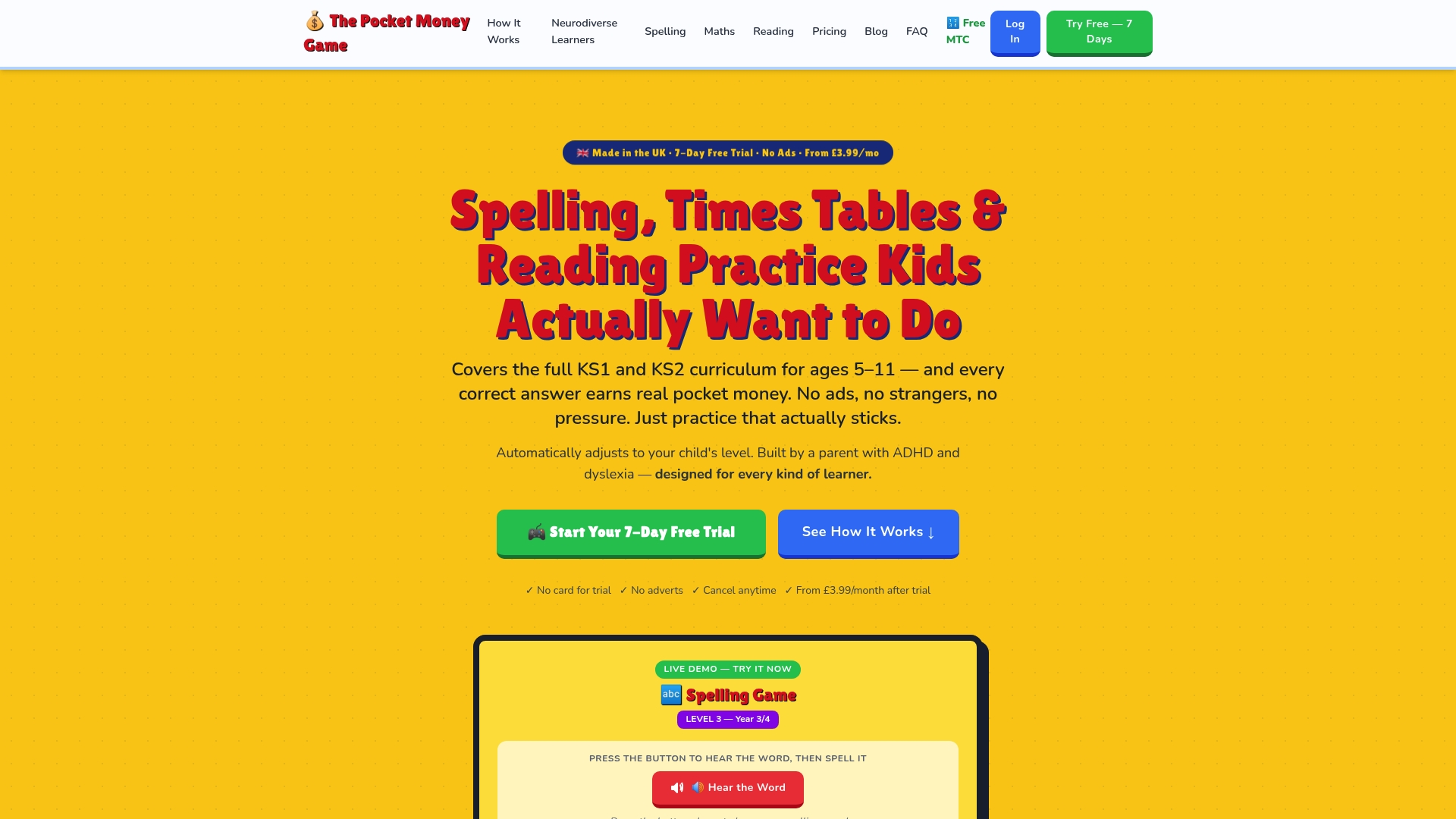
The platform is built for children aged 5–11 and was created by a parent who knows firsthand what it is like to struggle with reading. Three things make it a natural complement to your read-aloud routine. First, its voice support reads questions and content aloud, so children who are still building decoding skills can access the material without frustration. Second, its reading comprehension practice reinforces the inference and vocabulary skills you build together during read-alouds. Third, children earn real pocket money for correct answers, which keeps motivation high between sessions, especially for neurodivergent learners who need more frequent, tangible rewards to stay engaged.
Sessions are short by design. There is no pressure to sit for an hour. For families who want educational games that actually motivate kids to learn, Thepocketmoneygame gives children a reason to practice on the days you cannot sit down together. Start a free trial and see how it fits alongside your reading routine.
Useful sources for further reading
The sources below are organized by how you are most likely to use them: neural evidence, practice guidance, or classroom adoption.
| Source | What it covers | Best used for |
|---|---|---|
| Pediatric Research — fMRI study | Neural connectivity gains from parental storytelling | Understanding the brain science behind why parental read-alouds work |
| KYRRC Evidence Snapshot | Home fluency practice guidance for parents | Setting realistic practice schedules and understanding fluency growth |
| Dyslexia Help — Fluency Tips | Repeated reading, choral reading, and modeling techniques | Practical fluency methods for home use, especially for struggling readers |
| NWEA Blog — Fluency Benchmarks | WCPM benchmarks and six fluency strategies | Checking whether your child's fluency is on track by grade |
| Reading Rockets — Reading Aloud | Vocabulary, comprehension strategies, and classroom guidance | Scripts, book lists, and technique overviews for parents and teachers |
| NCBI PMC — Cognitive Outcomes | Peer-reviewed review of reading and cognitive resilience | Longitudinal evidence linking narrative exposure to lifelong cognitive health |
| Wiley — Narrative Listening Study | Controlled study on narrative-listening training and cognition | Clinical and research evidence for comprehension and cognitive process gains |
| The Atlantic — Reading and Brain Health | Adult brain benefits of narrative listening | Explaining why read-alouds benefit older learners and caregivers themselves |
| ASCD — Why Every Class Needs Read-Alouds | Classroom adoption guidance for teachers | Justifying and structuring read-alouds at the secondary level |
For reinforcing skills between read-aloud sessions, GeniusHub Learning's guidance on support after the lesson offers practical ideas on how to keep learning going outside structured time.
This article provides general educational information. For concerns about a child's reading development, consult a qualified literacy specialist or your child's school.