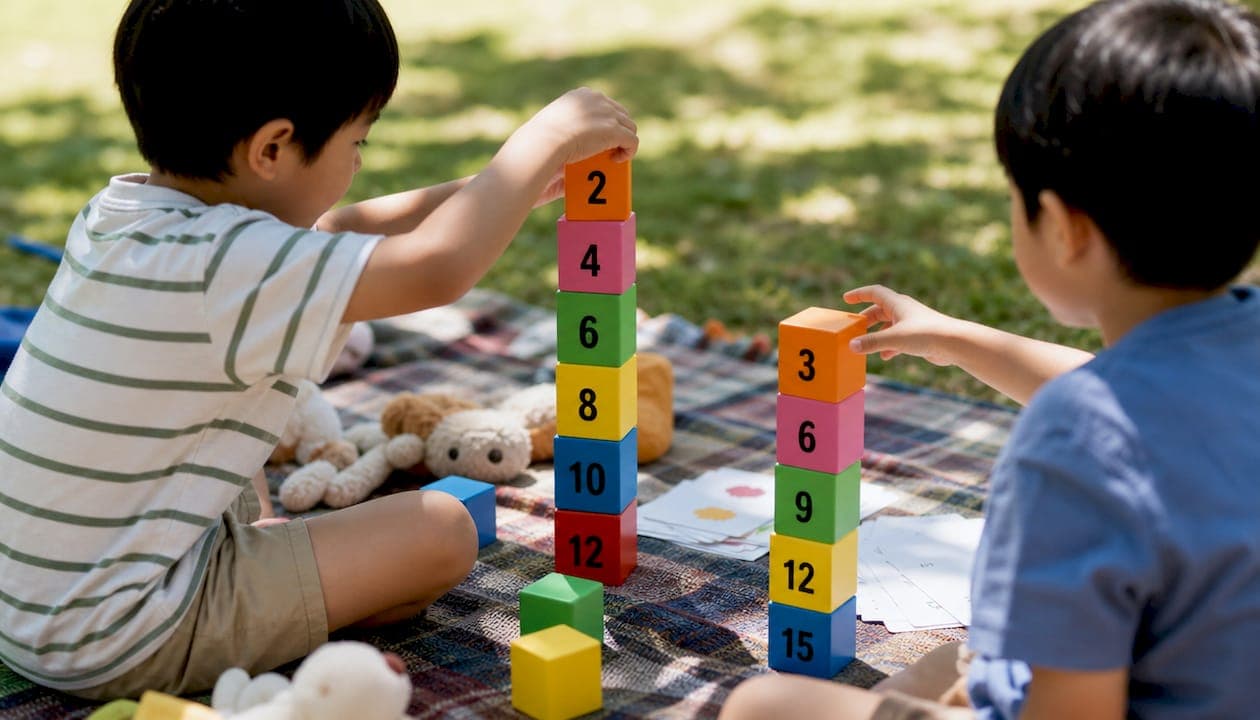
A factor is a whole number that divides exactly into another number, and a multiple is what you get when you multiply a number by a whole number. Factors of 8 are 1, 2, 4, and 8. Multiples of 5 are 5, 10, 15, 20, and so on, forever.
Once your child (or class) understands these two ideas, they can unlock a chain of KS2 maths skills:
- Finding factor pairs and using arrays to check their work
- Listing multiples confidently, without gaps or guesswork
- Working out the Highest Common Factor (HCF) and Lowest Common Multiple (LCM)
- Applying HCF and LCM to simplify fractions and find common denominators
That last skill is the real payoff. Factors and multiples KS2 work builds directly toward fraction fluency in Year 6, and getting the foundations solid now saves a lot of frustration later.
Key Takeaways
Factors and multiples form the backbone of KS2 fraction work, and mastering factor pairs, listing methods, and prime factorization by Year 6 makes HCF, LCM, and fraction simplification far less daunting.
| Point | Details |
|---|---|
| Factors come in pairs | Test numbers in order up to the square root to avoid missing a factor pair. |
| Multiples follow patterns | End-digit checks for 2 and 5, and digit-sum checks for 3, speed up spotting multiples. |
| HCF and LCM link to fractions | The National Curriculum ties both directly to simplifying and finding common denominators. |
| Prime factor trees scale up | Larger numbers are easier to handle with prime factorization than with long factor lists. |
| Practice little and often | Short daily sessions with quick feedback build confidence faster than occasional long ones. |
| Thepocketmoneygame supports practice | Its KS2 maths games use adaptive difficulty and reward-based feedback to reinforce factors and multiples at home. |
Table of Contents
- Understanding Factors KS2: What They Actually Are
- Understanding Multiples KS2: Spotting the Pattern
- How to Find All the Factors of a Number
- Finding Multiples and Common Multiples the Practical Way
- Common Factors and How to Find the HCF
- Common Multiples and How to Find the LCM
- Prime Factors and Factor Trees
- KS2 Factors Quiz: Worked Examples with Answers
- Progressive Activities for Teaching Factors and Multiples
- Helping Pupils Who Struggle with Factors and Multiples
- A Low-Prep Way to Practice Factors and Multiples at Home
- Frequently Asked Questions
- Sources
Understanding Factors KS2: What They Actually Are
A factor, in KS2 terms, is a positive whole number that divides exactly into another number with nothing left over. The NCETM describes factors as numbers that multiply together to make a given number, and they always come in pairs. For 12, the pairs are 1 × 12, 2 × 6, and 3 × 4, giving factors of 1, 2, 3, 4, 6, and 12.
Drawing an array (rows and columns of dots or squares) helps a child see this physically: 3 rows of 4 dots make 12, and so do 2 rows of 6. Both arrangements prove a factor pair works.
The most common mix-up is confusing factors with "things you can halve" or listing any number that seems related, rather than testing whether it divides in exactly. Watch for square numbers too. A number like 16 has an odd number of factors (1, 2, 4, 8, 16) because one factor, 4, pairs with itself. That pattern is worth pointing out early. It genuinely surprises most pupils the first time they spot it.
Understanding Multiples KS2: Spotting the Pattern
A multiple is the result of multiplying a number by a whole number, so multiples of 3 are just the 3 times table stretched out forever: 3, 6, 9, 12, 15, and on. BBC Bitesize frames multiples as an "extended times table," which is a helpful image for pupils who already know their tables but haven't linked the two ideas yet.
Quick pattern checks make spotting multiples much faster than counting up every time:
- Multiples of 2 always end in 0, 2, 4, 6, or 8.
- Multiples of 5 always end in 0 or 5.
- Multiples of 3 have digits that add up to a multiple of 3 (like 111, since 1+1+1=3).
Multiples of 3 start with 3, 6, 9, 12, 15, and multiples of 5 start with 5, 10, 15, 20, 25. Notice 15 shows up in both lists. That overlap isn't a coincidence, and it's exactly the idea your child needs later when finding a common denominator to add fractions.
How to Find All the Factors of a Number
The safest method is systematic, not random guessing. Start at 1 and test each number in order, checking whether it divides exactly.
Step 1: Test 1 (it always works, since 1 × the number = the number). Step 2: Test 2, 3, 4, and so on, stopping once you reach the square root of the number. Step 3: Every time a number divides exactly, write down both it and its partner factor.
Take 36 as a worked example. Testing in order: 1 × 36, 2 × 18, 3 × 12, 4 × 9, 6 × 6. Once you hit 6 × 6, you've reached the square root, so you can stop. The full factor list is 1, 2, 3, 4, 6, 9, 12, 18, 36, which is nine factors, an odd number, because 36 is a square number.
The NCETM recommends this ordered approach specifically because it stops pupils from missing pairs, which is the single most common error in factor questions.
Pro Tip: Get your child to draw a simple table with two columns, "small factor" and "matching factor," and fill both in at the same time. Working left to right in order means nothing gets skipped, and a gap in the table is easy to spot at a glance.
Finding Multiples and Common Multiples the Practical Way
Listing multiples is straightforward: write out the times table for each number until a shared value shows up in both lists.
- Write the multiples of the first number: for 4, that's 4, 8, 12, 16, 20, 24.
- Write the multiples of the second number: for 6, that's 6, 12, 18, 24, 30.
- Compare the two lists and circle any number that appears in both.
Here, 12 and 24 both appear, making them common multiples of 4 and 6. The smallest one, 12, is the Lowest Common Multiple, or LCM. Once fractions with different denominators show up in Year 5 and 6, the LCM becomes the go to way to find a shared denominator, which the National Curriculum links directly to work on equivalent fractions.
A colored times-table grid works brilliantly here. Give each number's multiples a different color and let the overlap jump out visually rather than asking a child to hold two lists in their head at once.
Common Factors and How to Find the HCF
A common factor is a number that divides exactly into two (or more) different numbers, and the Highest Common Factor, or HCF, is simply the biggest one they share.
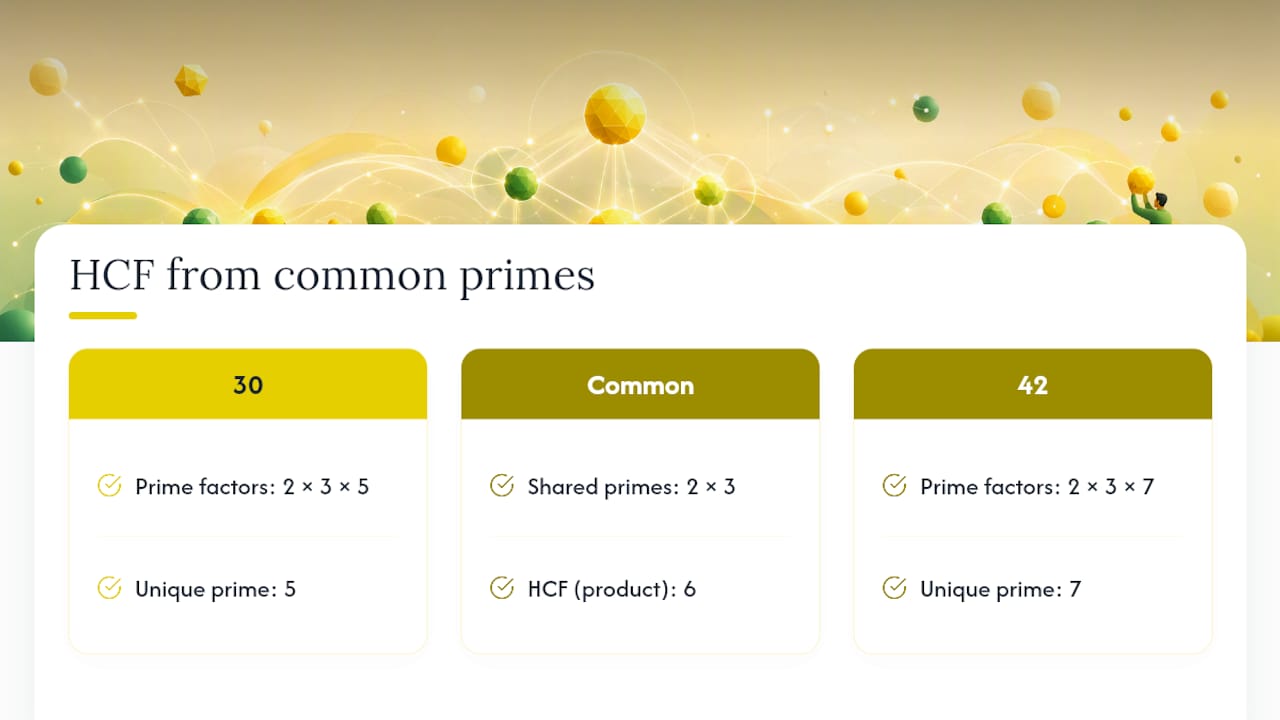
Method 1: listing (best for smaller numbers). List every factor of each number, then compare. Factors of 30: 1, 2, 3, 5, 6, 10, 15, 30. Factors of 42: 1, 2, 3, 6, 7, 14, 21, 42. The shared factors are 1, 2, 3, and 6, so the HCF of 30 and 42 is 6.

Method 2: prime factorization and a Venn diagram (best for larger numbers). Break each number into its prime factors, then draw two overlapping circles, one per number. Shared prime factors sit in the middle overlap; factors unique to one number sit on that side only. Multiplying everything in the overlapping section gives the HCF instantly, and BBC Bitesize sets out this exact stepwise approach for teachers introducing it for the first time.
For a quick check, ask pupils whether their answer actually divides into both original numbers. If it doesn't, they've made an arithmetic slip somewhere in the list.
Common Multiples and How to Find the LCM
The Lowest Common Multiple is the smallest number that two (or more) numbers both divide into. It's the mirror image of the HCF, and both matter most when fractions enter the picture.
- Method A, listing: write out multiples of both numbers until the first shared value appears. For 5 and 6: multiples of 5 are 5, 10, 15, 20, 25, 30; multiples of 6 are 6, 12, 18, 24, 30. The first overlap is 30, so the LCM of 5 and 6 is 30.
- Method B, prime factorization: for bigger numbers, break each into prime factors, then multiply every prime factor that appears in either number, using the highest power seen in any single number.
- Where it matters most: Third Space Learning points out that LCM is the standard route to a common denominator, so 1/5 + 1/6 becomes 6/30 + 5/30 once both fractions share that denominator of 30.
Listing suits visual learners and smaller numbers; prime factorization scales up better once numbers get into the higher tens or hundreds.
Prime Factors and Factor Trees
A prime number has exactly two factors, itself and 1, which is precisely why 1 doesn't count as prime. It only has one factor, not two. This trips up more pupils than almost any other rule in the topic, so it's worth stating plainly and repeating.
A factor tree breaks a number down branch by branch until every branch ends in a prime number. Take 84: split it into 2 × 42, then split 42 into 2 × 21, then split 21 into 3 × 7. Every branch now ends in a prime, giving prime factors of 2, 2, 3, and 7.
Those prime factors feed straight into HCF and LCM work later, since Venn diagrams and shared-factor methods both rely on knowing a number's prime building blocks. A quick classroom exercise: give pairs of pupils a number each and race to complete the tree correctly, comparing branches at the end.
KS2 Factors Quiz: Worked Examples with Answers
Use these as a quick starter, a homework set, or a mini factors and multiples quiz to check understanding before moving on to fractions work.
- List all the factors of 24. Answer: 1, 2, 3, 4, 6, 8, 12, 24. Watch for pupils stopping at 4 × 6 and forgetting to check further.
- What are the first five multiples of 7? Answer: 7, 14, 21, 28, 35. A common slip is skipping a multiple in the sequence.
- Find the HCF of 18 and 27. Answer: 9. Encourage listing factors of both before comparing.
- Find the LCM of 4 and 9. Answer: 36. Since 4 and 9 share no common factor besides 1, the LCM is simply their product.
- Is 1 a prime number? Explain why or why not. Answer: No, because it only has one factor.
- Write 60 as a product of its prime factors. Answer: 2 × 2 × 3 × 5. Check the factor tree ends only in primes.
- Simplify the fraction 12/18 using the HCF. Answer: 2/3, since the HCF of 12 and 18 is 6.
- Challenge: What is the smallest number with exactly four factors, and how do you know? Answer: 6 (factors 1, 2, 3, 6), because it's the product of two distinct primes, 2 and 3.
Progressive Activities for Teaching Factors and Multiples
Build understanding in stages rather than jumping straight to abstract listing.
Years 1 to 2: use physical objects, counters, or LEGO bricks to build arrays and spot equal groups. Five minutes is plenty at this stage.
Years 3 to 4: introduce times-table grids and simple factor-pair hunts using numbers up to 50. A shared whiteboard works well for pair work.
Years 5 to 6: move to factor trees, Venn diagrams, and applying HCF/LCM to fraction problems, gradually removing the visual scaffolding as confidence grows.
Success looks different at each stage, so judge Year 2 pupils on correct array building, not written factor lists. At home, a short nightly task, five multiples of a chosen number, or one factor pair puzzle, keeps skills fresh without turning into a battle. Visual charts on the fridge work just as well as a workbook.
Helping Pupils Who Struggle with Factors and Multiples
Concrete objects and arrays help far more than abstract number lists for pupils who find this topic tricky, and a number line makes multiples visible as jumps rather than an isolated sequence of digits. Break tasks into smaller chunks: find one factor pair, check it, then move to the next, rather than demanding a full list in one go.
For neurodiverse learners, voice support and clear worked examples reduce the reading load that can mask a child's actual maths ability. Short, frequent practice sessions with immediate feedback tend to build confidence faster than long, occasional homework sessions, particularly when a small reward marks each correct answer. Save prime-factor methods for once listing feels automatic, usually well into Year 5.
A parent's honest note on practice at home
Some evenings, five minutes of factor practice is a fight, and other evenings it clicks so fast you can't believe it took weeks to get there. Both are normal. Don't judge the week by one bad night. What actually shifted things for us was short, low-pressure sessions where a correct answer got noticed straightaway. That immediate response, rather than a saved-up sticker chart, is the piece worth trying tonight.
A Low-Prep Way to Practice Factors and Multiples at Home
Textbook worksheets are one route to fraction-ready fluency, and plenty of families use them well. Thepocketmoneygame takes a different route: it turns factor pairs, times tables, and multiples practice into short, adaptive question sets where every correct answer earns real pocket money, set and controlled entirely by you.

The platform adjusts difficulty automatically as a child improves, so factor questions get harder once times tables of 6 and 7 are solid, without you having to build that ladder yourself. Three things parents notice quickly:
- Time-efficient sessions: short daily bursts fit around homework and dinner, rather than replacing an evening.
- Reward-driven motivation: immediate feedback and small payouts keep a reluctant learner coming back without nagging.
- Progress tracking: a parent dashboard shows exactly which factor and multiple skills are solid and which need another pass.
The KS2 maths games cover factors, multiples, times tables, and fractions in one place, and a free trial lets you see whether the reward system actually motivates your child before committing to anything.
Frequently Asked Questions
What is the difference between a factor and a multiple? A factor divides exactly into a number, while a multiple is what you get by multiplying a number up. Factors of 12 are smaller than or equal to 12; multiples of 12 (12, 24, 36) go upward forever.
What's the easiest way to find factors of a number for KS2? List factor pairs in order, starting from 1, and stop once you reach the square root of the number. This systematic approach, recommended by the NCETM, prevents missed pairs.
How do you find the HCF of two numbers? List the factors of each number and pick the highest one they share, or use prime factorization with a Venn diagram for larger numbers, as outlined by BBC Bitesize.
Why do factors and multiples matter for fractions in KS2? The LCM gives a common denominator for adding or subtracting fractions, and the HCF simplifies fractions to their lowest terms, both explicit expectations in the National Curriculum.
Is 1 a factor of every number? Yes. Every whole number has 1 and itself as factors at minimum, which is why the shortest possible factor list has exactly two entries.
Sources
- Factors, multiples, prime numbers and composite numbers | NCETM
- National curriculum in England: mathematics programmes of study
- Multiples and factors - KS2 Maths resources for Year 6 - BBC Bitesize
- What Is The Lowest Common Multiple: Explained For KS2 | Third Space Learning