
Comprehension questions fall into a handful of clear types: literal (retrieval), inferential, evaluative (critical), vocabulary-in-context, main idea/summary, sequencing, prediction, comparative, applied/transfer, and synthesis. Each one asks the reader to do something different with the text.
Here's what separates them, in plain terms:
- Literal/retrieval: find a fact stated directly in the text ("Who found the letter?")
- Inferential: read between the lines using clues and background knowledge ("Why do you think she hid the letter?")
- Evaluative/critical: judge the author's purpose, tone, or bias ("Why did the author choose this ending?")
- Vocabulary-in-context: work out a word's meaning from surrounding sentences
- Main idea/summary: identify what the passage is mostly about
- Sequencing/prediction: order events or guess what happens next
- Comparative: weigh two characters, texts, or arguments against each other
- Applied/transfer: connect the text to a real situation or another text
- Synthesis: combine ideas from multiple parts of the text into one conclusion
You'll meet all of these on school reading tests, in classroom worksheets, and honestly, in everyday life every time you read a news article and ask yourself "wait, is this fair?"
Key Takeaways
Comprehension question types differ by the thinking they demand, and matching the right strategy to each type is what actually improves test scores and reading confidence.
| Point | Details |
|---|---|
| Ten core types exist | Literal, inferential, evaluative, vocabulary-in-context, main idea, sequencing, prediction, comparative, applied, and synthesis. |
| Match format to type | Use multiple-choice for retrieval, short answers for inference, and open responses for evaluative questions. |
| Blank's levels guide difficulty | Move lessons from naming (Level 1) to justifying and reasoning beyond the text (Level 4). |
| Teach question writing | Students who generate their own questions engage more deeply than those who only answer prewritten ones. |
| Practice in short, steady bursts | Daily micro-practice with one mixed passage beats occasional long cramming sessions. |
Table of Contents
- What Are Comprehension Question Types, and Why Do They Matter?
- The Main Comprehension Question Types, With Stems and Examples
- Blank's Four Levels: A Ladder for Question Difficulty
- Question Stems and Worked Examples You Can Use Today
- How to Answer Each Question Type Under Time Pressure
- Teach Students to Write Their Own Questions
- Practice Passage: Eight Mixed-Type Questions
- Building an Exam Prep Routine That Actually Sticks
- Practical Stems Worth Memorizing
- Why We Build Practice Around Stems, Not Just Answers
- Frequently Asked Questions
- Sources
What Are Comprehension Question Types, and Why Do They Matter?
A comprehension question type is a category defined by the kind of thinking it demands, not by its subject matter. Some questions just want you to locate a fact. Others want you to connect facts, judge them, or predict what comes next. That difference in mental demand is the entire point of classifying them.
Two frameworks show up again and again in reading instruction: Bloom's Taxonomy, which sorts thinking from remembering up to creating, and Blank's Four Levels of Questioning, a model built specifically for reading comprehension progression. Both say the same thing in different words: recall is the floor, not the ceiling.
Pro Tip: If you're a teacher planning a lesson, pick one question from each level of the taxonomy before you write the worksheet. It forces you to stretch beyond ten retrieval questions in a row, which is the single most common comprehension-question mistake we see.
- Recall questions build confidence and check basic understanding.
- Inference and evaluation questions build the deeper thinking skills tests actually reward.
- Mixing both types in one session, rather than drilling one type for weeks, tends to produce steadier gains.
The Main Comprehension Question Types, With Stems and Examples
Here's the reference list. For each type, you'll find a definition, common stems, a sample question, and a model answer showing the kind of evidence a strong response needs.
Literal or retrieval questions ask for information stated directly in the text. Common stems: "Who...", "What did...", "Where was...", "Which word tells you...". Example: "Where did the fox hide the key?" Model answer: "The fox hid the key under the old oak tree, as stated in paragraph two." The most frequent mistake here is over-inferencing: students search for hidden meaning when the answer is sitting in plain text. If a question is retrieval, the answer must be quotable, word for word.
Inferential questions require combining a text clue with background knowledge. Stems: "Why do you think...", "What can you infer...", "How did the character probably feel...". Example: "Why did Maya avoid her friend after the party?" Model answer: "Maya likely felt embarrassed, since the text says she 'looked away and walked faster' when Priya waved." Students often answer these with pure guesswork and no textual anchor. Teach them to name the clue, then name the inference.
Evaluative or critical questions ask readers to judge purpose, tone, or bias. Stems: "Why did the author choose...", "Is this argument convincing...", "What is the author's attitude toward...". Example: "Why does the author use short sentences in the final paragraph?" Model answer: "The short sentences speed up the pacing, mirroring the character's panic as she runs." Weak answers here state an opinion with zero evidence. Every evaluative response needs at least one quoted or paraphrased detail to back it up.
Vocabulary-in-context questions test whether a reader can decode meaning from surrounding sentences rather than a dictionary. Stems: "As used in paragraph 3, the word 'reluctant' most nearly means...". Model answer: "Reluctant means unwilling, because the sentence describes the boy dragging his feet and sighing before agreeing."
Main idea and summary questions ask what a passage is mostly about, not what happens in every sentence. Stems: "What is this passage mainly about?", "Which sentence best summarizes...". A common error is picking a detail instead of the overarching theme.
Sequencing and prediction questions test whether the reader can track chronology and reasonably project forward. Stems: "What happened first...", "What will most likely happen next...".
Comparative questions ask readers to weigh two characters, arguments, or texts. Stems: "How is Character A different from Character B?", "Which argument is stronger, and why?"
Applied or transfer questions connect the text to real life. Stems: "Has something similar happened to you?", "How could this lesson apply to..."
Multiple-choice items work well for retrieval and vocabulary checks because there's one clean right answer. Short-answer questions suit inference, where you need to see the reasoning. Open-ended questions fit evaluative and comparative tasks best, since they reward developed argument over a single correct phrase.
Pro Tip: For struggling readers, read the question stem aloud before the passage. Knowing "you'll need to find a place" primes the brain to scan for location words while reading, instead of rereading twice.
Blank's Four Levels: A Ladder for Question Difficulty
Blank's Four Levels of Questioning give teachers a practical ladder, moving from naming things in front of the reader to reasoning about things that aren't there at all.
- Level 1 (Matching perception): naming and labeling what's directly visible or stated. This lines up with literal/retrieval questions.
- Level 2 (Selective analysis): describing, sequencing, and finding similarities. This matches sequencing and comparative questions.
- Level 3 (Reordering): reasoning about cause and predicting outcomes. This is where inferential and prediction questions sit.
- Level 4 (Reasoning beyond): justifying, evaluating, and solving hypothetical problems. This is where evaluative and applied/transfer questions belong.
A simple classroom scaffold: start a lesson with "What is the dog's name?" (Level 1), move to "Put these three events in order" (Level 2), then "Why did the dog run away?" (Level 3), and finish with "Was the ending fair? Why or why not?" (Level 4). Five minutes per level keeps momentum without losing anyone.
Question Stems and Worked Examples You Can Use Today
Copy these straight onto a worksheet or reading log.
Literal/retrieval: Who...? What did...? Where...? When did...? Which word shows...? Inferential: Why do you think...? What can you infer from...? How did [character] probably feel? Evaluative: Why did the author...? What is the author's purpose in...? Is this argument convincing? Vocabulary: What does the word "___" mean as used in paragraph ___? Main idea: What is this passage mostly about? Which title best fits this text? Sequencing: What happened right before...? What might happen next?
These match the stem banks used in reading intervention research, which found that a fixed, familiar stem list helps students recognize question types faster during timed tasks.
Two worked examples:
- Passage excerpt: "The storm knocked out power across the village. Elena lit three candles and pulled her coat tighter." Question: "How did Elena likely feel during the storm?" Student answer: "Elena was probably nervous or cold, since she pulled her coat tighter and needed candlelight." Teacher note: Award full credit only if the answer names both the emotion and the textual clue.
- Passage excerpt: "The market closed early because the fishermen returned with no catch." Question: "Why did the market close early?" Student answer: "The market closed early because the fishermen didn't catch any fish." Teacher note: This is retrieval, not inference. The answer is stated directly, so full marks require the exact reason, not a guess.
For younger or multilingual readers, shorten stems to their simplest form ("Who?" instead of "Who is the main character in this passage?") and add a visual icon per question type.
How to Answer Each Question Type Under Time Pressure
Before writing anything, identify the question type in five seconds using this checklist:
- Scan the question word. "Who/what/where/when" usually signals retrieval.
- Check for reasoning words like "why," "how," or "what if." These signal inference or evaluation.
- Note the expected length. One-word or one-phrase answers point to retrieval or vocabulary; several sentences point to evaluative or comparative questions.
Once you know the type, match your tactic to it. For retrieval, scan for keywords rather than rereading the whole passage. For inference, underline the clue sentence, then write your reasoning next to it. For evaluative answers, always name the technique or choice before explaining its effect.
On timed tests, spend roughly ten seconds identifying type, thirty to sixty seconds locating evidence, and the rest writing. A reliable template: two to three sentences for short factual answers, four to five sentences for evaluative responses that need a claim, evidence, and explanation.
Teach Students to Write Their Own Questions
One of the most effective, evidence-backed practices in reading instruction isn't answering questions at all. It's writing them. Reading Rockets reports that teaching students to generate their own questions turns them from passive readers into active ones, and measurably improves both engagement and comprehension.
Try this sequence tomorrow:
- Model it: read a paragraph aloud and think aloud as you write one retrieval and one inferential question.
- Guided practice: have students write one question per paragraph in pairs, then swap and answer each other's.
- Independent practice: students generate a full mixed set (retrieval, inference, evaluative) for a new passage.
For neurodiverse learners, cut the stem list down to three or four core options, add voice read-aloud so decoding doesn't compete with comprehension, and use visual icons next to each question type instead of relying on text labels alone.
Pro Tip: Give students a shorter time window per question rather than one long block. Five tight two-minute bursts beat one unbroken ten-minute stretch for maintaining focus, especially for readers who find sustained attention hard.
Practice Passage: Eight Mixed-Type Questions
Passage: Tomas had never liked the old lighthouse at the edge of town, but when his kite got caught on its railing, he had no choice. He climbed the spiral stairs slowly, his hand tracing the cold metal rail. Halfway up, he found a small wooden box wedged behind a loose brick. Inside was a faded photograph of two children standing in front of the same lighthouse, decades ago. Tomas pocketed the photo, grabbed his kite, and climbed back down, already planning to ask his grandmother about it.
- Retrieval: What did Tomas find behind the loose brick? Answer: A small wooden box containing a faded photograph.
- Vocabulary-in-context: What does "wedged" mean here? Answer: Squeezed tightly into a space.
- Inferential: Why might Tomas plan to ask his grandmother about the photo? Answer: She may be old enough to recognize the children or know the lighthouse's history.
- Main idea: What is this passage mostly about? Answer: A boy discovering a mysterious old photograph while retrieving his kite.
- Sequencing: What did Tomas do right after finding the box? Answer: He pocketed the photo and grabbed his kite.
- Evaluative: Why might the author have included the detail about the "cold metal rail"? Answer: It builds a sense of unease, matching Tomas's dislike of the lighthouse.
- Comparative: How does Tomas's attitude at the start differ from his attitude at the end? Answer: He starts reluctant and ends curious.
- Prediction: What will Tomas most likely do next? Answer: Show the photo to his grandmother and ask about its history.
A weak answer to question 3 might just say "because he's curious," with no reference to the grandmother's possible age or connection. Strengthening it means naming the specific clue that supports the guess.
Building an Exam Prep Routine That Actually Sticks
Short, steady practice beats last-minute cramming for comprehension skills. Try this: five to ten minutes of daily micro-practice, one mixed passage every session covering at least three question types, and one timed short-answer drill per week.

A simple two-week rhythm: week one focuses on retrieval and vocabulary to build confidence, week two layers in inference and evaluative questions once the basics feel automatic. Our KS2 reading comprehension guide walks through a fuller version of this schedule, and pairing short sessions with small, immediate rewards tends to keep motivation from fading by day four.
Practical Stems Worth Memorizing
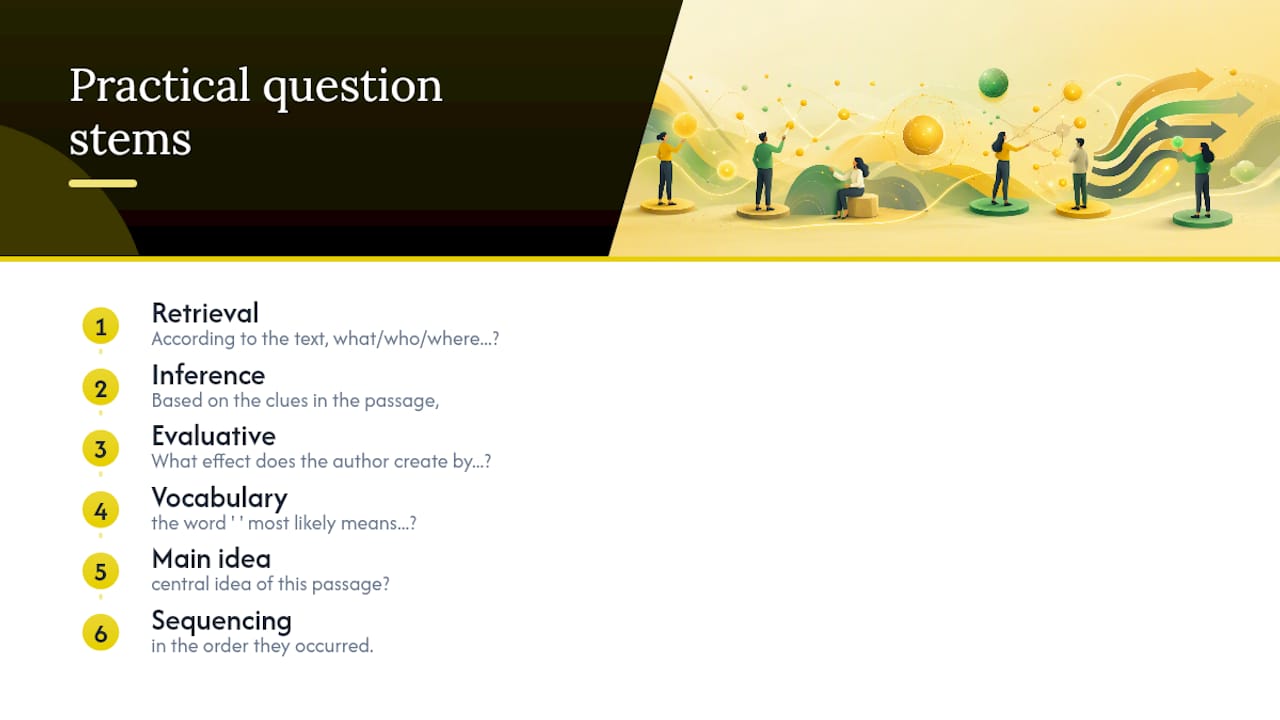
A short, memorized bank of stems saves time on every test and worksheet you'll ever face. Here's a version worth pinning above a desk or handing to a class as a laminated card:
For retrieval: "According to the text, what/who/where...?" For inference: "Based on the clues in the passage, what can you conclude about...?" For evaluative: "What effect does the author create by...?" For vocabulary: "In the sentence ',' the word '' most likely means...?" For main idea: "Which sentence best captures the central idea of this passage?" For sequencing: "Put these three events in the order they occurred."
These aren't decorative. Familiar phrasing removes a layer of confusion during a timed test, since the brain recognizes the pattern instead of parsing it fresh each time. Research-backed stem lists built for grades 6 through 8 use exactly this approach, grouping stems by cognitive demand rather than by topic.
One adjustment worth making for younger children: swap "based on the clues in the passage" for "what clue tells you this?" The shorter phrasing asks for the same skill without the extra processing load.
Why We Build Practice Around Stems, Not Just Answers
Most reading programs test whether a child got the right answer. Few teach why a question is shaped the way it is. Once a student can name a question type on sight, the rest of the work gets easier, because they already know where to look and what kind of evidence to bring.
Thepocketmoneygame builds its comprehension activities around that same idea: adaptive questions that shift difficulty as a child improves, paired with voice support so decoding never blocks understanding, and immediate feedback so a child learns from a wrong answer in the moment, not three days later on a marked-up worksheet.
Frequently Asked Questions
What are comprehension question types? They're categories of reading questions grouped by the kind of thinking each one demands, ranging from literal recall to evaluative judgment.
What's the difference between retrieval and inferential questions? Retrieval questions have an answer stated directly in the text; inferential questions require combining a text clue with background reasoning.
How many comprehension question types are there? Most classroom frameworks group them into around eight to ten practical categories, though the underlying skills map onto just three broad levels: literal, inferential, and evaluative.
What are Blank's Four Levels of Questioning? A model that ranks comprehension questions from matching what's directly visible (Level 1) to reasoning beyond the text (Level 4), used to scaffold question difficulty in lessons.
How can parents help with comprehension question types at home? Practice one mixed passage at a time, ask the child to name the question type before answering, and keep sessions short and consistent rather than long and infrequent.
Sources
- Question generation: A key comprehension strategy | Reading Rockets
- Resource 3B.3: Question stems — IES (REL Reading Intervention Grades 6–8)