
Teach KS2 long division by leading with the four-step formal algorithm (divide, multiply, subtract, bring down) alongside chunking, and start every lesson with place-value unitising and multiplication-fact practice. Both methods belong in your toolkit, but the formal algorithm is what pupils need for SATs-style questions. Here is where to begin:
- Start with unitising. Before touching the algorithm, make sure your child or pupil can talk about 432 as "4 hundreds, 3 tens, 2 ones" rather than three separate digits.
- Check multiplication facts. Shaky times tables slow every step of long division. A daily five-minute warm-up on the relevant table (e.g., the 13 times table before dividing by 13) pays off immediately.
- Model the four steps out loud. Write each step on the board: divide, multiply, subtract, bring down. Repeat until the sequence is automatic.
For ready-to-use lessons and printable worksheets, Third Space Learning and Oak National Academy both offer free, curriculum-aligned materials you can use tomorrow.
Pro Tip: Write the steps on a sticky note and keep it on the desk during early practice. The goal is to make the sequence feel automatic, not to test memory before the method is secure.
Key Takeaways
The single most effective move in teaching long division is securing place-value unitising and multiplication-fact fluency before introducing the formal algorithm.
| Point | Details |
|---|---|
| Start with unitising | Teach pupils to say "4 hundreds" not "4" before the algorithm begins. |
| Always write the subtraction | Insisting on the written subtraction step prevents most alignment and remainder errors. |
| Check with multiplication | Multiply quotient by divisor, add remainder; the result must equal the original dividend. |
| Use chunking to build understanding | Chunking shows why the algorithm works and helps pupils recover from mistakes. |
| Thepocketmoneygame for home practice | Adaptive difficulty, voice support, and parent-controlled rewards complement classroom teaching. |
Table of Contents
- What long division KS2 actually means in the national curriculum
- The two main methods, with worked examples you can use in class
- How to structure your teaching sequence across multiple lessons
- Common pupil errors and how to fix them quickly
- Where to find KS2-aligned worksheets, lessons, and videos
- How long division shows up in SATs and what markers look for
- Simple ways parents can support long division practice at home
- Adaptations for neurodiverse learners and keeping motivation high
- What actually works in the classroom, and what to try first
- Thepocketmoneygame makes home practice feel less like homework
- Sources
What long division KS2 actually means in the national curriculum
Long division is the written method for dividing a large number (the dividend) by a two-digit number (the divisor), producing a quotient and sometimes a remainder. It differs from short division because every multiplication and subtraction step is written out in full, making the working visible and checkable.
The national curriculum is clear: by the end of Year 6, pupils should be fluent in written methods for all four operations, including long division, and should be able to interpret remainders as whole-number remainders, fractions, or rounded answers depending on context. In practice, this means:
- Year 5: Introduction to dividing by two-digit numbers, usually starting with short division and progressing toward the formal long-division layout.
- Year 6: Consolidation of the formal method, multi-step word problems, and SATs preparation where remainder interpretation is tested directly.
The Mathematics Appendix 1 from the Department for Education sets out the expected written calculation methods and provides worked examples teachers can reference when planning.
Pro Tip: Use place-value language consistently from the first lesson. Saying "how many 13s fit into 4 hundreds?" rather than "how many 13s fit into 4?" prevents the single most common error pupils make.
The two main methods, with worked examples you can use in class
The formal long-division algorithm
The formal method follows four repeating steps: divide, multiply, subtract, bring down. Here is a worked example using 432 ÷ 15.
- Divide: How many 15s fit into 43? The answer is 2 (since 2 × 15 = 30, and 3 × 15 = 45 is too big). Write 2 above the line.
- Multiply: 2 × 15 = 30. Write 30 beneath 43.
- Subtract: 43 − 30 = 13. Write 13.
- Bring down: Bring the 2 down next to 13 to make 132.
- Repeat: How many 15s fit into 132? The answer is 8 (8 × 15 = 120). Write 8 above the line. Subtract: 132 − 120 = 12. No more digits to bring down, so the remainder is 12.
Answer: 432 ÷ 15 = 28 remainder 12.
Oak National Academy stresses that pupils must write out the subtraction step explicitly (e.g., 43 − 30 = 13) rather than calculating it mentally. Skipping that written step is where alignment errors creep in.
The chunking method
Chunking (subtract-and-repeat) solves the same problem by subtracting known multiples of the divisor from the dividend until nothing is left.
For 432 ÷ 15:
- Start with 432. Subtract a large chunk: 20 × 15 = 300. Remaining: 132.
- Subtract another chunk: 8 × 15 = 120. Remaining: 12.
- No more full 15s fit. Total chunks: 20 + 8 = 28, remainder 12.
Answer: 432 ÷ 15 = 28 remainder 12. Same result, different path.
Comparing the two approaches
| Feature | Formal algorithm | Chunking |
|---|---|---|
| Place-value demand | High (digit-by-digit) | Lower (whole chunks) |
| Steps recorded | Compact, structured | More lines, flexible |
| Speed for confident pupils | Faster | Slower |
| SATs suitability | Strong match | Acceptable, but less efficient |
| Best for | Pupils with secure tables | Pupils still building fluency |
To check any answer, multiply the quotient by the divisor and add the remainder: 28 × 15 = 420, plus 12 = 432. Correct. Third Space Learning pairs this checking step with estimation: before calculating, ask pupils to round the divisor and estimate the answer so they know roughly what to expect.
How to structure your teaching sequence across multiple lessons
A multi-day block works better than a single lesson. Schools like St Gilbert's RC spread long division across a full week, moving from fluency warm-ups to independent problem-solving progressively. Here is a practical sequence:
| Lesson | Focus | Scaffold |
|---|---|---|
| 1 | Recap short division and times tables | Multiplication grids, place-value charts |
| 2 | Introduce unitising; estimate answers | Base-ten blocks, number lines |
| 3 | Model formal algorithm with teacher think-aloud | Whiteboard step-by-step, multiples list |
| 4 | Guided practice (chunking and formal side by side) | Partially completed examples |
| 5 | Independent practice with increasing complexity | Word problems, self-checking with multiplication |
Scaffolding checkpoints to build in:
- Before Lesson 3, check that every pupil can write the first five multiples of the divisor. If they cannot, pause and drill those facts.
- During Lesson 4, circulate and look specifically at whether pupils are writing the subtraction step. If they are skipping it, stop the class and model it again.
- After Lesson 5, use a quick exit ticket: one long-division problem with a remainder that must be interpreted in context.
Differentiation: Lower-attaining pupils benefit from staying with chunking longer and using a printed multiples strip. Fast finishers can tackle four-digit dividends or problems where the remainder must be expressed as a fraction.
Pro Tip: Whiteboard modelling is more effective than worksheet-only practice in early lessons. When pupils see you cross out a mistake and correct it in real time, they learn that errors are part of the process, not a sign of failure.
Common pupil errors and how to fix them quickly
Most long-division mistakes trace back to a small number of root causes. Spot them early and the fix is usually quick.
- Not unitising. The pupil treats "4" in 432 as the digit 4, not as 4 hundreds. Diagnostic question: "What is the value of this digit?" Fix: return to place-value language and use base-ten blocks to show 4 hundreds physically.
- Skipping written subtraction. The pupil does the subtraction mentally and writes only the result, then loses track of alignment. Fix: insist on writing every subtraction in full (e.g., 43 − 30 = 13) before moving to the next step, as Oak National Academy recommends.
- Misplacing digits in the quotient. The pupil writes the partial answer in the wrong column. Diagnostic question: "Which column does this answer sit above?" Fix: draw a vertical line through each column and make pupils check alignment before writing.
- Mishandling remainders. The pupil stops when a remainder appears, unsure whether to round up, round down, or write a fraction. BBC Teach recommends a contextual discussion: "If you are packing boxes and 12 items are left over, do you need another box?" The context decides the remainder format.
Here is a typical mis-set subtraction and its correction:
Incorrect: Pupil writes 43 − 30 = 23 (a mental arithmetic slip, never caught because the step was not written out).

Corrected: Write 43 on one line, 30 beneath it, draw a subtraction line, and calculate: 43 − 30 = 13. The written layout makes the error visible immediately.
Pro Tip: During marking, circle the subtraction step specifically. If it is missing, write "show your working here" rather than marking the answer wrong. This trains the habit without discouraging the pupil.
Where to find KS2-aligned worksheets, lessons, and videos
You do not need to build resources from scratch. These four sources cover the full range of what teachers and parents need:
- BBC Bitesize is the quickest starting point for parents at home. Short videos explain the method clearly, and the quizzes give instant feedback.
- Oak National Academy provides complete lesson plans with slides, teacher notes, and pupil activities. The long-division lesson on dividing by a two-digit divisor is particularly thorough.
- Third Space Learning offers free downloadable long division worksheets alongside its teaching guidance, making it easy to pair reading with practice.
- Twinkl supplies step-by-step worked examples (including 7,397 ÷ 13 as a classroom display example) and differentiated printable packs. A subscription unlocks the full range, but the teaching wiki is free.
For home use, pairing a short video from BBC Bitesize with one printed worksheet from Third Space Learning covers both explanation and practice in under 20 minutes.
How long division shows up in SATs and what markers look for
Long division appears in both the KS2 arithmetic paper and the reasoning papers. In arithmetic, pupils are given a straightforward calculation and expected to show their method. In reasoning, the same skill is embedded in multi-step word problems where the remainder must be interpreted.
Three common SATs formats:
- Whole-number remainder: "432 ÷ 15 = ?" Answer: 28 remainder 12.
- Remainder as a fraction: "Share 432 equally among 15 groups. How much does each group get?" Answer: 28 and 12/15 (simplified to 4/5).
- Rounded result: "A coach holds 15 people. How many coaches are needed for 432 people?" Answer: 29 (round up because the remaining 12 people still need a coach).
For marking and feedback, focus on three things: whether the method is set out clearly, whether the subtraction step is written, and whether the remainder is handled correctly for the context. Method marks are available even when the final answer is wrong, so pupils who show clear working can still score.
Simple ways parents can support long division practice at home
You do not need to be a maths teacher to help at home. A few short, consistent sessions make a real difference.
- Use the four-step script. When your child is stuck, prompt with: "What goes into the first part? Multiply it. Subtract. Bring the next digit down." Keep the language consistent with what their teacher uses.
- Talk about remainders in everyday life. "We have 43 sweets and 15 children. How many each? What do we do with the leftovers?" Real context makes the abstract decision (round up, round down, or fraction) feel obvious.
- Five minutes a day beats an hour on Sunday. Short daily practice on multiplication facts (the fuel for long division) builds fluency faster than long, infrequent sessions. If your child's tables are shaky, this guide on times-table fluency has practical activities you can start tonight.
- Check with multiplication. After every answer, ask: "Can you check it?" Multiply the quotient by the divisor and add the remainder. If it matches the original number, the answer is right.
- Prompt, don't solve. When your child is stuck, ask "What do you know about the 15 times table?" rather than showing the answer. Productive struggle builds the skill; giving the answer short-circuits it.
Adaptations for neurodiverse learners and keeping motivation high
Children with ADHD, dyslexia, or working-memory weaknesses often find long division particularly demanding because it chains four steps together. The good news is that small adjustments make a significant difference.
- Multisensory modelling. Use base-ten blocks or place-value counters to show physically what "bringing down" means. It is a regrouping of place value, not a mysterious new operation, and seeing it concretely removes a lot of anxiety.
- Step-by-step verbal prompts. Read each step aloud as it is written. Voice support (whether from a teacher, a parent, or an app) reduces the cognitive load of holding the sequence in working memory.
- Written checklists. A laminated card with the four steps (divide, multiply, subtract, bring down) on the desk means the pupil can check the sequence without asking, which builds independence.
- Short timed sessions. Ten minutes of focused practice with a clear stopping point works better than 40 minutes of drifting attention. Set a timer, do three problems, then stop.
- Immediate feedback. Knowing straight away whether an answer is right or wrong keeps motivation alive. Waiting until the next day's marking means errors get reinforced overnight.
- Micro-rewards. Small, immediate rewards for correct answers (a sticker, a point, real pocket money) sustain effort through a difficult topic. Reward-based learning is especially effective for children with ADHD, where the gap between effort and payoff is a key barrier.
Pro Tip: Keep manipulatives available longer than you think you need to. Many pupils appear to understand the abstract method but quietly revert to confusion when the concrete support disappears too soon. A good rule: if a pupil can do three problems correctly without the blocks, try removing them for one lesson and see whether accuracy holds.
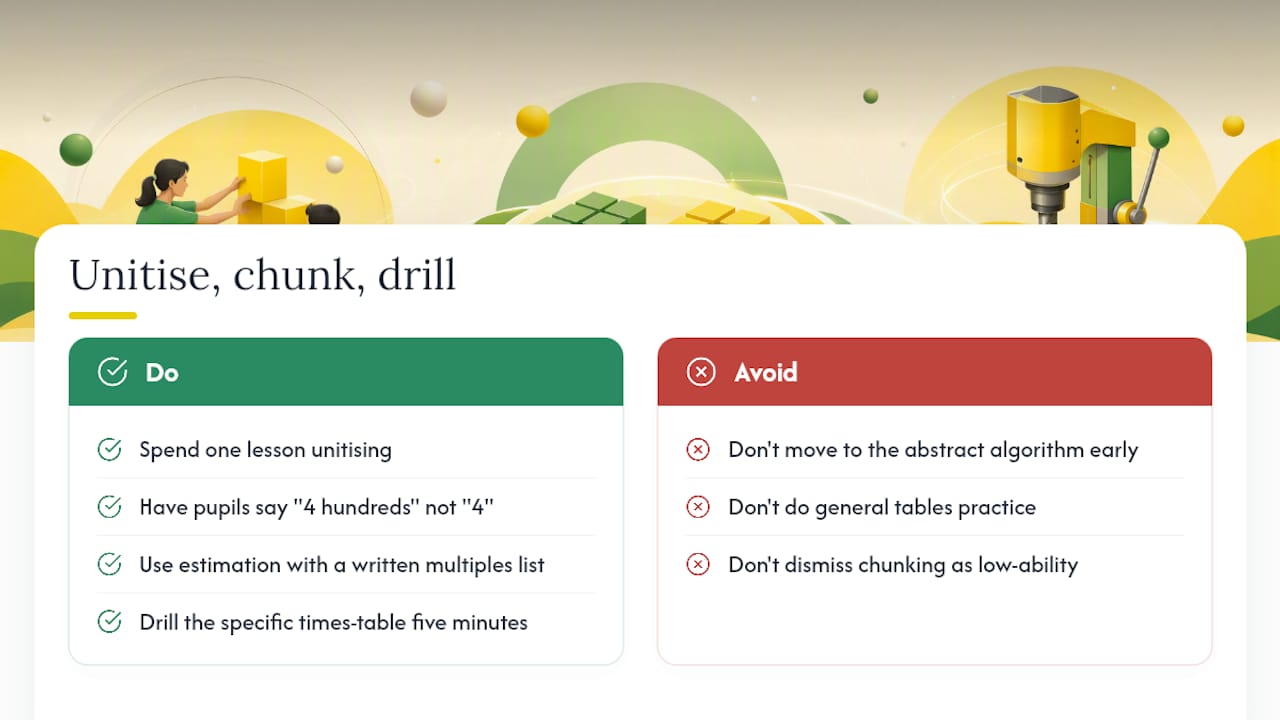
What actually works in the classroom, and what to try first
There is a version of long-division teaching that looks thorough on paper but quietly fails children: moving to the abstract algorithm before place-value understanding is secure. It produces pupils who can sometimes get the right answer but cannot explain a single step they took. When the question changes slightly, they are lost.
The most reliable shift you can make is to spend one full lesson doing nothing but unitising before the algorithm appears. Ask pupils to say "4 hundreds" not "4." Ask them to estimate: "Roughly how many 15s in 432? About 30? About 20?" That estimation habit, paired with a written multiples list for the divisor, removes most of the guesswork that causes errors.
Chunking often gets dismissed as a "lower-ability method," but that framing misses the point. Chunking makes the structure of division visible. Pupils who understand chunking understand why the formal algorithm works, which means they can recover when they make a mistake rather than starting over from scratch.
The one change worth trying tomorrow: before any long-division lesson, spend five minutes on multiplication facts for the divisor you are about to use. Not general tables practice. The specific table. If the lesson uses 13 as the divisor, drill the 13 times table for five minutes first. The difference in lesson pace is noticeable immediately.
Thepocketmoneygame makes home practice feel less like homework
Printable worksheets are useful, but they do not adapt when your child gets something wrong, and they do not tell you which step is causing the problem. Thepocketmoneygame takes a different approach: it pairs KS2 maths practice with adaptive difficulty and instant feedback, so your child gets the right level of challenge every session, not the same sheet repeated.

The reward system is the part parents notice first. Children earn real pocket money for correct answers, which you control through the parent dashboard. For a child who finds long division frustrating, that immediate payoff changes the emotional experience of practice entirely. Voice support reads questions aloud, which helps children with dyslexia or weaker reading confidence engage with the maths rather than getting stuck on the words. You can start with a free trial and see whether it fits your child's learning style before committing to a subscription. Visit The Pocket Money Game to get started.
Sources
These are the most reliable, curriculum-aligned sources for KS2 long-division teaching and practice:
- National curriculum in England: mathematics programmes of study
- Dividing by a 2-digit divisor including using long division | Oak National Academy
- Dividing using written methods - BBC Teach
- Long Division Method At KS2 With Free Worksheets — Third Space Learning
- How to do Long Division | Teaching Wiki — Twinkl
Recommended
- KS2 Maths Word Problems: Strategies for Parents and Educators
- How to Help My Year 4 Child Pass the Multiplication Tables Check | The Pocket Money Game
- Times Tables Year 4: MTC Curriculum Guide for Parents | The Pocket Money Game
- Blog | The Pocket Money Game — Tips for Parents, ADHD Learning & UK Curriculum