
The "i before e, except after c" rule is one of the most-taught spelling mnemonics in English, but it works reliably only in a specific situation: when the ie or ei pair makes a long "e" sound (/iː/). According to Grammarly, it's a rule of thumb, not a law, and it breaks down quickly outside that sound condition. Here's what you actually need to know:
- The core rule: Write i before e (believe, field), except after the letter c (receive, ceiling).
- The sound restriction: The rule is most reliable when the pair sounds like /iː/ (the "ee" in feet). Outside that sound, it often doesn't apply.
- The practical takeaway: Use it as a quick first check, memorize a short list of common exceptions, and reach for a dictionary or spell-check whenever you're unsure.
Key Takeaways
The ie or ei rule is a useful but limited mnemonic that works reliably only when the vowel pair makes a long "e" sound (/iː/), and learning six high-frequency exceptions by sight covers most real-world spelling errors.
| Point | Details |
|---|---|
| Core rule and its limit | Write i before e, except after c, but only when the pair sounds like /iː/. |
| Sound check first | Say the word aloud; if the sound is /eɪ/ or the letters split syllables, skip the mnemonic. |
| Top exceptions to memorize | Learn seize, weird, height, foreign, either, and protein as sight words. |
| Etymology explains the gaps | French-derived words follow the rule; Germanic and other-origin words often don't. |
| Thepocketmoneygame | Offers adaptive spelling quizzes, voice support, and real rewards to help children practice these patterns consistently. |
Table of Contents
- How the ie or ei rule actually works with sounds
- Common words that show the pattern clearly
- Exceptions that trip up even confident spellers
- How pronunciation tells you when to use the rule
- Why English has so many exceptions to this rule
- Memory aids and practice activities that actually stick
- Why the rule alone won't get your child there
- Thepocketmoneygame makes spelling practice feel worth showing up for
- Sources
How the ie or ei rule actually works with sounds
The rule is really about digraphs — two letters that combine to make one vowel sound — not about every word that happens to contain i and e next to each other. That distinction matters more than most people realize.
- Digraph vs. separate syllables: The mnemonic applies when ie or ei forms a single vowel sound. In words like de-i-ty or sci-ence, the i and e belong to different syllables entirely, so the rule simply doesn't enter the picture.
- Long "e" (/iː/) is the sweet spot: When the digraph sounds like the "ee" in feet, the rule is useful. Believe (/bɪˈliːv/), field (/fiːld/), and relief (/rɪˈliːf/) all follow it cleanly.
- After c for the same sound: When c precedes the digraph and the sound is still /iː/, you flip to ei: receive (/rɪˈsiːv/), ceiling (/ˈsiːlɪŋ/), deceive (/dɪˈsiːv/).
- Long "a" (/eɪ/) is a separate case: Words like neighbor (/ˈneɪbər/) and weigh (/weɪ/) use ei for a long "a" sound, which is why the expanded rhyme (more on that below) adds "or when sounding like A."
A pronunciation-first approach is generally more reliable than a letter-only check, as The Free Dictionary explains. Say the word, identify the vowel sound, then apply the rule.
Common words that show the pattern clearly
Seeing the three main groups side by side makes the pattern click faster than any explanation.
| Pattern | Example words |
|---|---|
| ie making /iː/ | believe, field, relief, piece, grief, thief, achieve, niece |
| ei after c making /iː/ | receive, ceiling, deceive, perceive, conceit, receipt |
| ei making /eɪ/ | neighbor, weigh, eight, freight, vein, reign, sleigh |
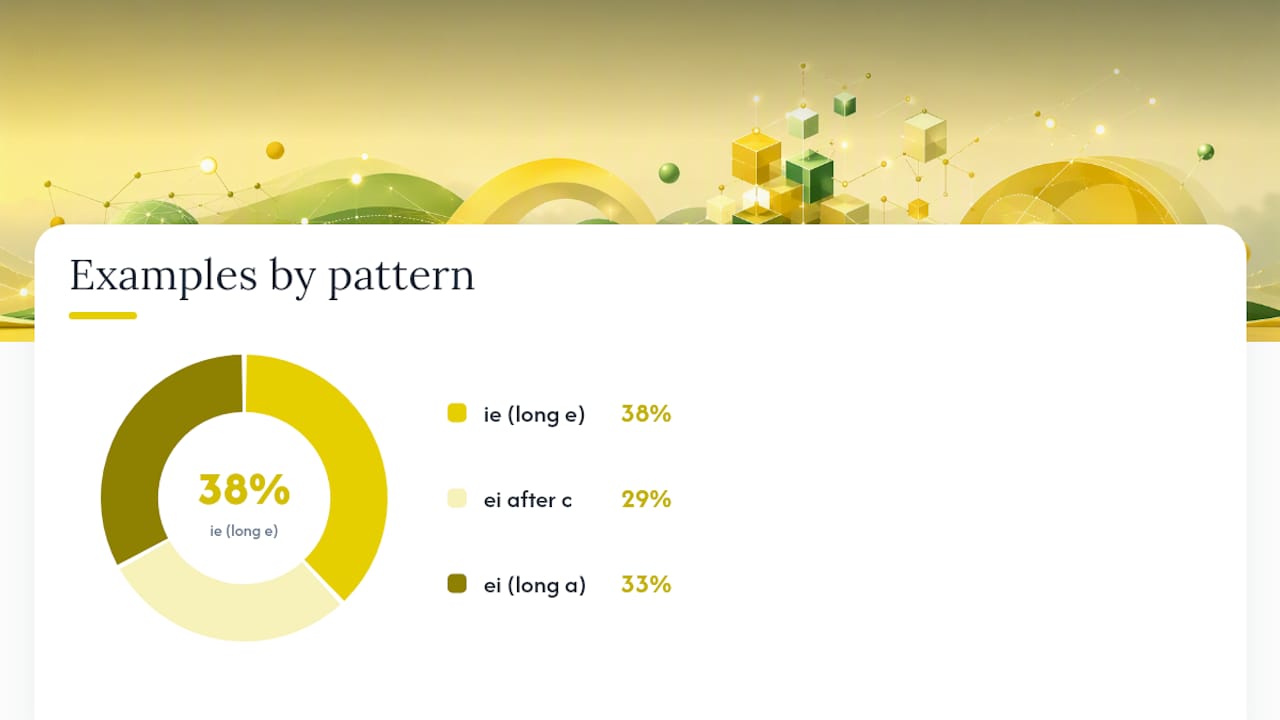
The cei family is actually small and consistent — Wikipedia's entry on the rule notes that there are very few true cei exceptions, which means memorizing that short cluster (receive, ceiling, deceive, perceive, conceit) covers most of what your child will encounter in class.
Exceptions that trip up even confident spellers
This is where the rule earns its reputation for being unreliable. Several high-frequency words simply don't follow the pattern, and they're words kids use all the time.
- seize — /iː/ sound, but ei without a c in sight
- weird — /ɪə/ sound, Germanic origin, breaks both the letter and sound conditions
- height — /aɪ/ sound, Old English root, nothing like /iː/ or /eɪ/
- foreign — /ɒ/ vowel in the first syllable; the ei here isn't even a digraph in the usual sense
- either / neither — pronunciation varies (American English often uses /ˈiːðər/, British often /ˈaɪðər/), which is exactly why the rule can't reliably guide you here
- protein — /iː/ sound but ei without a preceding c, borrowed from French protéine
The expanded Merriam-Webster rhyme — "I before E, except after C, or when sounding like A as in neighbor and weigh" — handles the /eɪ/ group neatly. But seize, weird, and height remain outliers no rhyme fully captures. That's not a flaw in your child's memory; it's a flaw in the rule itself.
Words like either and neither deserve a special mention. Because their pronunciation shifts depending on dialect and speaker, even the sound-based test gives inconsistent results. For these, sight-word practice beats rule-application every time.
How pronunciation tells you when to use the rule
Think of pronunciation as your decision filter. Before reaching for the mnemonic, say the word slowly and ask: what sound does that vowel pair make?
- If it's /iː/ (long "e"): The rule is worth applying. Write ie unless c comes right before the pair, in which case write ei.
- If it's /eɪ/ (long "a"): Write ei. The rule's "except after C" clause doesn't apply here; the sound itself tells you.
- If the letters split across syllables: The rule doesn't apply at all. De-i-ty and sci-ence both have i and e in separate syllables, so there's no digraph to govern. The Free Dictionary uses syllable division as a practical test for exactly this reason.
Pro Tip: When you're unsure whether i and e form one sound or two, try splitting the word into syllables out loud. If the letters land in different syllables, skip the mnemonic entirely and check a dictionary instead.
This pronunciation-first method is what classroom specialists at Cuesta College recommend when teaching the rule as part of a broader set of sound-spelling correspondences.
Why English has so many exceptions to this rule
The short answer: English borrowed words from everywhere, and those source languages had different spelling conventions.
Many of the reliable cei words (receive, deceive, perceive, ceiling) came into English through Old French and Latin, where the c + /iː/ pattern was consistent. The rule was essentially reverse-engineered from that French-derived cluster. Germanic and Old English words, by contrast, followed their own vowel patterns, which is why weird, height, and weigh look the way they do.
Merriam-Webster puts it plainly:
Sound changes over centuries added another layer of complexity. Words that once rhymed no longer do, and spellings that were phonetically logical in Middle English can look arbitrary today. This isn't a reason to abandon the rule, but it does explain why learning a short list of high-frequency exceptions is more practical than searching for a perfect mnemonic.
Memory aids and practice activities that actually stick
The expanded rhyme is the best starting point. Instead of the bare "I before E, except after C," use the fuller version:
"I before E, except after C, or when sounding like A as in neighbor and weigh."
That single addition handles an entire category of /eɪ/ words. From there, a few targeted activities make the exceptions stick.
- Sight-word card drill: Write each high-frequency exception (seize, weird, height, foreign, either, protein) on a separate index card. Flip through them daily for two minutes. Repetition at short intervals beats one long study session.
- Slow-dictation practice: Read a sentence aloud very slowly, pausing before each ie or ei word. Ask your child to say the vowel sound first, then spell the word. This builds the pronunciation-check habit before the guessing habit.
- Sorting game: Write 12 words on slips of paper — a mix of rule-followers and exceptions — and ask your child to sort them into two piles: "follows the rule" and "breaks the rule." Sorting is active retrieval, which EnglishClub's spelling resources support as a way to reinforce pattern recognition.
- Quick quiz format: Call out five words. Your child writes each one, then you reveal the correct spelling immediately. Instant feedback is the key ingredient — waiting until the end of a worksheet to check answers is far less effective.
Pro Tip: Don't try to memorize every exception. Focus on the six most common ones (seize, weird, height, foreign, either, protein) and learn them as sight words. That short list covers the vast majority of errors learners actually make.
Why the rule alone won't get your child there
Here's something most spelling guides won't say directly: the "i before e" mnemonic is a starting point, not a finish line. For children who learn differently, treating it as a complete system sets them up for frustration.
The rule works beautifully as a visual check for /iː/ spellings — it helps a child decide between two plausible-looking options for the same sound. That's genuinely useful. But the moment a child encounters weird or seize and the rule fails them, confidence can take a hit. The fix isn't a better rule; it's pairing the rule with deliberate sight-word practice for the exceptions.
For children with ADHD or dyslexia, this matters even more. Immediate feedback, multi-sensory cues, and short repeated practice sessions help these learners internalize irregular patterns far more effectively than longer, passive study. A child who hears a word read aloud, writes it, and gets instant confirmation is building a memory trace that a worksheet alone rarely creates. Spelling practice approaches for dyslexic learners consistently point to this combination of sound, movement, and rapid feedback as the most reliable path to retention.

The goal isn't to memorize a rule perfectly. It's to build enough pattern recognition that spelling feels manageable, not like a minefield.
Thepocketmoneygame makes spelling practice feel worth showing up for
Knowing the rule is one thing. Getting enough practice to make it automatic is another, and that's where most children stall. Thepocketmoneygame is built for exactly this gap: bite-sized spelling questions, immediate feedback after every answer, and voice support so children can hear words pronounced correctly before they try to spell them.

The adaptive difficulty means your child won't be stuck on words they've already mastered or lost on words that are too hard. Parent controls let you set the pace and the reward level, and the reward mechanic is real: children earn actual pocket money for correct answers, which turns a two-minute spelling drill into something they actually want to do. For children who struggle with ie and ei exceptions, that motivation is the difference between one attempt and ten.
Start your free 7-day trial at Thepocketmoneygame and see whether a little reward goes a long way.
Sources
- Spelling Words With EI and IE: "I Before E Except After C" Rule | Grammarly
- I Before E Except After C | Merriam-Webster
- Thefreedictionary
- I before E except after C | Wikipedia
Recommended
- How to Practise KS1 Common Exception Words at Home (No Flashcards) | The Pocket Money Game
- Common Exception Words Year 2: Full List and Activities
- Fun Ways to Practise KS2 Statutory Spelling Lists Online | The Pocket Money Game
- KS1 Phonics and Common Exception Words: A Parent's Complete Guide — The Pocket Money Game