
The phonics screening check is a statutory, one-to-one assessment in England that confirms whether most Year 1 pupils can decode words at an age-appropriate level. It contains items consisting of an equal number of real words and pseudo-words, read aloud to a teacher. For 2026, the expected standard is a specific threshold set for that year., and the primary administration week begins in early June, with a subsequent catch-up window lasting a short period afterwards.
This is a diagnostic snapshot, not a high-stakes exam. Its purpose is to help schools identify children who need a little extra support, not to label or rank them.
Three things to do right now:
- Ask your child's school for the exact test week and when you'll receive results.
- Keep any home practice short, playful, and low-pressure.
- Read on for what's actually in the check and how to help your child feel ready.
Table of Contents
- What's actually in the phonics screening check?
- Who takes it, when, and how it works
- How scoring works and what the threshold means
- What the check actually measures and how schools use results
- What happens if your child doesn't meet the expected standard
- Practical ways to support phonics at home
- What your child will experience on test day
- Where to find official guidance and practice materials
- Key Takeaways
- The check matters less than what happens next
- A practical tool for home phonics practice
- Useful sources
What's actually in the phonics screening check?
The check is straightforward: 40 words read aloud, one at a time, to a teacher. The words include both real English words and pseudo-words (sometimes called "alien words"), which are made-up but phonetically plausible. The 2026 materials include a practice sheet, pupils' materials, an answer sheet, and scoring guidance.
Pseudo-words exist for a good reason. A child who has memorized "cat" by sight can say it correctly without decoding it. A made-up word like freb can only be read by applying letter-sound knowledge, which is exactly what the check is measuring.
"The phonics screening check is designed to confirm that pupils have learned phonic decoding to an age-appropriate standard and to identify those who need extra help." — Standards and Testing Agency
Schools use a double-sided practice sheet before the check begins, so your child will see the format before any real items are presented. Avoid drilling word lists at home. Rote memorization of real words won't help with pseudo-words, and it can actually make children second-guess themselves.
Pro Tip: Instead of test prep, spend 5 minutes a day on "robot talk" — say a word in separate sounds ("c-a-t") and ask your child to blend them back. It builds the exact skill the check tests, without any pressure.
Who takes it, when, and how it works
Most pupils in Year 1 who will reach age 6 by the end of the academic year take the check. It's administered one-to-one with a teacher, in a quiet setting, during a specific June window.
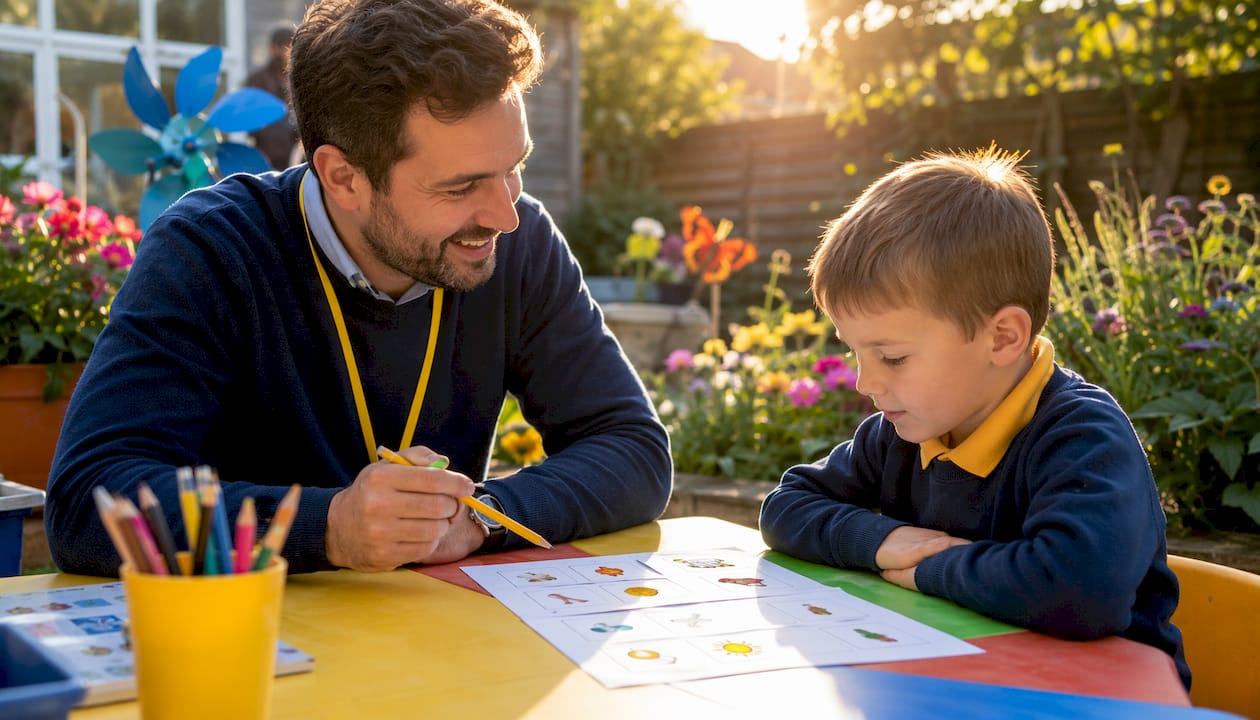
There is a specific administration window in June during which the check is taken, with a catch-up period following. Each pupil attempts the check one time during this period.
What happens on the school side:
- Schools receive materials in advance and must store them securely.
- Teachers administer the check one-to-one and score responses immediately.
- The headteacher completes and submits a Headteacher Declaration Form (HDF).
- Schools report results to their local authority by set deadlines.
- Parents receive written notification of their child's result.
If a pupil is absent during the primary week, the catch-up window applies. In exceptional cases where a pupil cannot access the check at all, schools notify the Standards and Testing Agency (STA) and complete the HDF accordingly.
How scoring works and what the threshold means
Teachers score each of the 40 items as correct or incorrect during the check itself, using the official scoring guidance. The total is then compared against that year's threshold to determine whether a pupil has met the expected standard.
The threshold changes every year. This is deliberate. The annual threshold is set based on the difficulty of that year's specific items, which prevents schools from teaching to a fixed pass mark and keeps the focus on genuine decoding ability.
- The threshold changes slightly each year based on the difficulty of the test items.
A score at or above the threshold means a pupil has met the expected standard. A score below it means the school will put targeted support in place, not that your child has "failed" anything.
What parents should know about scoring:
- Teacher judgment matters for borderline pronunciations, especially on pseudo-words.
- Scoring guidance includes examples to help teachers apply consistent standards.
- Schools publish the threshold once it's confirmed and communicate results to parents in writing.
What the check actually measures and how schools use results
The check's goal is diagnostic, not competitive. Assessment should guide instruction — the result tells a teacher where to focus next, not how to rank children against each other.
When a child meets the expected standard, the school knows their phonics foundation is solid. When a child doesn't, the result triggers targeted support: small-group phonics sessions, one-to-one work, or a structured intervention program in Year 2.
What you can expect from your child's school:
- A written report of your child's score after the check window closes.
- An explanation of what the result means and what support will follow.
- An intervention plan if your child needs additional phonics work.
Pro Tip: At your next parent-teacher meeting, ask specifically: "Which phonics phases is my child confident in, and which ones need more practice?" That question gets you far more useful information than a score alone.
What happens if your child doesn't meet the expected standard
A score below the threshold in Year 1 means one thing: your child's school is required to provide targeted phonics support and your child will retake the check in Year 2. That's the whole process. There's no formal consequence beyond that, and many children who retake it go on to meet the standard with the right support in place.
Steps to take if your child needs extra help:
- Request a clear intervention plan from the school — ask what specific phonics work will happen and how often.
- Ask for examples of activities used in school so you can reinforce the same approach at home.
- Schedule short check-ins with the class teacher every few weeks to track progress.
- Coordinate home practice around the phases your child's teacher identifies as priorities.
- Stay calm and positive with your child — their confidence matters as much as their decoding skill.
Schools must record interventions and report progress. You have every right to ask for updates, and most teachers welcome the partnership.
Practical ways to support phonics at home
Short, playful sessions beat long drilling every time. Early mastery of phoneme segmentation and letter-sound knowledge is highly predictive of later reading success, so the activities below target exactly those skills.
A simple 10-minute daily routine:
- Warm-up (2 minutes): Say three sounds and ask your child to blend them into a word. ("What word is /sh/ /o/ /p/?")
- Decoding practice (5 minutes): Use flashcards with individual phonemes, not whole words. Mix familiar and slightly tricky ones.
- Decodable reading (2 minutes): Read one page of a decodable book together, letting your child lead.
- Celebrate (1 minute): Name one thing they did well. Specific praise ("You got that tricky /igh/ sound!") works better than general praise.
For children with ADHD or dyslexia, shorter bursts with reward-based motivation and multisensory approaches (tracing letters in sand, clapping syllables) make a real difference. Voice support, where someone reads the word aloud before the child attempts it, also reduces anxiety.
Pro Tip: Mix phoneme awareness, letter-sound knowledge, and simple decodable reading in every session rather than focusing on one skill in isolation. Research on early reading assessment consistently shows that combining these three elements produces stronger outcomes than any single approach alone.
What your child will experience on test day
The check is designed to feel low-key. Teachers introduce it as a reading activity, not a test, and children work through the practice sheet first so the format feels familiar before any scored items begin.
What the day looks like for your child:
- A quiet, one-to-one session with their own teacher or a familiar adult.
- A short practice run using the double-sided practice sheet.
- Reading 40 words aloud, one at a time, at their own pace.
- No time pressure and no visible marking during the session.
Your day-of checklist as a parent:
- Make sure your child gets a good night's sleep.
- Keep the morning routine normal — a calm breakfast beats a rushed one.
- Avoid any last-minute drilling or "remember to try your best" pressure.
- Use supportive language: "You know loads of sounds. Just do what you always do."
The teacher's job is to make the child feel comfortable. Your job is to send them in feeling settled.
Where to find official guidance and practice materials
The most reliable starting point is GOV.UK. Everything else should supplement it, not replace it.
Authoritative sources to bookmark:
- Phonics screening check ARA: Statutory guidance covering eligibility, administration, scoring, and reporting timelines.
- 2026 materials page: Practice sheets, pupils' materials, answer sheet, and scoring guidance.
- Primary assessments: future dates: Official administration windows for 2026 and beyond.
- Reading Rockets: Research-backed guidance on early reading assessment and how to use results to guide instruction.
Comparing resource types at a glance:
| Resource type | Best for | When to use |
|---|---|---|
| Official GOV.UK practice sheets | Understanding the exact format | Before the check window |
| Decodable readers | Building fluency with real text | Daily reading practice |
| Phoneme awareness games | Segmenting and blending skills | Short daily warm-ups |
| School-provided materials | Matching home practice to class | Whenever the teacher shares them |
When evaluating any at-home app or tool, look for: adaptive difficulty that adjusts to your child's level, voice support so they can hear sounds modeled correctly, a parent dashboard showing progress, and settings that work for neurodiverse learners. A tool that ticks all four is worth far more than one that simply drills word lists.
Key Takeaways
The phonics screening check is a diagnostic tool, not a judgment: a score below the threshold in the given year triggers targeted school support, not a label.
| Point | Details |
|---|---|
| 2026 threshold is 31/40 | Scores at or above this mark mean the expected standard is met; below it triggers school support. |
| June window, one attempt | The primary week begins June 8; catch-up runs to June 19; each child attempts it once. |
| Pseudo-words test real decoding | Made-up words like freb can only be read by applying letter-sound knowledge, not memory. |
| Year 2 retake if needed | Children who don't meet the standard in Year 1 retake the check in Year 2 with targeted support. |
| Thepocketmoneygame supports home practice | Adaptive difficulty, voice support, and reward-based sessions help children build phonics skills between school days. |
The check matters less than what happens next
Most of the anxiety parents feel about this assessment comes from treating it like a high-stakes exam. It isn't. The Standards and Testing Agency designed the check specifically to be a starting point for support, not a finish line.
What actually moves the needle for children is what happens in the weeks and months around the check, not the check itself. Short, consistent phonics practice at home, a teacher who knows which sounds need work, and a child who feels confident rather than anxious — those three things matter far more than whether a child scores 30 or 34.
The variable threshold is one of the smarter design choices in the whole system. By resetting the pass mark each year based on item difficulty, the check stays honest. It measures decoding skill, not familiarity with a fixed word list. That's worth understanding, because it means drilling last year's practice sheet is genuinely less useful than building the underlying skill.
If your child needs extra support after the check, ask for specifics. "What phonics phases are we targeting?" is a better question than "What's the plan?" It signals that you understand the system and want to be a genuine partner in the process.
A practical tool for home phonics practice
If you're looking for a way to keep phonics practice going between school days without it feeling like homework, Thepocketmoneygame was built for exactly this situation.
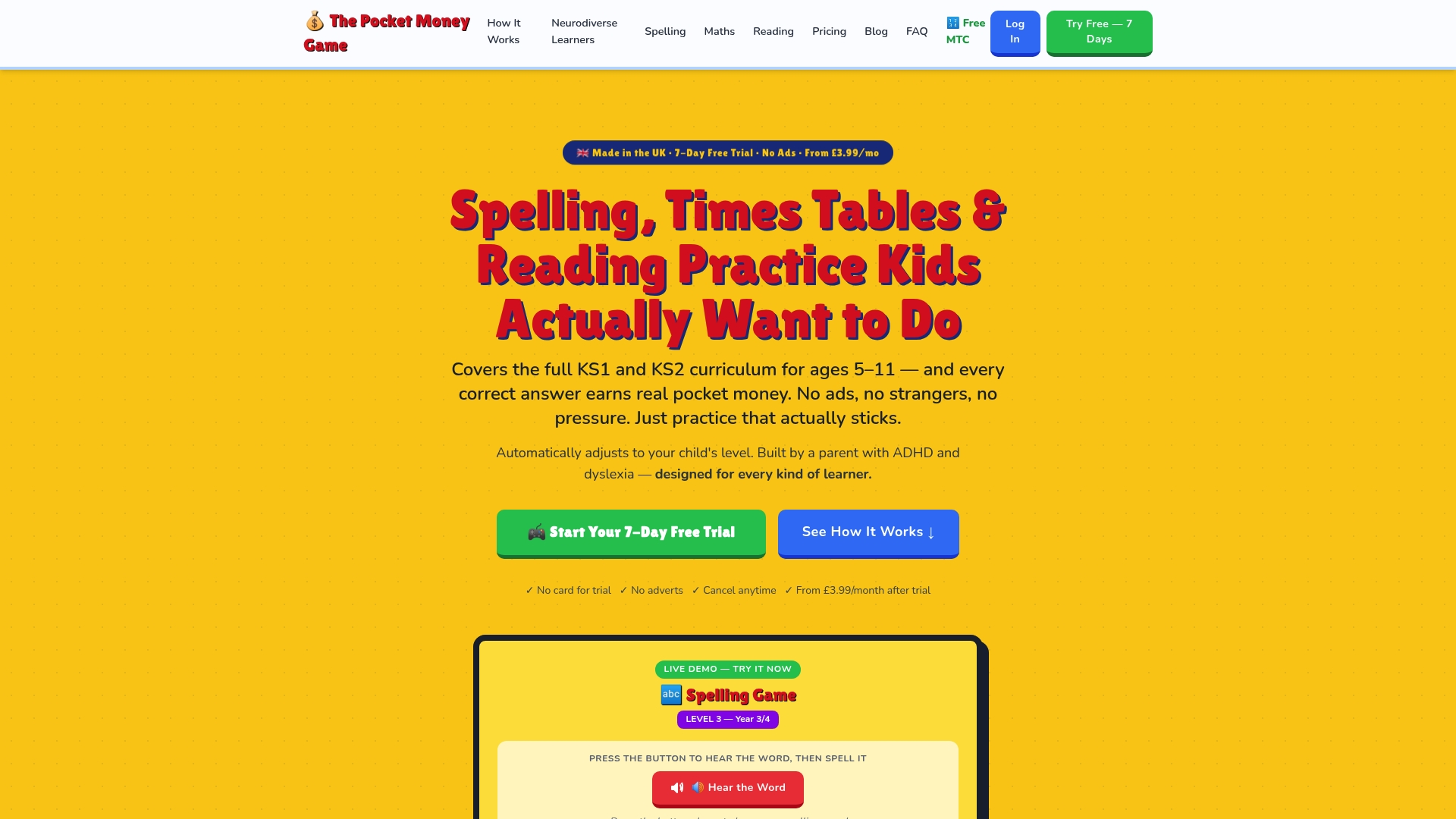
Developed by a parent with ADHD and dyslexia, the platform gives children aged 5–11 short, adaptive reading and spelling sessions with voice support built in. Children earn real pocket money for correct answers, which turns a 10-minute practice session into something they actually want to do. The parent dashboard shows you exactly which skills are improving, so you can share progress with your child's teacher. Neurodiversity-friendly settings, adjustable difficulty, and multi-child profiles make it practical for real family life.
You can try it free for 7 days with no commitment. If you have a child with ADHD or dyslexia, the neurodiversity-specific features are worth exploring before the check window opens.
This is a paid platform with a 7-day free trial, after which a subscription applies. All features described are available on the paid plan.
Useful sources
- Phonics screening check ARA — GOV.UK: The statutory guidance document covering eligibility, administration, scoring, and reporting. Start here for any official question about the check.
- 2026 phonics screening check materials — GOV.UK: Contains the 2026 practice sheet, pupils' materials, answer sheet, scoring guidance, and the confirmed threshold of 31/40.
- Primary assessments: future dates — GOV.UK: Official source for the June 8 administration window and June 19 catch-up deadline.
- 2026 administration guidance — GOV.UK: Covers secure handling of materials, one-to-one administration, HDF submission, and reporting timelines.
- Early Reading Assessment: A Guiding Tool for Instruction — Reading Rockets: Research summary on how phoneme awareness and letter-sound knowledge predict reading outcomes, and how assessment results should shape instruction.
- KS1 Phonics and Common Exception Words: A Parent's Complete Guide: Practical guidance on using assessment outcomes to shape home practice, including phase-by-phase support.
"Assessment is most powerful when it guides what happens next in the classroom — not when it ends the conversation." — Reading Rockets, Early Reading Assessment: A Guiding Tool for Instruction
This article provides general information about the phonics screening check in England. For guidance specific to your child's situation, contact your school or consult the official GOV.UK materials directly.
Recommended
- KS1 Phonics and Common Exception Words: A Parent's Complete Guide — The Pocket Money Game
- The Pocket Money Game in Cambridgeshire — KS1 & KS2 Spelling, Maths and Reading
- The Pocket Money Game in Hertfordshire — KS1 & KS2 Spelling, Maths and Reading
- The Pocket Money Game in Oxfordshire — KS1 & KS2 Spelling, Maths and Reading