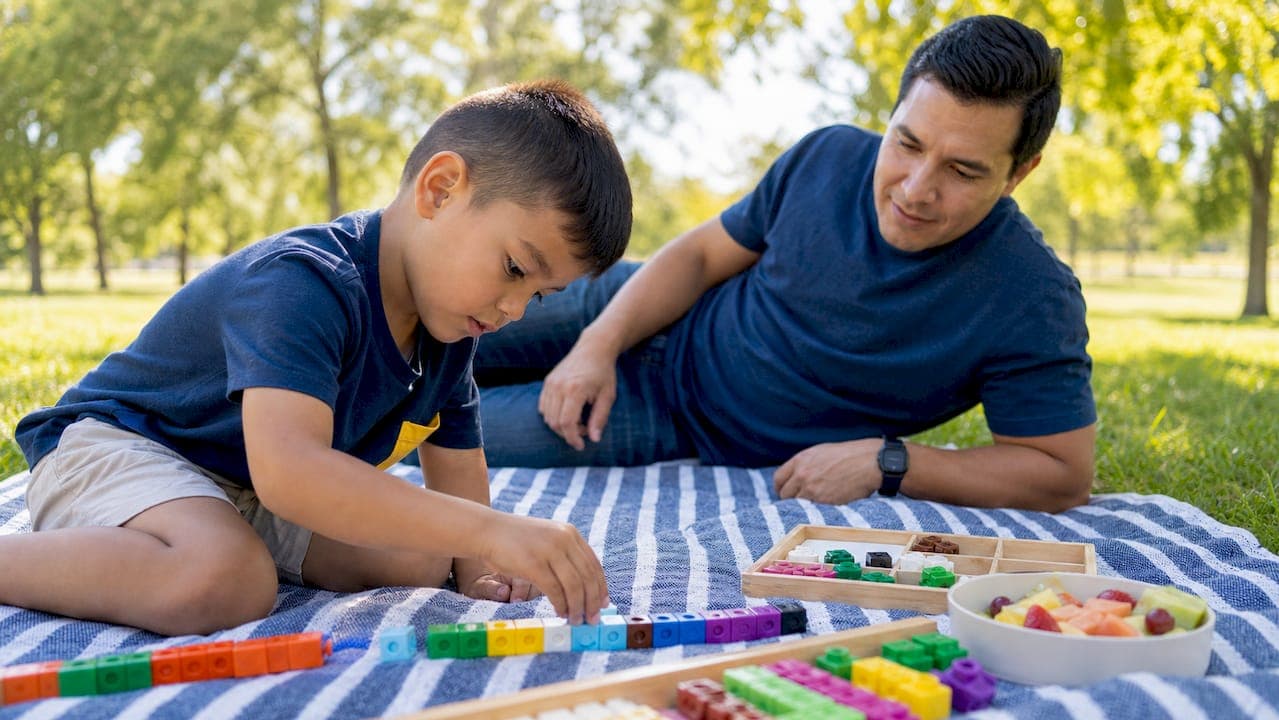
Number bonds to 10 are pairs of numbers that add up to 10 and form the bedrock of early arithmetic for children aged 5–11. Every pair, from 1 and 9 to 4 and 6, teaches children how numbers relate to each other as parts of a whole. Mastering these pairs builds number sense and one-to-one correspondence, which children need for addition, subtraction, and mental math well beyond primary school. The good news is that you do not need to be a math teacher to help your child get there.
1. What are number bonds to 10?
Number bonds are a way of showing how two numbers join together to make a total. The formal term used in primary education is "part-part-whole relationship," and understanding number bonds to 10 is the clearest introduction to that idea. Think of it like a simple puzzle: if one part is 3, the other part must be 7, because 3 and 7 make 10.
What makes this concept so powerful is that one number bond creates four equations. The bond 3 and 7 gives you 3+7=10, 7+3=10, 10-3=7, and 10-7=3. That means your child is not just learning one fact. They are learning a whole fact family at once, which accelerates their grasp of both addition and subtraction.
Fluency with these pairs also supports the "make a ten" strategy, where children use pairs like 7+3 to solve harder problems mentally. A child who knows 8 and 2 make 10 can quickly work out 8+5 by thinking "8+2=10, then 3 more makes 13." That kind of mental flexibility is the goal.
2. How hands-on methods build strong number bond understanding
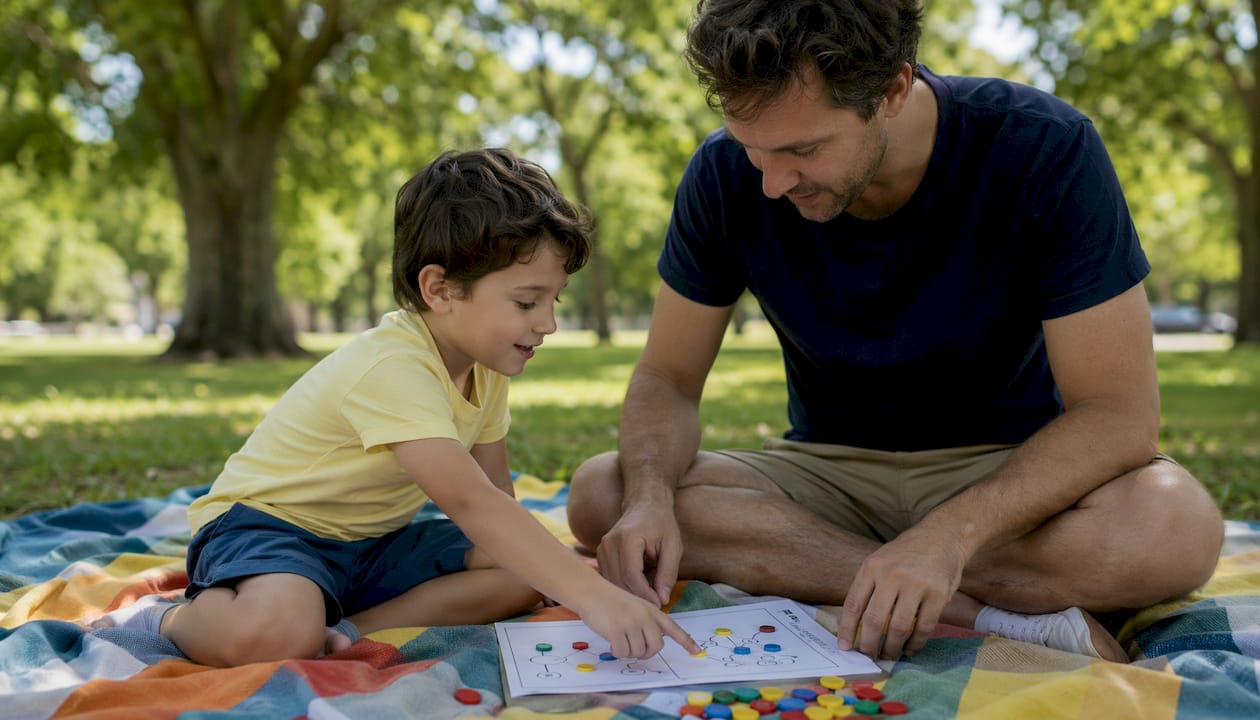
Physical objects come before pencil and paper. Every time. Moving objects between circles on a part-part-whole mat gives children a mental picture they can recall later when numbers become abstract. This "body work" is not optional. It is the foundation.
Here is what hands-on practice looks like in practice:
- Ten-frames: A simple grid of 10 boxes where children place counters to see how many are filled and how many are empty. If 6 boxes are filled, 4 are empty. The visual is immediate and clear.
- Part-part-whole mats: Draw two circles (the parts) feeding into one large circle (the whole). Children physically move counters between the part circles and the whole circle.
- Everyday objects: Grapes, building blocks, coins, or buttons all work. The object itself does not matter. The moving and counting does.
- Body movement: Have your child hold 10 small objects in two hands, then open their palms to reveal the split. "I have 4 in this hand and 6 in this hand. What do they make together?"
Tactile engagement supports neurodivergent learners better than worksheets alone, enabling concept mastery before symbols are introduced. This matters especially if your child has ADHD or dyslexia, where abstract symbols can feel disconnected from meaning.
Pro Tip: Keep sessions to two minutes. Experts recommend short, calm, tactile practice rounds to avoid frustration. Two focused minutes beats twenty distracted ones every time.
3. Top 5 engaging activities to practice number pairs that make 10
Games remove the pressure. When your child is playing, they practice recall without realizing it. These five activities work well at home with no special equipment.
-
Matching card games. Write the numbers 0–10 on separate cards, then make a second set. Shuffle them and lay them face down. Your child flips two cards and checks whether they make 10. Unicorn-themed or animal-themed versions of this game boost engagement through hands-on play, and you can easily make your own at home.
-
Roll and match. Roll a single die. Your child says the number that pairs with the result to make 10. Roll a 4, they say 6. Roll a 2, they say 8. Keep it fast and light. Celebrate every correct answer.
-
Hide and seek with counters. Place 10 counters on the table. Ask your child to close their eyes while you hide some under a cup. They open their eyes, count what is visible, and tell you how many are hidden. This builds missing-addend thinking, which is a direct path to subtraction.
-
Songs and chants. Set the number pairs to a simple rhythm. "One and nine, two and eight, three and seven, four and six, five and five." Repetition through song uses auditory memory, which is a different learning channel from visual or tactile. Children who struggle with written math often recall sung facts with ease.
-
Quick oral quizzes. Ask "What goes with 7 to make 10?" during car rides or at the dinner table. Keep it conversational, not test-like. If your child hesitates, give the answer cheerfully and move on. The goal is exposure, not pressure.
Pro Tip: Rotate activities every few days. Children disengage when the same format repeats too often. Variety keeps the practice feeling fresh.
4. Using number bonds worksheets effectively after hands-on mastery
Worksheets are a consolidation tool, not a teaching tool. The moment you hand a child a worksheet before they have physically handled the concept, you risk turning practice into guessing. Worksheets should follow multiple successes with physical objects, not precede them.
Signs your child is ready for written practice:
- They can recall most pairs without counting on fingers.
- They answer oral questions with confidence and speed.
- They can explain why a pair works, not just repeat it.
Once those signs are there, worksheets become genuinely useful. The best types for this age group include:
- Tracing and filling in: Part-part-whole diagrams where one number is given and the child writes the missing part.
- Cut and paste: Children cut out number cards and paste them into the correct bond diagram. The physical cutting keeps tactile learning alive.
- Simple equations: Rows of equations like 6+?=10 or ?+3=10, kept to 10 questions per session.
- Reference charts: A printed chart showing all pairs from 0+10 to 10+0 that your child can keep at their desk and consult during practice.
| Worksheet type | Best used when |
|---|---|
| Tracing and filling in | Child knows most pairs orally |
| Cut and paste | Child needs tactile reinforcement alongside writing |
| Missing number equations | Child recalls pairs quickly and confidently |
| Reference chart | Any stage, as a visual anchor |
Keep sessions short. Ten questions is enough. Returning to manipulatives breaks any plateau before reintroducing written work.
5. Common challenges and how to solve them
Most children hit at least one wall when learning these pairs. Knowing what to expect makes it far less stressful for you both.
Finger counting instead of recalling. This is normal and not a sign of failure. It means the child has not yet internalized the pair. Go back to physical objects for a few sessions before trying oral recall again.
Guessing on worksheets. Guessing is a signal, not a character flaw. It tells you the worksheet came too soon. Put the paper away, get the counters out, and rebuild the physical understanding first.
Forgetting that zero counts. Zero and 10 form a genuine bond. Overlooking zero as a valid part is one of the most common mistakes, and it matters because understanding 0+10=10 and 10+0=10 directly supports missing-addend work later.
Slow recall under pressure. Some children know the pairs but freeze when asked quickly. Reduce the speed of your questions. Calm, unhurried practice builds recall faster than timed drills.
"Patience and calm practice matter more than speed when teaching number bonds to young children. A child who feels safe to think slowly will recall facts faster over time than one who feels rushed."
If your child has ADHD or dyslexia, the physical and game-based methods above are especially worth prioritizing. Short sessions with clear rewards keep motivation high without overwhelming working memory.
Key takeaways
Number bonds to 10 are best learned through physical manipulation first, followed by games, and then worksheets, in that order.
| Point | Details |
|---|---|
| Start with physical objects | Use counters, ten-frames, or everyday items before introducing any written work. |
| Keep sessions short | Two-minute practice rounds prevent frustration and build stronger recall over time. |
| Games accelerate recall | Matching cards, roll-and-match, and oral quizzes make repetition feel effortless. |
| Worksheets come last | Introduce written practice only after a child can recall pairs confidently and orally. |
| Zero is a valid bond | Always include 0+10 and 10+0 to build complete understanding of the full set of pairs. |
What I have learned from watching children actually master this
The conventional wisdom says "practice makes perfect." My experience says "calm practice makes permanent." There is a real difference.
I have watched children sit through 20-minute worksheet sessions and retain almost nothing. I have also watched the same children spend two minutes moving counters between circles and walk away with a pair locked in for good. The physical experience creates a mental anchor that symbols alone cannot.
The other thing parents often get wrong is skipping zero. They teach 1+9, 2+8, all the way to 5+5, and then stop. But 0+10 is just as real, and children who miss it later struggle with missing-addend problems in ways that seem mysterious. Teach the full set from the start.
My honest advice for busy parents: do not try to fit this into a formal "lesson." Weave it into the day. Ask a bond question while you are making breakfast. Play roll-and-match for two minutes before bath time. Use the car ride. Short and frequent beats long and occasional, every single time. If you want to support your child further with times tables and other math skills, the strategies in learning times tables at home follow the same principles and are worth reading alongside this.
— Neil
How Thepocketmoneygame supports early math skills
Thepocketmoneygame is an adaptive learning platform built specifically for children aged 5–11, covering math, spelling, and reading. What makes it different is the reward system: children earn real pocket money for every correct answer, which turns practice into something they actually want to do.
The platform was created by a parent with ADHD and dyslexia, so it is built with diverse learners in mind. Voice support, immediate feedback, and short session formats mean children who struggle with traditional methods can still build real confidence. For children who need extra support, the ADHD and dyslexia learning app page explains exactly how the platform adapts to different learning needs. Parents control the difficulty and reward settings, keeping the experience matched to where their child actually is.
FAQ
What are number bonds to 10?
Number bonds to 10 are pairs of numbers that add up to 10, such as 3 and 7, or 4 and 6. Each pair represents a part-part-whole relationship and generates a family of four related addition and subtraction equations.
When should children learn number bonds to 10?
Most children begin learning these pairs in Reception or Year 1, typically between ages 5 and 6. Mastery by the end of Year 1 gives children the mental math foundation they need for more complex arithmetic in Key Stage 2.
How do I teach number bonds without worksheets?
Use physical objects like counters, building blocks, or coins on a part-part-whole mat. Short games such as roll-and-match or hide-and-seek with counters build recall through play before any written practice is introduced.
Does zero count as a number bond to 10?
Yes. Zero and 10 form a genuine bond, giving equations like 0+10=10 and 10+0=10. Including zero from the start helps children understand missing-addend problems and builds a complete picture of how 10 can be composed.
How long should practice sessions be?
Two minutes of focused, calm practice is enough for most young children. Short, frequent sessions build stronger recall than longer, infrequent ones, and they prevent the frustration that leads to guessing or disengagement.
Recommended
- How to Help Your Child Learn Times Tables at Home — The Pocket Money Game
- Times Tables Year 4: MTC Curriculum Guide for Parents | The Pocket Money Game
- Blog | The Pocket Money Game — Tips for Parents, ADHD Learning & UK Curriculum
- My Child Still Can't Do Times Tables in Year 5 — Here's What Actually Helps | The Pocket Money Game