
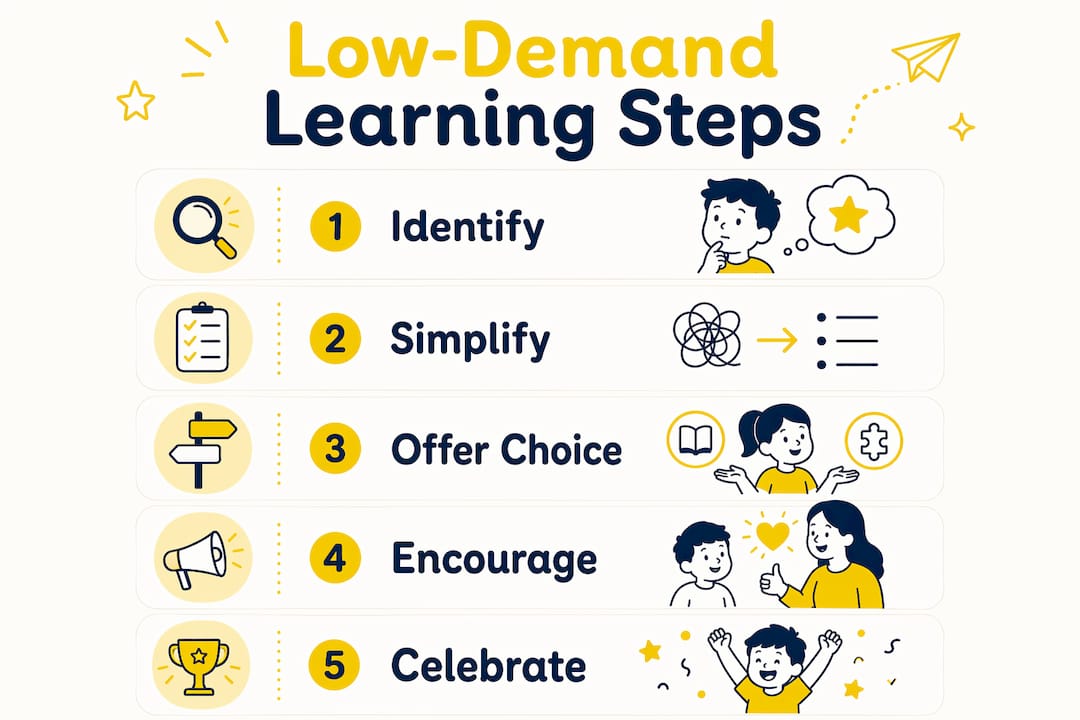
Low-demand learning is a deliberately scoped, invitation-led way to teach one small skill at a time. If your child regularly refuses schoolwork, shuts down at the homework table, or cries before a lesson even starts, try it tonight. The decision rule is simple: if you see repeated task refusal, anxiety spikes, or meltdowns around learning, this approach is worth starting now. Your first step takes under five minutes: pick one tiny task, offer it as an invitation ("I'm going to practice three spellings — want to join me?"), and stop the moment it's done.
Table of Contents
- What is low demand learning, and why does it work?
- Why does this help neurodiverse and anxious children?
- How do you run a low-demand learning session at home?
- What activities work well for spelling, maths, and reading?
- What features should a digital platform have for this approach?
- Why Thepocketmoneygame fits low-demand principles
- How do you know if it's working, and when should you get extra help?
- Your two-week starter plan
- Key Takeaways
- Why I built this approach into everything
- Try Thepocketmoneygame with your child tonight
- Useful sources
What is low demand learning, and why does it work?
Low-demand learning means reducing the scope of a task to its smallest useful unit, offering it as a choice rather than a command, and embedding it inside something the child already enjoys. It is not about lowering expectations. It is about changing the delivery so the learning actually lands.
The cognitive science behind it is straightforward. Working memory can handle roughly 4–7 items at a time. Push past that limit and the brain disengages. The Minimal Viable Content framework, developed in learning design research, builds on this by arguing that focused, single-outcome tasks raise completion and retention far better than content-heavy lessons. Overloading a session predicts dropout; scoping it tightly keeps children in the game.
The core mechanics, in plain terms:
- Reduce scope: one skill, one question type, one short task
- Invite, don't instruct: offer the activity as a choice
- Embed in interests: wrap the skill inside Minecraft, baking, football stats, or whatever your child loves
- Keep it finishable: a clear end point removes the dread of "how long is this going to take?"
Pro Tip: Before each session, write down one sentence: "Today we're practicing [X] and we're done when [Y]." That single sentence is your whole session plan.
Why does this help neurodiverse and anxious children?
For many neurodiverse children, a demand is not just an inconvenience. It registers as a threat. Children with PDA (Pathological Demand Avoidance) profiles, ADHD, or high anxiety can experience a genuine nervous-system response to being told what to do, even when the task itself is simple. Lowering perceived demand increases willingness to engage because it removes that threat signal before it escalates.
Two scenarios most parents recognize:
Scenario 1: It's 4:30 PM. You ask your seven-year-old to do ten minutes of reading. Within seconds there are tears, a slammed book, and a standoff that lasts forty minutes. The task wasn't the problem. The demand was.
Scenario 2: Your nine-year-old freezes at the start of a maths worksheet. She can do the sums. But the moment the sheet appears, she's gone. That "start-line freeze" is a demand response, not a capability gap.
Shifting from commands to invitations, keeping boundaries kind and predictable, and embedding skills in a child's interests are the three levers that make this work in practice.
How do you run a low-demand learning session at home?
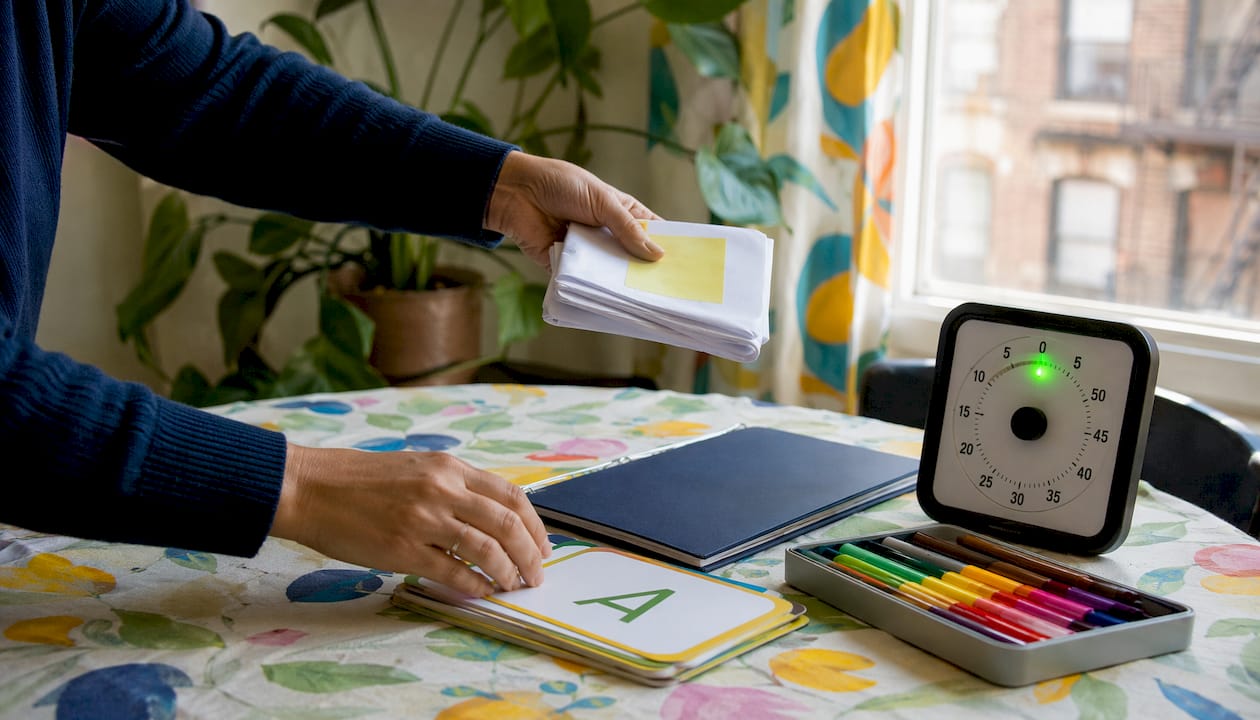
- Prepare the environment. Remove clutter from the table. A calm, low-distraction space makes a real difference. Dim the overhead light if your child is sensitive to it.
- Offer the invitation. Use declarative language: "I'm going to practice three spellings" rather than "You need to do your spellings." Let them opt in.
- Embed the interest. Spelling a Pokémon name counts. Counting Lego bricks counts. The skill is the same; the wrapper changes everything.
- Set a visible finish line. A timer, a small pile of cards, or a simple checklist tells the child exactly when it ends.
- Celebrate the finish, not the score. "You did it" beats "you got seven right."
Scripts to use: "Want to help me with this?" / "I wonder if you can…" / "No pressure, but I'm doing X if you want to join."
Scripts to avoid: "You have to…" / "Just do it" / "Why can't you just try?"
Adjustment by age:
- Ages 5–7: Up to four items. Use physical objects (counters, letter tiles). Keep sessions short.
- Ages 7–9: Up to seven items. Introduce a simple choice between two activities. Keep sessions brief.
- Ages 9–11: Up to seven items with choice of topic or format. Sessions last a short duration.
Language swaps for refusal matter more than most parents expect. The phrasing shift alone can cut resistance in half.
What activities work well for spelling, maths, and reading?
Minimalist instructional design shows that shorter, active tasks raise retention over long explanations. These templates are built on that principle.
| Subject | Activity | Age | Time | Reward idea |
|---|---|---|---|---|
| Spelling | Spell your favorite character's name in chalk outside | 5–7 | 5 min | Sticker or small coin |
| Spelling | Write three words in a silly story | 7–11 | 10 min | Extra screen time |
| Maths | Count out baking ingredients (doubles/halves) | 5–8 | 5 min | Lick the spoon |
| Maths | Times tables via a dice game | 8–11 | 10 min | Points toward a reward |
| Reading | Read one page of a comic or graphic novel aloud | 5–9 | 5 min | Choose the next book |
| Reading | Find three facts in a book about their interest | 9–11 | — | Share the facts at dinner |
Low-demand resource packs designed for PDA and ADHD children often use "strew" prompts — leaving an interesting object or activity out for the child to discover, with no instruction attached. That same principle works at home: leave a maths puzzle on the kitchen table and say nothing.
- Keep rewards immediate and small. Delayed rewards lose their pull for children with ADHD.
- Let the child choose between two activities, not from an open list.
- For spelling practice with dyslexia, multi-sensory approaches (tracing in sand, building with letter magnets) reduce the written-output demand while keeping the learning intact.
What features should a digital platform have for this approach?
Not every app supports low-demand principles. Here's what to look for and why each feature matters:
| Feature | Why it matters for low-demand practice |
|---|---|
| Adaptive difficulty | Automatically adjusts so the child is never stuck or bored |
| Voice support | Removes the reading barrier for dyslexic or younger learners |
| Immediate feedback | Closes the loop fast; no waiting for a parent to mark work |
| Parent controls / reward settings | Lets you set the daily cap and the reward level |
| Multi-child profiles | Siblings can use the same platform without competing |
| Clear finish lines | Daily question caps give a visible end point |
Three things to check in the first 10 minutes of a free trial: Does the difficulty adjust after a wrong answer? Can your child hear the question read aloud? Can you set a daily limit so sessions stay short?
Why Thepocketmoneygame fits low-demand principles
Thepocketmoneygame was built by a parent with ADHD and dyslexia who understood firsthand why traditional platforms fail neurodiverse children. Every core feature maps directly to low-demand practice:
- Adaptive difficulty adjusts question by question, so the scope stays manageable
- Voice support reads questions aloud, removing the decoding barrier
- Real pocket money rewards for correct answers give immediate, tangible motivation
- Parent dashboard lets you set daily question caps and difficulty levels before the session starts
- KS1/KS2 curriculum coverage for spelling, maths, and reading means it aligns with what school expects
First-session checklist:
- Create your child's profile and set the daily question cap to 5–10 questions
- Enable voice support
- Pick spelling or maths as the starting subject
- Sit nearby for the first session without directing — let them explore
Pro Tip: Reward-based learning works especially well for children with ADHD because the reward arrives the moment the answer is correct — no waiting, no uncertainty.
How do you know if it's working, and when should you get extra help?
Expect a 2–8 week window before you see consistent change. Early signs that the approach is working:
- Fewer meltdowns at the start of a session
- Your child voluntarily re-enters the activity (asks to do more)
- Faster recovery when they do refuse
- One small skill improvement per week (one new spelling word retained, one times table fact faster)
Simple weekly check: note how many sessions started without a fight. That number trending upward is your signal.
Escalate to school, SENCO, or a specialist if:
- Refusal is total and consistent after four weeks of low-demand adjustments
- Anxiety is affecting sleep, eating, or friendships
- You suspect an undiagnosed condition (ADHD, dyslexia, autism, PDA)
- Your child's school has flagged concerns
Low-intensity strategies work best when parents and teachers coordinate. Sharing your approach with your child's SENCO means the school can mirror it, which doubles the consistency.
Your two-week starter plan
| Day | Focus | Session (5–—) | Track |
|---|---|---|---|
| 1 | Observe only | Watch how your child plays; note interests | List 3 interests |
| 2 | Environment prep | Tidy the learning space; gather materials | Done / not done |
| 3 | First invitation | Offer one tiny spelling or maths task | Started? Y/N |
| 4 | Rest day | No formal learning; strew a puzzle or book | Note reaction |
| 5 | Repeat invitation | Same subject, slightly different wrapper | Completed? Y/N |
| 7 | Weekend | Interest-led activity only | Mood rating 1–3 |
| 8 | Add reading | One page of a chosen book | Pages read |
| 9 | Introduce a reward | Small immediate reward for finishing | Reward used? Y/N |
| 10 | Rest day | Free play | — |
| 11 | Combine two subjects | Spelling + maths in one 10-minute session | Both done? Y/N |
| — | Review | What worked? What didn't? | Notes |
| — | Plan week 3 | Slightly increase scope if week 2 went well | New goal written |
After two weeks: if sessions are starting without a fight most days, gently increase the task from three items to five. If resistance is still high, keep the scope the same and vary the wrapper (different game, different location, different reward).
Key Takeaways
Low-demand learning works because it removes the threat of demand before the nervous system can fire a refusal response, making consistent practice possible for children who struggle with traditional instruction.
| Point | Details |
|---|---|
| Scope is everything | One skill, one task, one clear finish line per session keeps working memory from overloading. |
| Invitation beats instruction | Shifting from "you must" to "want to join me?" reduces resistance without lowering expectations. |
| Progress takes 2–8 weeks | Track session starts and voluntary re-entries weekly; one small skill gain per week is a real win. |
| Escalate when needed | Involve your child's SENCO if refusal is total after four weeks or anxiety affects daily life. |
| Thepocketmoneygame | Adaptive difficulty, voice support, and real pocket money rewards make it a purpose-built low-demand platform for KS1/KS2 children. |
Why I built this approach into everything
Low-demand learning isn't a theory I read about. It's what I lived. Raising a child who shut down at the sight of a worksheet, while also navigating my own ADHD and dyslexia, taught me that the problem was never the child's ability. It was the delivery. The moment I stopped issuing instructions and started offering invitations, something shifted. Not overnight. But steadily.
That experience is baked into every decision behind Thepocketmoneygame: the voice support for kids who can't decode text under pressure, the daily question cap so sessions never drag past the point of willingness, the real pocket money reward that lands the second a correct answer is given. These aren't features added for marketing. They're the things that actually worked in our house first.
If you want to read more about the background, the team page has the full story.
Try Thepocketmoneygame with your child tonight
Real pocket money for every correct answer sounds simple. For a child who has learned to dread schoolwork, it changes everything. Thepocketmoneygame gives you a neurodiversity-friendly learning platform built around the exact principles in this guide: adaptive difficulty that adjusts question by question, voice support that reads every prompt aloud, and parent controls that let you cap the session before it starts.
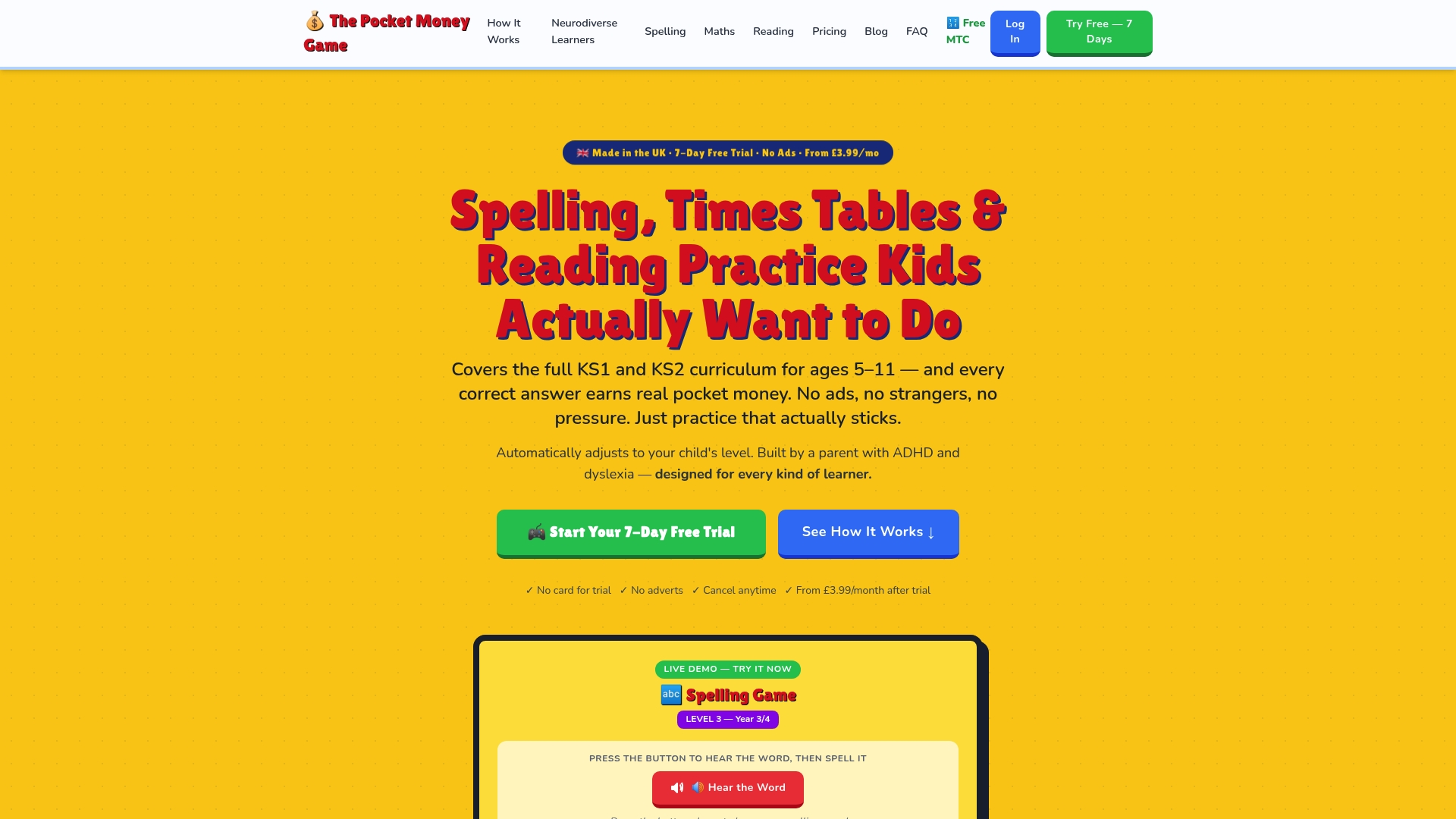
Start a free 7-day trial at Thepocketmoneygame. Create your child's profile, set the daily question cap to five questions, turn on voice support, and let them pick spelling or maths. That's the whole first session. No pressure, no long setup, and your child earns real money the moment they get their first answer right.
Useful sources
- Cognitive Load Theory and the Minimal Viable Course — explains why scoping to fewer items raises completion and retention
- The Minimal Viable Content Framework — practical framework for designing single-outcome learning tasks
- Minimalist instructional design research (LSE) — academic evidence that shorter, active tasks outperform long explanations
- Low-demand homeschooling for autonomy and skill-building — parent-practitioner guide covering invitation language and interest embedding
- Low-Demand Learning Pack — ready-made prompts and choice menus for PDA and ADHD learners
- Low-intensity strategy implementation research — evidence for combining praise, choice, and invitation for better outcomes
UK support contacts:
- Your child's school SENCO (Special Educational Needs Coordinator) is your first port of call for formal assessment or in-school adjustments
- Your local authority SEND team can advise on Education, Health and Care (EHC) plans
- Search "ADHD UK," "PDA Society," or "British Dyslexia Association" for parent support groups and specialist guidance
Recommended
- ADHD and Learning at Home: What Actually Works for Primary School Children — The Pocket Money Game
- Why Reward-Based Learning Works for Children with ADHD | The Pocket Money Game
- Blog | The Pocket Money Game — Tips for Parents, ADHD Learning & UK Curriculum
- A Dad, His Son, and the Learning App That Started It All | The Pocket Money Game