
What are the best reading apps available in the UK right now?
For UK families in 2026, the strongest reading apps are Libby (free via library card), Amazon Kindle (massive catalogue), Speechify (text-to-speech accessibility), Epic Games UK Ltd (kids' interactive content), and Pickatale Ltd (UK curriculum-aligned primary learning). Each serves a different reader, so the right pick depends on age, budget, and whether you want passive reading or active learning.
Here is how the top options compare across the dimensions that matter most to UK parents and readers:
| App | Best for | Catalogue breadth and quality | Kid-friendliness | Cost | UK content availability | Ads and in-app purchases | Rating |
|---|---|---|---|---|---|---|---|
| Epic Games UK Ltd | Kids' interactive reading and multimedia | Strong children's catalogue with multimedia | High, parental controls included | Subscription | Good UK curation | Minimal ads | 1.8★ (9 reviews) |
| Pickatale Ltd | Primary school children aged 5–11 | UK curriculum-aligned books | Very high, adaptive learning | Subscription | Strong UK alignment | Ad-free | — |
| Libby | Free ebooks and audiobooks | Large catalogue via library | Family-friendly, read-alongs | Free with library card | Excellent UK library integration | No ads | — |
| Amazon Kindle | General reading, large catalogue | Extensive titles across genres | Moderate, parental controls available | Free app, books purchased separately | Excellent | Upsells present | — |
| Speechify | Accessibility and read-aloud | Any uploaded text or document | Good for older children and adults | Free tier, premium paid | Works with any UK content | No ads | — |
Standout features at a glance:
- Epic Games UK Ltd: Locally curated UK content, interactive multimedia stories, parental controls
- Pickatale Ltd: Adaptive difficulty, UK curriculum alignment, designed for ages 5–11
- Libby: Completely free via UK library card, offline reading, kid read-alongs, no ads
- Amazon Kindle: Cross-device sync, built-in dictionary, Kindle Unlimited subscription option
- Speechify: text-to-speech AI with customizable voices, supports dyslexia and ADHD learners
How do the top kids' reading apps really compare?
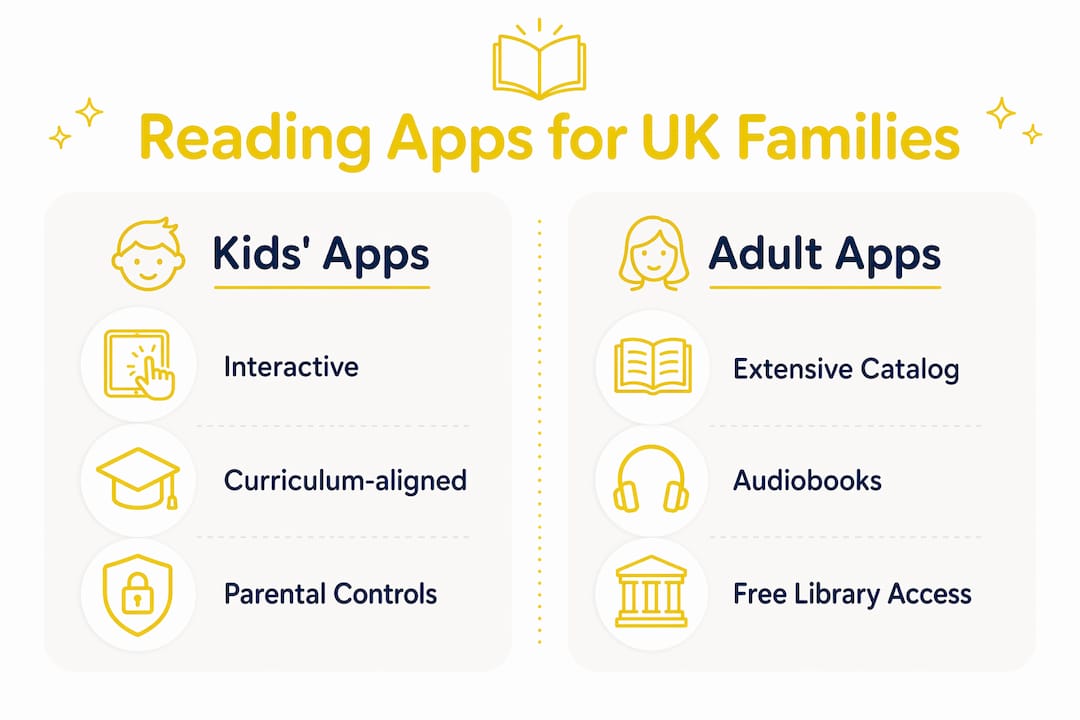
The difference between a good reading app and the right one often comes down to details parents only discover after signing up. Age-appropriateness, ad policies, and whether the content actually maps to what UK schools teach are the factors worth digging into before you commit.
Epic Games UK Ltd focuses on interactive, multimedia-rich reading for children. Its catalogue leans toward engaging stories with animations and audio, which works well for reluctant readers who need a hook beyond plain text. The parental controls let you manage screen time and content access, and the UK content curation means your child is less likely to encounter titles with no relevance to their world.

Pickatale Ltd takes a more structured approach. Its platform is built around the UK curriculum, with adaptive learning features that adjust difficulty as a child progresses. For parents of children in KS1 and KS2, that alignment with what school expects is genuinely useful. The ad-free environment also removes a common frustration with children's apps.
For general adult reading, Amazon Kindle remains the default for most UK readers, largely because of its catalogue depth and cross-device sync. The app is free; you pay per book or subscribe to Kindle Unlimited. Its built-in X-Ray feature links characters and places to Wikipedia, which adds a layer of comprehension support that most standalone readers lack.
Speechify sits in a different category. Rather than a book catalogue, it reads any content aloud using AI voices, making it especially useful for people with dyslexia, ADHD, or anyone who absorbs information better by listening. It works across iOS, Android, Chrome, and desktop, and supports content in over 60 languages.

For readers who want granular control over their reading environment, justRead (iOS) offers deep typography customization including custom fonts, edge-to-edge display, and two-way Calibre sync for large personal libraries. It is built for EPUB and PDF files rather than a storefront catalogue.
Device and offline support:
- Libby: iOS, Android, offline downloads available
- Amazon Kindle: iOS, Android, web, Kindle devices, offline reading
- Speechify: iOS, Android, Chrome, Mac, Windows
- Epic Games UK Ltd: check platform availability directly
- Pickatale Ltd: check platform availability directly
How to choose the best reading app for your needs in the UK
Picking the right app gets much easier once you know which questions to ask. Here are the criteria worth working through before you download anything.
1. Who is the reader? A seven-year-old learning phonics needs something very different from an adult who wants to read novels on the commute. Apps like Pickatale and Epic Games UK Ltd are purpose-built for children; Kindle and Libby serve general readers of all ages.
2. What does it cost, really? Free apps often monetize through in-app purchases or ads. Libby is genuinely free if you have a UK library card. Kindle is free to download but books cost money unless you subscribe to Kindle Unlimited. Speechify offers a free tier with premium features behind a paywall. Always check what the free version actually includes before assuming it covers your needs.
3. Does it work on your devices? Most major apps cover iOS and Android. If your child uses a school-issued tablet or a specific e-reader, verify compatibility first. Kindle has the widest device support, including its own hardware range.
4. What accessibility features does it offer?
- Text-to-speech (read aloud) support
- Adjustable font size and background color
- Dyslexia-friendly fonts
- Offline reading for no-internet situations
5. Are parental controls adequate? For children's apps, look for content filters, screen time limits, and the ability to restrict in-app purchases. Pickatale and Epic Games UK Ltd both include parental controls; general apps like Kindle offer some controls but are less specialized.
6. How big and relevant is the content library? A huge catalogue means nothing if it lacks UK-relevant titles or age-appropriate books. Libby pulls from your actual local library's digital collection, which tends to reflect UK reading habits well.
Pro Tip: Before subscribing to any paid reading app, check whether your local UK library offers Libby access. Many councils provide it free, giving you a large catalogue of ebooks and audiobooks at no cost.
What are the best free reading apps for UK readers?
Free does not have to mean limited. Several strong options give UK readers access to thousands of titles without a subscription.
- Libby: The standout free option. Link your UK library card and you get access to your library's full digital catalogue, including offline ebooks and audiobooks, read-alongs for children, and no ads. Many UK councils participate, so check your local library's website.
- Amazon Kindle (app only): Free to download with access to thousands of free public domain titles. Paid titles require purchase or Kindle Unlimited.
- Speechify (free tier): Lets you upload documents and have them read aloud. The free version covers basic text-to-speech with a selection of voices.
- NaturalReader: A text-to-speech app trusted by over a million monthly users, with a free no-account-required tier, dyslexia-friendly fonts, and support for PDFs, Word documents, and Google Drive files.
- Project Gutenberg (via browser or compatible app): Over 70,000 free public domain ebooks, including classic British literature.
For children specifically, Libby's read-along feature lets a parent and child follow text together while the app narrates, which research from Oxford Owl identifies as one of the most effective ways to build early reading skills. That combination of free access and educational value is hard to beat.
How do adaptive apps and parental involvement support children's reading?
No app replaces a parent sitting down with a book. That said, the right app can extend learning in ways that feel natural to a child, especially when it adapts to how they learn.
Shared reading and active discussion are consistently highlighted by educators as the foundation of language development in children aged 5–11. Apps work best as a supplement, not a substitute. When a child reads something on an app and you ask them about it afterward, that conversation does more for comprehension than any quiz the app can generate.
For children with ADHD or dyslexia, adaptive apps with voice support and immediate feedback make a real difference. Adaptive learning with voice support and customizable difficulty helps neurodiverse learners stay engaged without the frustration of a one-size-fits-all pace. Parental controls that let you adjust difficulty and reward structures keep the experience positive rather than pressured.
Pickatale Ltd's curriculum alignment means children practice skills their teacher is already building on. Epic Games UK Ltd's multimedia approach works well for children who disengage from plain text. Neither replaces reading together, but both give children a reason to read independently between those shared sessions.
What to look for in a children's reading app:
- Adaptive difficulty that responds to the child's actual performance
- Voice support and read-aloud for early or struggling readers
- Parental dashboard showing progress and time spent
- No ads or manipulative in-app purchase prompts
- Content aligned with UK curriculum expectations (KS1/KS2)
Pro Tip: Pair any reading app with a simple offline activity: after your child finishes a story, ask them to draw their favorite moment or retell it to a sibling. That one step builds comprehension far beyond what screen time alone achieves.
For families looking at educational apps for primary school children more broadly, reading is just one piece. Maths and spelling practice matter equally at KS1 and KS2, and the best platforms address all three together. GeniusHub Learning also offers personalized tutoring for UK learners in Years 2–12, which pairs well with app-based reading practice for children who need more structured support.
Thepocketmoneygame takes a different approach to reading practice
If you've looked at the apps above and thought "my child needs more than just books on a screen," Thepocketmoneygame is worth a look. Rather than a reading catalogue, it's a learning platform built for children aged 5–11 that covers reading comprehension alongside spelling and maths, all within a reward system where children earn real pocket money for correct answers.
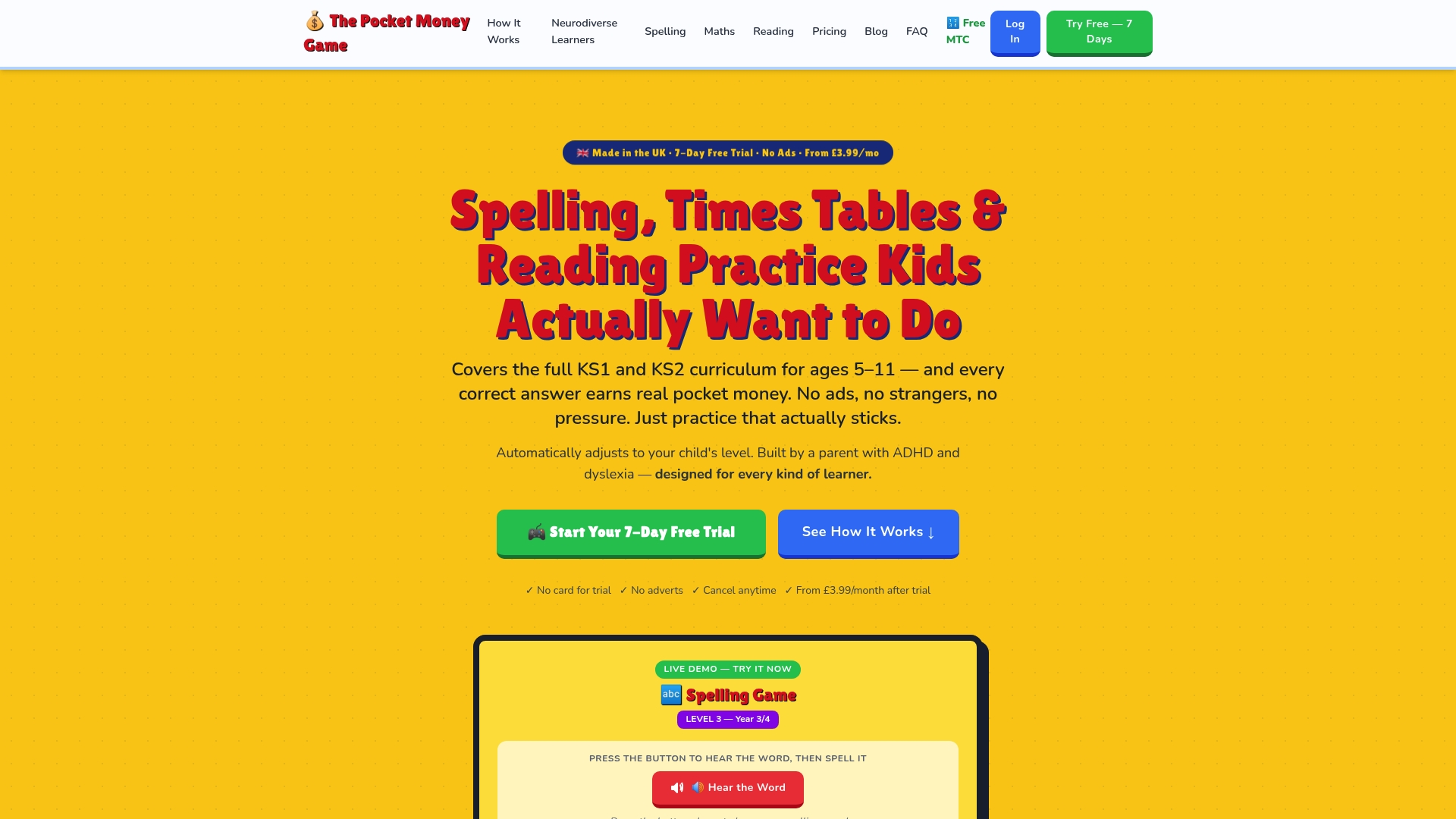
That reward structure changes the dynamic completely. Children aren't reading because they have to; they're reading because there's something tangible at the end of it. The platform was built by a parent with ADHD and dyslexia, so the adaptive features for neurodiverse learners aren't an afterthought. Voice support, immediate feedback, and adjustable difficulty are built into the core experience. Parents control the reward amounts and lesson difficulty through a dashboard, and the content covers KS1 and KS2 curriculum expectations. If you want your child to practice reading, spelling, and maths in one place, with motivation built in, Thepocketmoneygame offers a genuinely different route from the apps compared above.
Key Takeaways
The best reading app for UK families in 2026 depends on age, budget, and whether the goal is leisure reading, curriculum support, or accessibility.
| Point | Details |
|---|---|
| Free access via library | Libby gives UK readers free ebooks and audiobooks through a local library card, with no ads. |
| Kids need curriculum alignment | Pickatale Ltd and Epic Games UK Ltd offer UK-relevant content and parental controls for children aged 5–11. |
| Accessibility matters | Speechify and NaturalReader support dyslexia and ADHD learners with text-to-speech and adjustable settings. |
| Parental involvement is key | Research shows shared reading and discussion build comprehension more effectively than app use alone. |
| Thepocketmoneygame | Covers reading comprehension, spelling, and maths for ages 5–11 with a real pocket money reward system and adaptive, neurodiverse-friendly features. |
Recommended
- The Best Educational Apps for Primary School Children in the UK (2025) — The Pocket Money Game
- Spelling, Times Tables & Reading Practice Kids Actually Enjoy | The Pocket Money Game
- The Pocket Money Game in London — KS1 & KS2 Spelling, Maths and Reading
- The Pocket Money Game in Yorkshire — KS1 & KS2 Spelling, Maths and Reading