
Thepocketmoneygame is the clearest recommendation for U.S. parents who want their child to earn real pocket money for correct answers in spelling, math, and reading. It combines parent-controlled micro-rewards with adaptive lessons and neurodiversity-friendly design, so your child stays motivated and you stay in charge. Here is what to do right now:
- Start the 7-day free trial at Thepocketmoneygame — no commitment, full access.
- Set a daily question cap in the parent dashboard before your child plays their first session.
- Choose a per-answer amount that feels meaningful to your child but manageable for your household budget.
- Add each child's profile so difficulty adapts to their individual level from day one.
Table of Contents
- How do pocket-money learning games actually work?
- What does research say about rewarding kids with money for learning?
- How to set up Thepocketmoneygame step by step
- What does Thepocketmoneygame cost, and what does the trial include?
- Is Thepocketmoneygame safe and private for U.S. families?
- Which children benefit most from this kind of platform?
- Practical tips for amounts, pacing, and financial literacy
- Why Thepocketmoneygame stands out among educational money games
- Key Takeaways
- Why the reward-first approach works better than you might expect
- Try Thepocketmoneygame free for 7 days
- Useful sources
How do pocket-money learning games actually work?
The core loop is simple: your child answers a question correctly, and a micro-payment lands in their account. You decide how much each correct answer is worth, how many questions they can answer per day, and whether payments are immediate or batched. That control sits entirely in the parent dashboard.
Thepocketmoneygame covers spelling, math, and reading for children aged 5–11. The platform's adaptive engine adjusts difficulty based on your child's performance, so questions stay at the right challenge level rather than becoming too easy or frustratingly hard. Voice support reads questions aloud, which matters for younger learners and for children with dyslexia or other reading differences.
- Multi-child profiles: — each child gets their own difficulty track and reward history.
- Payment method: — link a card or bank account through the parent dashboard during setup.
Pro Tip: Start with a lower per-answer amount than you think you need. Children respond to the act of earning, not just the size of the payout. You can always increase it later.
What does research say about rewarding kids with money for learning?
Used well, micro-rewards can be the spark that gets a reluctant learner started. Research on reward-based motivation describes extrinsic rewards as a potential "entry point" that helps children start the positive feedback loop of internally rewarding learning. The risk is leaving rewards in place without pairing them with feedback, which can shift a child's focus from the learning itself to the payout.
Extrinsic rewards do not inherently undermine intrinsic motivation when they are used as an entry point and paired with specific, effort-focused feedback. The key variable is what the parent does alongside the reward, not the reward itself.
The Harvard Center on the Developing Child recommends combining incentives with coaching and autonomy support to build lasting motivation. Separately, process-focused praise — commenting on effort and strategy rather than just the result — predicts better persistence and enjoyment than generic praise like "good job."
What to do:
- Do praise the strategy: "You sounded that word out carefully — that's exactly the right approach."
- Do let your child choose which subject to practice first (autonomy support matters).
- Don't make the reward the whole conversation. Ask what was tricky, not just what they earned.
Pro Tip: After each session, ask your child one question about their strategy, not their score. "What did you do when you got stuck?" builds more lasting confidence than tallying the payout.
How to set up Thepocketmoneygame step by step
Getting started takes about ten minutes. Work through this checklist before your child sits down for their first session.
- Link your payment method — a debit card or bank account — through the secure payment section of the dashboard.
Most families notice a more consistent homework routine within one to three weeks. Measurable skill gains — faster recall, fewer spelling errors — typically show up within four to eight weeks of regular practice, though every child's pace differs.
Practitioner guidance consistently highlights that active parental involvement, including adjusting difficulty and reviewing progress logs, reduces the risk of reward dependency and keeps challenge at the right level.
What does Thepocketmoneygame cost, and what does the trial include?
The platform runs on a subscription model with a 7-day free trial that gives full access to all subjects and the parent dashboard. No credit card charge during the trial period.
| Plan | Trial | Profiles | Dashboard | Subjects |
|---|---|---|---|---|
| Family (monthly) | 7 days free | Multi-child | Full | Spelling, math, reading |
| Family (annual) | 7 days free | Multi-child | Full | Spelling, math, reading |
Exact subscription pricing is listed on the Thepocketmoneygame website, as rates can be updated. For household budgeting, add your subscription cost to the pocket-money payouts your child earns. A simple way to think about it:
- Low rate (e.g., $0.01 per correct answer, 20 questions/day): about $0.20/day in rewards.
- Medium rate (e.g., $0.05 per correct answer, 20 questions/day): about $1.00/day.
- Higher rate (e.g., $0.10 per correct answer, 20 questions/day): about $2.00/day.
The daily cap is your safety net. Set it before your child starts and you will never face a surprise bill. For more guidance on per-answer amounts, the platform's own resource page walks through age-appropriate ranges in detail.
Is Thepocketmoneygame safe and private for U.S. families?
Child data privacy is non-negotiable, and U.S. parents should confirm a few things before any platform stores information about their child.
- COPPA alignment: look for a clear privacy policy that limits data collection for children under 13 and requires parental consent.
- Minimal data collection: the platform should collect only what is needed to run the learning sessions and reward system.
- Parent approval flows: account creation for a child should require a parent to authorize it.
- Secure payment processing: card and bank details should be tokenized, meaning the platform never stores raw payment credentials.
- Audit logs: the parent dashboard should show a history of sessions, correct answers, and payouts so you can review everything.
- Automatic pause: you should be able to freeze all payouts instantly if something looks off.
Security check: Before entering payment details on any learning platform, confirm the URL uses HTTPS and that the payment page is handled by a recognized processor. Thepocketmoneygame routes payments through its secure parent dashboard, keeping child-facing screens entirely separate from billing.
Which children benefit most from this kind of platform?
Thepocketmoneygame is designed for children aged 5–11, covering the primary-school years. Within that range, the platform's value shifts by age:
- Ages 5–7: focus on early phonics, simple number bonds, and sight words. Short sessions with immediate rewards suit this age group well.
- Ages 8–11: upper-primary fluency, times tables, reading comprehension, and spelling patterns. The adaptive engine can push challenge level as skills grow.
Children who respond strongly to immediate feedback tend to get the most from this format. That includes many children with ADHD, for whom reward-based learning with short, frequent reinforcement can improve on-task behavior noticeably. The platform's voice support and adaptive difficulty also make it accessible for children with dyslexia.
Consider a child aged eight with ADHD who struggles to sit through a 30-minute homework session. Short bursts of five to ten questions, each followed by an immediate micro-reward, match how that child's attention works rather than fighting against it. A parent can set the daily cap low at first, then gradually extend session length as the routine takes hold. The ADHD and dyslexia learning features built into Thepocketmoneygame were designed with exactly this pattern in mind.

When a child has significant learning differences, combining the platform with school coordination or targeted tutoring gives the best results.
Practical tips for amounts, pacing, and financial literacy
Getting the reward structure right from the start saves a lot of adjustment later. Here are the specifics:
- Per-answer amounts by age: younger children (5–7) often respond to $0.01–$0.02 per answer; older children (8–11) may need $0.05–$0.10 to feel the reward is meaningful.
- Daily caps: start at 20 questions per day and adjust after two weeks based on how your child responds.
- Gradual reduction: after six to eight weeks, consider lowering the per-answer rate slightly and introducing praise and progress charts as co-rewards. Research on reward transitions supports a phased move from micro-payments toward intrinsic incentives.
- Keep learning rewards separate from chores. Chores build responsibility; learning rewards build skills. Mixing them creates confusion about what each payment means.
- Use earned money as a money lesson. When your child earns $1.50 in a week, talk about saving a portion toward a goal. Digital reward charts that teach financial literacy can make that conversation concrete.
- Sample praise script: "You kept going even when that spelling was tricky. That's the kind of effort that makes you better."
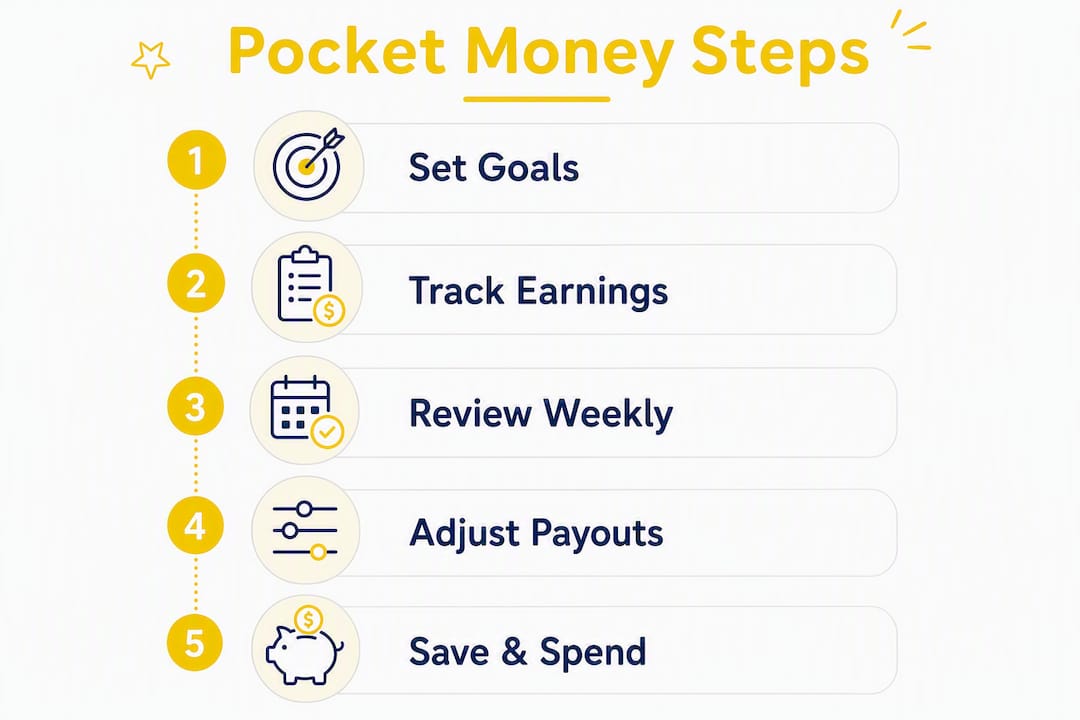
Pro Tip: Schedule a five-minute "money review" with your child each Sunday. Look at what they earned, what they saved, and what they want to work toward next week. It turns pocket money into a real financial literacy lesson.
Why Thepocketmoneygame stands out among educational money games
The platform was built by a parent who has ADHD and dyslexia, which shaped every design decision. That origin matters because it means the features that support neurodiverse learners are not afterthoughts.
Key strengths:
- Parent-controlled payments with full dashboard oversight
- Adaptive KS1/KS2-aligned content in spelling, math, and reading
- Voice support for learners who struggle with reading questions
- Neurodiversity-friendly pacing: short bursts, immediate feedback
- Multi-child profiles under one family subscription
- 7-day free trial with no charge during the trial period
- Original curriculum-aligned content, not repurposed worksheets
The platform was built from a parent's lived experience of watching a child struggle with traditional learning methods. Every feature, from the voice support to the daily cap, exists because a real family needed it.
Practitioner guidance confirms that dashboards giving parents control over difficulty and payouts are the most reliable way to prevent reward dependency and personalize learning for children with diverse needs.
Key Takeaways
Thepocketmoneygame is the strongest choice for U.S. parents who want parent-controlled pocket-money micro-rewards paired with adaptive spelling, math, and reading practice for children aged 5–11.
| Point | Details |
|---|---|
| Start with the free trial | The 7-day trial gives full access; set your daily cap before your child's first session. |
| Pair rewards with effort praise | Process-focused feedback ("you worked through that carefully") protects long-term motivation. |
| Budget both costs | Add subscription fees and daily reward payouts; the daily cap prevents surprise spending. |
| Neurodiverse learners benefit most | Immediate micro-rewards and short sessions match how many children with ADHD learn best. |
| Thepocketmoneygame | Adaptive, parent-controlled, and built by a parent with ADHD and dyslexia for children aged 5–11. |
Why the reward-first approach works better than you might expect
Most parents worry that paying a child to learn will backfire. It is a fair concern, and the research does show real risks when rewards are used carelessly. But the evidence also shows something the worry often misses: the reward is not the destination, it is the door.
Children who have given up on spelling or math often need something external to get them back to the table. Once they are there, once they have experienced a few wins and felt the satisfaction of getting something right, the internal reward system starts to engage. The micro-payment is the reason they sat down; the feeling of competence is what keeps them coming back.
The parents who see the best results are not the ones who set the highest per-answer rate. They are the ones who use the dashboard actively, adjust difficulty when their child is breezing through or hitting a wall, and talk about strategy rather than score. That combination, reward plus coaching plus autonomy, is exactly what the Harvard and Springer research points to as the most durable approach.
Try Thepocketmoneygame free for 7 days
Thepocketmoneygame gives your child real pocket money for every correct answer in spelling, math, and reading, and gives you complete control over every dollar. The safe, no-download learning platform runs in any browser, so there is nothing to install and no app store needed.
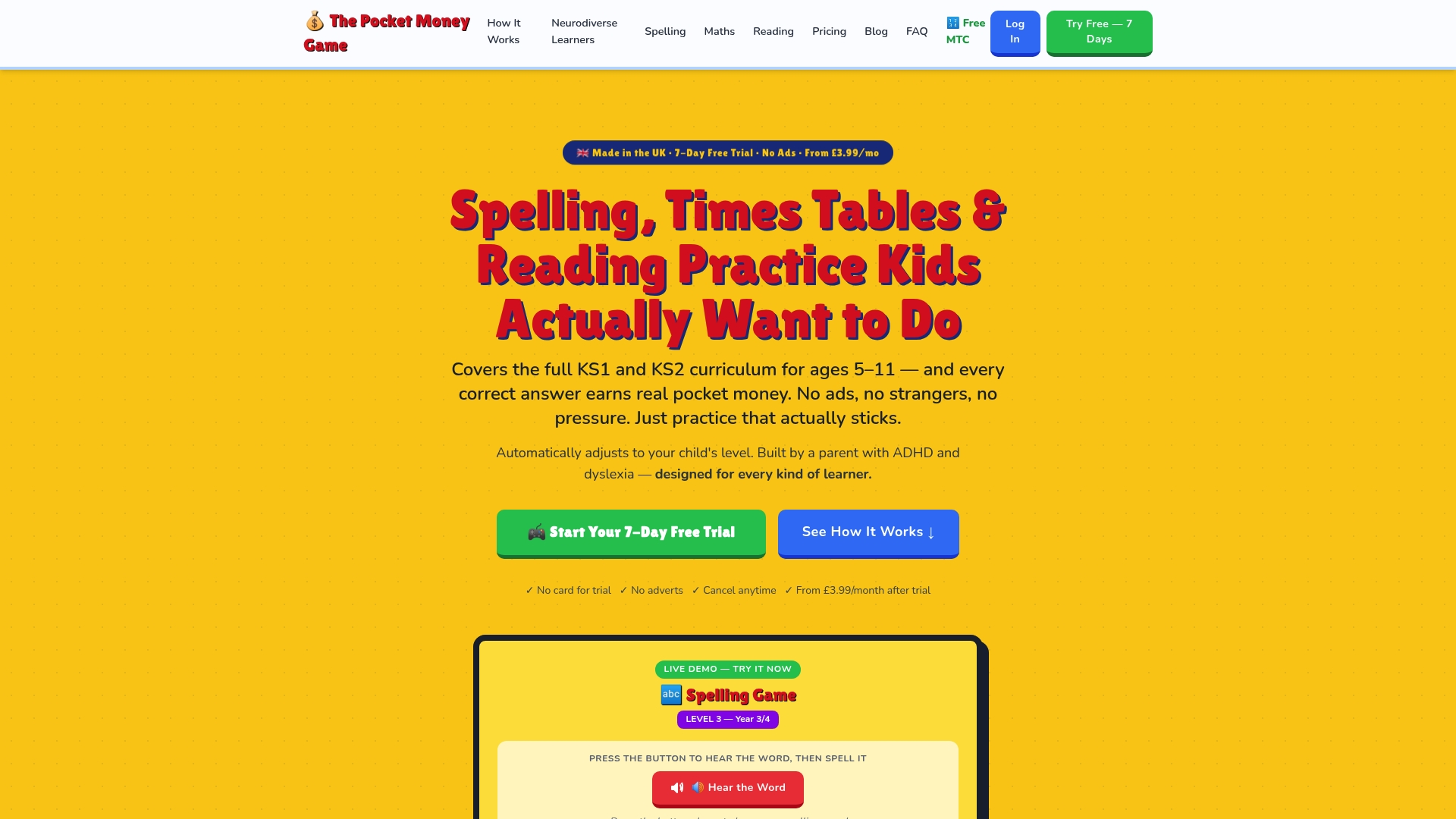
During your free week, test the dashboard: set a per-answer amount, cap the daily questions, and watch how your child responds. Most parents find the routine clicks within the first few sessions. After the trial, a family subscription keeps all subjects, all child profiles, and the full parent dashboard active. Visit Thepocketmoneygame to start your 7-day free trial today — no charge until you decide to continue.
This article provides general information about educational reward systems and is not a substitute for professional educational or financial advice. Confirm current platform features and pricing directly with Thepocketmoneygame.
Useful sources
The research behind this article comes from peer-reviewed studies and practitioner guidance. These links let you read the original findings directly.
- The Effects of Praise on Children's Intrinsic Motivation Revisited — Corpus & Good; process-focused praise and intrinsic motivation.
- Understanding Motivation: Building the Brain Architecture That Supports Learning — Harvard Center on the Developing Child; combining incentives with autonomy support.
- The Role of Rewards in Motivation: Beyond Dichotomies — ScienceDirect; reward-as-entry-point framework and transition strategies.
- Revisiting the Role of Rewards in Motivation and Learning — Springer; neuroscientific findings on reward processing and undermining effects.
- Introducing Uninteresting Tasks to Children: Autonomy Support vs. Rewards — Self-Determination Theory; autonomy-supportive instructions vs. reward-only approaches.
- Practitioner Guidance on Reward Systems and Parental Involvement — ERIC; parent dashboards, tailoring difficulty, and active involvement.
For product-specific guidance, the Thepocketmoneygame help pages cover dashboard setup, per-answer amounts, and privacy settings in detail.
Recommended
- Apps That Let Parents Pay Pocket Money for Maths Practice | The Pocket Money Game
- Apps That Pay Kids to Learn: How They Work (UK Guide) | The Pocket Money Game
- The Best Educational Apps for Primary School Children in the UK (2025) — The Pocket Money Game
- Spelling, Times Tables & Reading Practice Kids Actually Enjoy | The Pocket Money Game