
What are the best home learning apps for UK primary children?
The strongest options for UK home learning in 2025 are EdShed, Kaligo, Phonics Hero, Reading Eggs, Mathseeds, Lingumi, and Familytime. Each one covers a different slice of primary education, from phonics and handwriting to early math and language acquisition, and all are available to families in the UK right now.
Here's a quick snapshot of what each app brings to the table:
- EdShed: Spelling, phonics, and math games with AI-driven progression, aligned to the UK primary curriculum. Offers a free tier plus a premium plan.
- Kaligo: AI-powered literacy platform covering handwriting, phonics, spelling, and reading. Particularly strong for children with special educational needs.
- Phonics Hero: Full phonics curriculum wrapped in a superhero storyline, with a 7-day free trial. Certified by the Educational App Store 2025.
- Reading Eggs: Interactive reading and literacy practice aligned with KS1 and KS2 curricula, supporting progressive reading levels.
- Mathseeds: Award-winning math program for children aged 3–9, with a free 30-day trial and structured motivational lessons.
- Lingumi: Child-friendly language learning platform with adaptive content, well-suited for tablet use by younger children.
- Familytime: Family-oriented platform that combines home learning resources with scheduling tools to keep parents involved.
Age ranges span from toddlers through upper KS2, so there's a genuine fit for most primary-aged children regardless of where they are in their learning.
How do these top educational apps compare?
Every app on this list does something well, but they don't all do the same things. The table below maps the key differences across the dimensions that matter most to parents choosing a home study app.

| App | Age Range | Subject Focus | Free Trial | Curriculum Alignment | AI Personalization | Parent Dashboard | Certifications / Ratings |
|---|---|---|---|---|---|---|---|
| EdShed | 5–11 | Spelling, phonics, math | Free tier available | UK primary (KS1/KS2) | AI spelling progression | Group proficiency tracker | 4.1★ (90 reviews) |
| Kaligo | 5–11 | Literacy, handwriting, phonics | Not publicly listed | UK primary, SEN support | AI personalized paths | Teacher/parent portal | 5★ (2 reviews) |
| Phonics Hero | 3–7 | Phonics, early reading | 7-day free trial | Phonics curriculum | Progress-adaptive games | Progress tracking | Educational App Store 2025 |
| Reading Eggs | 2–13 | Reading, literacy | Not publicly listed | KS1/KS2 aligned | Progressive reading levels | Parent dashboard | — |
| Mathseeds | 3–9 | Math, problem-solving | 30-day free trial | Early math curriculum | Structured lesson paths | Parent reports | Award-winning |
| Lingumi | 2–13 | Language, early literacy | Not publicly listed | Early years | Adaptive content | — | — |
| Familytime | 5–11 | Multi-subject, family tools | Not publicly listed | Home learning support | — | Scheduling integration | 5★ (2 reviews) |
A few things stand out when you look at this side by side. Phonics Hero is the only app on the list with a current third-party certification from the Educational App Store, which carries real weight as a trust signal. Mathseeds offers the longest free trial at 30 days, giving you a full month to see whether your child actually engages before you spend anything. EdShed's AI spelling progression is genuinely curriculum-led, not just a quiz engine with a progress bar.
Kaligo is worth a closer look if your child struggles with handwriting alongside literacy. Its AI-driven instruction adjusts to each child's writing patterns, and the teacher portal doubles as a parent tool for tracking progress at home. Adaptive learning technology like this can significantly improve reading growth with just 15 minutes of daily practice, according to University of Maryland research.
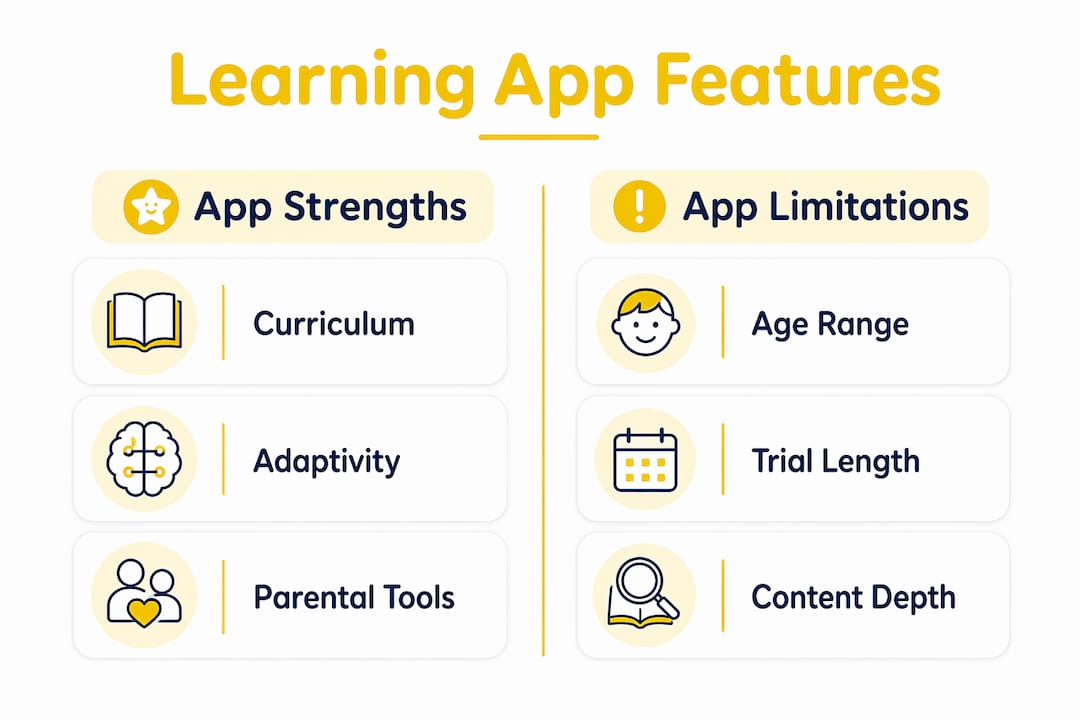
Reading Eggs covers the widest age span of any app here, from age 2 through 13, making it one of the few options that can grow with a child across the full primary phase. Lingumi and Familytime are thinner on published detail, but both serve a clear purpose: Lingumi for very young language learners, Familytime for parents who want scheduling and learning support in one place.
How to choose the best home learning app for your child
Picking the right app comes down to a few honest questions, not marketing claims. Here's what to actually look for:
- Curriculum alignment: Does the app map to KS1 or KS2 content your child is working on? Apps like EdShed and Reading Eggs are explicit about this. Vague "educational content" claims are a red flag.
- Age appropriateness: A math app built for a 3-year-old won't stretch a 9-year-old. Check the stated age range and, where possible, read parent reviews from families with children the same age as yours.
- Free trial availability: Phonics Hero offers 7 days; Mathseeds gives you 30. Use them. A child who won't engage with an app after a week of free access won't engage after you've paid either.
- Adaptive learning: The best apps adjust difficulty in real time rather than moving every child through the same sequence. Research from the University of Maryland shows this kind of personalization produces measurably faster progress.
- Parent involvement features: Progress dashboards, assignment tools, and customizable settings keep you in the loop. Passive screen time without any parent visibility tends to produce less learning.
- Data privacy and device compatibility: Check that the app complies with UK GDPR and works on the devices you already own. Most of the apps listed here run on iOS and Android tablets, but confirm before subscribing.
- Trust signals: Third-party certifications (like Phonics Hero's Educational App Store 2025 badge), educator endorsements, and verified user reviews all matter more than the app's own marketing copy.
Research from the Harvard Graduate School of Education consistently finds that apps encouraging conversation and interaction between parent and child produce better outcomes than those designed for solo screen time. The best apps give you something to talk about with your child, not just something to hand them.
Pro Tip: Before committing to a subscription, sit with your child during the free trial. Watch what they do when they get stuck. An app that keeps them curious and trying is worth far more than one with a polished interface they abandon after ten minutes.

Why Thepocketmoneygame works especially well for children with diverse learning needs
Most learning apps are built for the average child. Thepocketmoneygame was built by a parent with ADHD and dyslexia, for children who don't always fit that mold, and that origin shapes every feature.
The platform covers spelling, math, and reading for children aged 5–11, aligned to the KS1 and KS2 UK curriculum. What makes it different is the reward structure: children earn real pocket money for every correct answer, with parents controlling the amounts and daily question caps. That's not a gimmick. For children who struggle to find intrinsic motivation in traditional learning, a tangible, immediate reward is often the thing that keeps them going.
Key features that support neurodiverse learners include:
- Voice support: Audio prompts reduce the reading load for children with dyslexia, letting them focus on the actual learning task.
- Adaptive difficulty: The platform adjusts question difficulty based on each child's responses, so children aren't stuck on content that's too easy or crushed by content that's too hard.
- Immediate feedback: Every answer gets an instant response, which is particularly effective for children with ADHD who lose focus when feedback is delayed.
- Parent dashboard: You set the difficulty, the reward amounts, and the daily limits. Nothing happens without your input.
- Multi-child profiles: Siblings with different needs and different year groups can each have their own settings under one family account.
Thepocketmoneygame is recognized among the best educational apps for UK primary school children in 2025, and its ADHD and dyslexia support features are built from lived experience rather than theory. For families who've tried other apps and found their child disengages quickly, the reward-based model is genuinely worth testing.
If you're also exploring structured math support alongside an app, personalized math tutoring through a platform like GeniusHub Learning can complement what an app delivers at home.
Thepocketmoneygame: a different kind of home learning tool
The apps compared above are all strong choices for UK families. If you're looking for something that goes a step further by tying learning directly to a child's real-world motivation, Thepocketmoneygame takes a different approach.
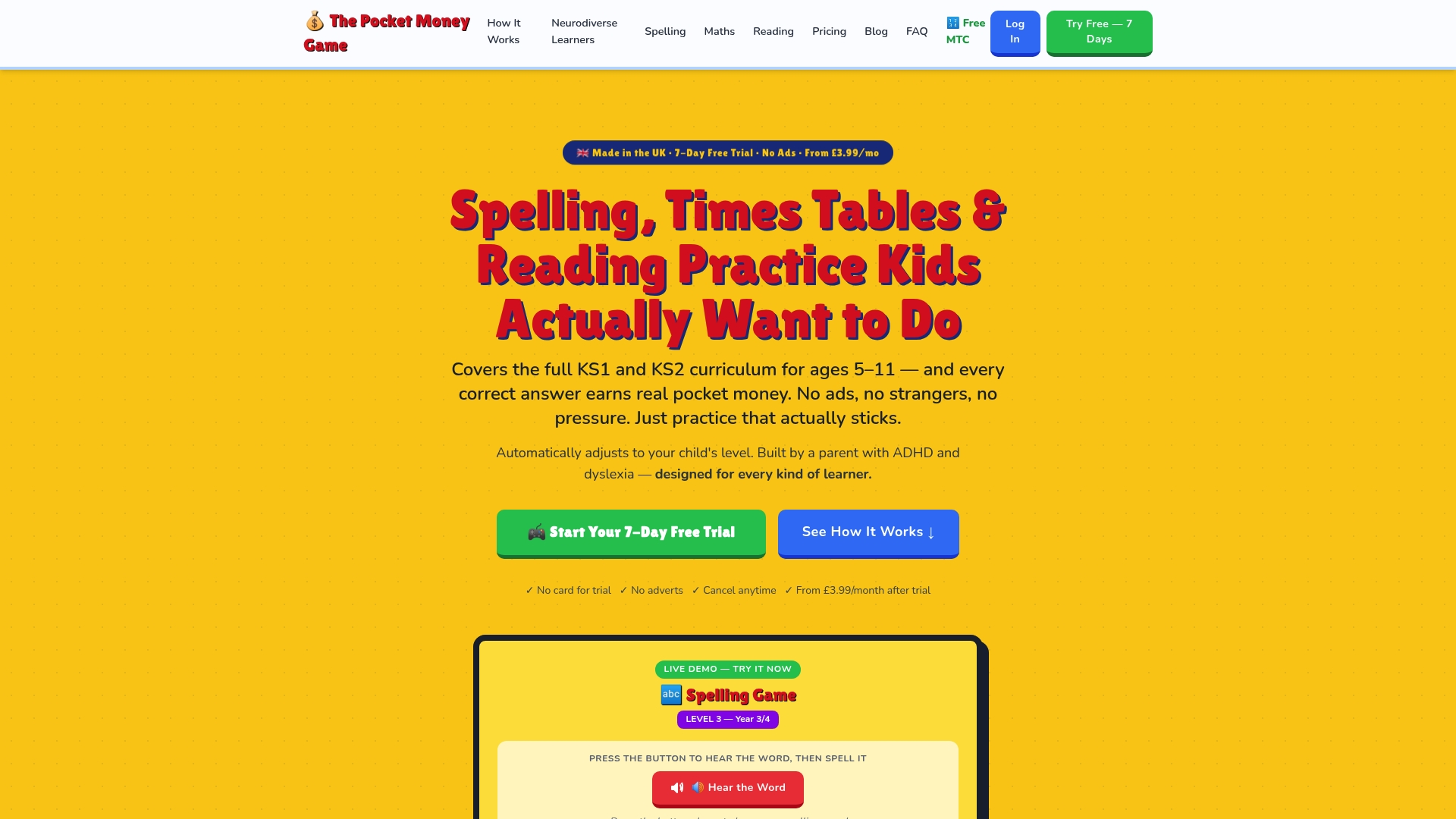
Where most apps reward children with stars or badges, Thepocketmoneygame rewards them with actual pocket money that parents control and approve. Children aged 5–11 practice spelling, times tables, and reading comprehension through games they actually want to play, while you track every session from a parent dashboard. It was built by a dad who watched his own son struggle with traditional learning, and that story shapes everything about how the platform works. You can read more about how it started and decide whether it fits your family.
Key Takeaways
The strongest home learning apps for UK primary children combine curriculum alignment, adaptive difficulty, and genuine parent involvement rather than passive screen time alone.
| Point | Details |
|---|---|
| Free trials reveal real engagement | Mathseeds offers 30 days free; Phonics Hero offers 7 days. Use them to test whether your child actually sticks with the app. |
| Adaptive learning accelerates progress | Just 15 minutes daily of adaptive practice can significantly improve reading growth, according to University of Maryland research. |
| Third-party certification matters | Phonics Hero holds an Educational App Store 2025 certification, the only app on this list with a current independent badge. |
| Parent involvement drives outcomes | Harvard research shows apps that encourage parent-child interaction produce better learning outcomes than solo screen time. |
| Thepocketmoneygame suits neurodiverse learners | Its reward-based model, voice support, and adaptive difficulty make it a strong fit for children with ADHD or dyslexia aged 5–11. |
Recommended
- The Best Educational Apps for Primary School Children in the UK (2025) — The Pocket Money Game
- Blog | The Pocket Money Game — Tips for Parents, ADHD Learning & UK Curriculum
- Free Spelling & Maths Game for UK Children | London, Manchester, Birmingham & More
- Spelling, Times Tables & Reading Practice Kids Actually Enjoy | The Pocket Money Game